The Play’s The Thing: A History of Cook’s Opera House
- Christopher Brennan
Reposted with permission from Local History ROCs!
Those who lived in Rochester during the 1990s and the first decade of the present century will remember the local discussion surrounding the need for a new performing arts center. While downtown is still home to some prominent entertainment facilities, an abundance of theaters once lined the streets of the center city, including the renowned Cook’s Opera House.
In 1903, Rochester had five large theaters. By 1910, the number had increased to 19. Many of these newer venues may have been smaller vaudeville houses and movie theaters, but the multiplicity of such facilities suggests the demand. Unfortunately, in the intervening decades, many of these facilities were closed and demolished.
Arguably the oldest and most revered of these older theaters was Cook’s Opera House, located at 23-25 South Avenue. Called “Cook’s” by locals, the building had a long history that witnessed changes in owners, names, and theatrical formats.

Cook’s Opera House on the west side of South St. Paul Street (now South Avenue), just below Main Street in 1900. From: City of Rochester Plat Map, 1900.

The Rochester Riverside Convention Center now stands where Cook’s Opera House once stood. From: City of Rochester, 2022.
The original theater on the site was built by Rochester pioneer Enos Stone. Begun in 1846 and opened in 1848 as the Metropolitan Theater, the three-story brick structure was situated on South St. Paul Street (now South Avenue) near Main Street. Among its offerings was the November 1857 production of Shakespeare’s Richard the Third, featuring the renowned American actor Edwin Booth, older brother of Lincoln’s assassin, John Wilkes Booth.
Unfortunately, in this period much of Rochester was resistant to the magnetic attraction of the theater, leading to intermittent offerings between 1855 and 1859.

The Grand Opera House. From: Rochester History 37 no. 2 (April 1975)
Popular attendance increased after 1859 for two reasons. The first was the presentation of more popular offerings like tightrope walking. The second reason was the outbreak of the Civil War in 1861, which led many people to come to the theater seeking a temporary distraction.
In 1865, the theater was remodeled and renamed the Rochester Grand Opera House. Yet, only four years later, disaster struck. On November 6, 1869, during a performance of “Black Eyed Susan,” a massive fire destroyed the theater and all its effects, toppling two walls and gutting the interior. The building manager, Thomas Carr, who slept on the premises, was lucky to escape with his life.

Interior of the Grand Opera House. From: the Collection of the Rochester Public Library’s Local History & Genealogy Division
The owners subsequently accepted a purchase offer from Brooklyn theatrical promoter, Charles Finke. Finke set out to make the theater larger and better than its predecessor. The new performance hall was 110 feet by 70 feet (7,700 sq. ft.), with a bigger stage and more commodious balconies.
It opened on May 12, 1871, with a production of Giuseppe Verdi’s opera Il Trovatore. The theater also witnessed an appearance by renowned actress Sarah Bernhardt in the drama Camille in March 1881. Not all of its offerings were high art, however.
One memorable performance on September 27, 1875, was an early Buffalo Bill Cody production, Life on the Border. Unfortunately, in 1891, the rebuilt opera house, like its predecessor, suffered a disastrous fire.

William Frederick “Buffalo Bill” Cody. From Democrat & Chronicle, October 8, 1950.
Just the year before, Finke had sold the theater to Frederick Cook and his partner Jacob Gerling for $62,500. Insurance covered only $30,000 of the cost, leaving the partners with a considerable loss. As the lead partner, Cook was the public face of the theater.
His life story reads like a Horatio Alger novel. Born in Wildbad, Germany, he arrived in America in October 1848 at the age of 15. After beginning his working life as a shoemaker’s apprentice, he later served as the Secretary of State of New York and the President of both the German American Bank and the Rochester Gas and Electric Company. His ownership of Cook’s Opera House represented just one of his many investments.
In reconstructing the theater under the talented supervision of renowned Rochester architect John Foster Warner, Cook created a structure that continued the large scale and grandeur of its predecessor. He extended the dimensions of the building, providing a larger stage door to ease the loading and unloading of props, nine dressing rooms, and additional fire exits.
The performance hall was outfitted with cream, buff, salmon, and terra cotta-colored decorations and 1,400 red plush seats. The new construction also allowed rental space for commercial enterprises, so Cook’s became a destination for patrons beyond theater goers. The venue re-opened for business in January 1892.

Façade of Cook’s Opera House. From: Democrat & Chronicle, October 8, 1950.
The famed Cook’s Opera House had just become victim to a disastrous fire. But, much like a phoenix, the theater rose from the ashes. It reopened on January 14, 1892, with brief remarks by Mayor William Carroll and a performance of the opera, Alessandro Stradella, followed a few days later by Gilbert and Sullivan’s H.M.S. Pinafore.
Still, for the next few decades, its primary offerings were vaudeville acts, including singers, dancers, comedians, magicians, musicians, and acrobats. Among the more famous performers to appear at Cook’s were Al Jolson, Lillian Russell, and Harry Houdini.
Houdini appeared for a week-long run starting on May 6, 1907. One of his performances included a jump from the old Erie Canal weighlock bridge. He was handcuffed but managed to free himself underwater. Among the reputed 10,000 onlookers were photographers from Eastman Kodak who filmed the stunt; it remains the oldest surviving footage of his performances. (The George Eastman Museum now owns the film, but those who wish to view it can also find it here.)

Portion of an Advertisement for Houdini’s May 1907 Performance. From: Democrat & Chronicle, May 5, 1907.
After Frederick Cook died in 1905, his partner Jacob Gerling inherited his share of the business. In 1912, Albert Fenyvessy acquired the venue, who renamed it the Family Theater, but the bill still featured vaudeville acts and the new medium of silent motion pictures.
It did not offer “talking pictures” until January 10, 1931, and was the last local theater to do so, more than three years after the October 1927 debut of the medium. In the intervening years, business had declined to the point that it never really recovered.

Stage View of the Family Theater (nee Cook’s Opera House, 1913). From: the Collection of the Rochester Public Library’s Local History & Genealogy Division.
By the 1930s, the taste of its clientele had changed, transitioning from magicians and comics to more risqué offerings. An October 1932 advertisement for the Family Theater promoted a performance by “Miss New Orleans and Her Living Models” for men only. The venue continued to showcase more family friendly fare as well.

Performance of Nat Fields Musical Comedy Company at the Family Theater, ca. 1920-1921. From: the Collection of the Rochester Public Library’s Local History & Genealogy Division.
The Loew’s Company purchased the building in 1937 and reopened it as the Embassy Theater, offering burlesque performances. American burlesque originally consisted of three kinds of acts: comic sketches or standup routines, often by ribald comics; short song and dance offerings; and an exotic dancer.
Among the more famous performers to be featured at the Embassy was African American comic Stepin Fetchit (real name Lincoln Perry) and exotic dancer Sally Rand (born Helen Beck), who played “peek a boo” with the audience, her body hidden by large ostrich feathers or a translucent bubble.

Albert Lebowitz, Manager of the Embassy Theater, Arrested for Presenting an Indecent Show. From: Democrat & Chronicle, February 1, 1940.
Burlesque would be the Embassy Theater’s last offering. At least initially, these offerings were monitored to ensure compliance with existing obscenity laws. In February 1940, the theater’s manager, Albert Lebowitz, was arrested for permitting “an indecent, immoral and impure show and entertainment.”
Lebowitz denied the charge, claiming it was a “frame-up” but consented to a deal. The police would drop the charge in exchange for the surrender of his entertainment license; thereafter, Lebowitz returned to his previous field of employment, dentistry.
The Embassy continued its burlesque offerings for another dozen years, although its latter day focus was mostly strippers. The theater shut down for good after the May 1952 performances by Rose La Rose (real name Rosina De Pella). The theater was to close thereafter for the summer and then reopen in the fall but never did.
For years the edifice lay abandoned, and in 1958, the marquee crashed to the sidewalk. The city planned to raze the building the following year, but the demolition was cancelled when it was discovered the old theatre shared a common wall with another business. In the 1970s, the city hatched further plans to redevelop the theater to its nineteenth century appearance as part of the “Canaltown” urban renewal project, but those plans too came to naught.
Its ultimate demise occurred on April 17, 1974, when a fire destroyed the building, after which it was demolished; a sad end to more than a century of entertainment in Rochester. Today, the Rochester Riverside Convention Center sits on the lot that witnessed performances by Al Jolson, Harry Houdini, Lillian Russell, and other notable entertainers.

The former site of Cook’s Opera House circa 1983, before the completion of the Rochester Riverside Convention Center. From: City of Rochester
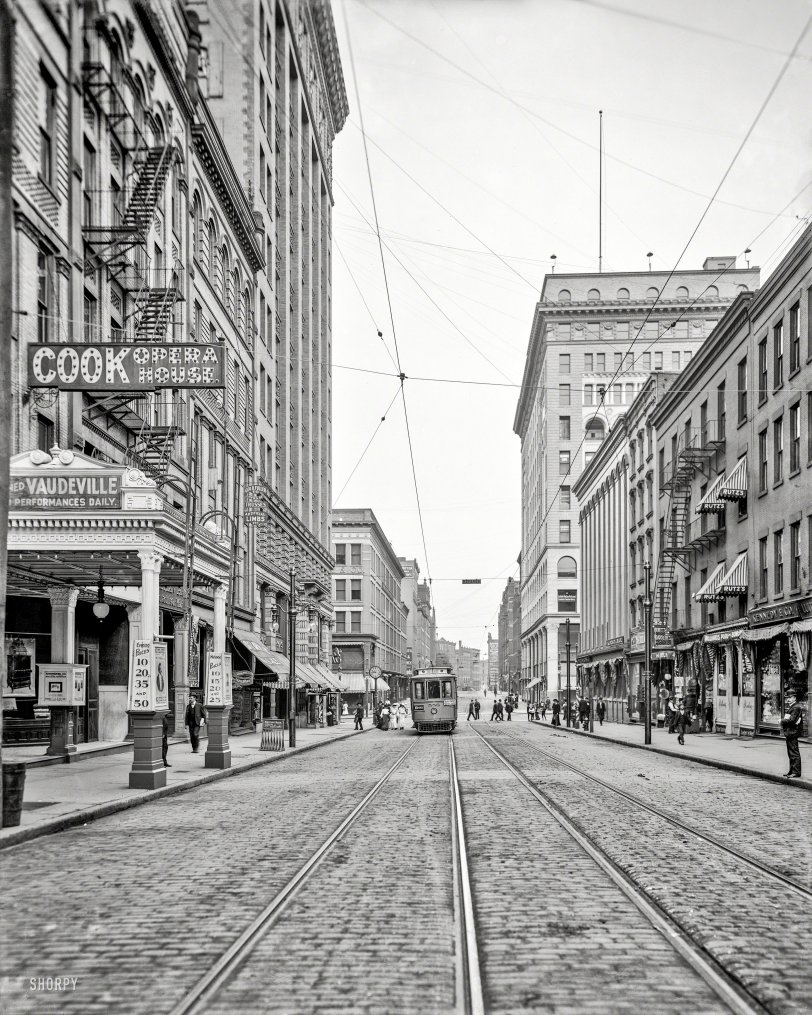
Looking North down South St. Paul Street towards Main (the Granite Building on the right still stands).
For Further Information:
John Fenyvessy – Family Theater Papers. [Volume 5]. Local History and Genealogy Division, Central Library of Rochester and Monroe County N.Y.
“Houdini’s Rochester Bridge Jump,” Wild About Harry (https://www.wildabouthoudini.com/2018/08/houdinis-1907-rochester-bridge-jump.html : accessed March 11, 2022).
Bob Marcotte, “Downtown Rochester Stages Had Lively History,” Democrat and Chronicle, November 24, 2003, p. 2B.
Bob Marcotte, “Opera House Was Grand, But Its Fare Often Wasn’t,” Democrat and Chronicle, November 28, 2003, p. 2B.
Bob Marcotte, “Vaudeville Starred at Cook Theater,” Democrat and Chronicle, November 30, 2003, p. 4B.
Blake McKelvey, “Canaltown: A Focus of Historical Traditions,” Rochester History 37, no. 2 (April 1975).
Blake McKelvey, “The Theater in Rochester During Its First Nine Decades,” Rochester History 16, no. 3 (July 1954).
“Fire Jeopardizes Canaltown Plan,” Democrat and Chronicle, April 18, 1974, p. 3B.
“Sudden Death of Frederick Cook,” Democrat and Chronicle, February 18, 1905, p. 14.
“Theater’s Future Crumbling,” Democrat and Chronicle, July 14, 1972, p. 8B.
John H. Fenyvessy, “The First Ninety Years: A History of Rochester’s Opera House” (Ms., typescript, 1982).
Arch Merrill, “102 Years of Theater Make This Our Historic Stage,” Democrat and Chronicle, October 8, 1950, p. 1C.
“Embassy Reopens for One Week,” Democrat and Chronicle, May 9, 1952, p. 32.
“Manager Faces Morality Charge Over Burlesque,” Democrat and Chronicle, February 1, 1940, p. 13.
“Theater Barricaded: One More Step to Oblivion,” Democrat and Chronicle, June 20, 1962, p. 22.
Related Posts:
Want to publish a guest post?
Subscribe to Our Monthly Update
Enjoy our once-monthly newsletter highlighting our efforts to beautify downtown Rochester
Want to be a ROCstar?
Please consider supporting the work of Downtown ROCs with a tax-deductible gift. Every dollar directly funds awesome projects that beautify & energize our city.
Thank you for your support! 🙏🏼