Rochester: The Pipe Cleaner City
- Geoffrey Zeiner
Reposted with permission from the Gonechester blog
An unsung but prevalent industry in Rochester’s history was, believe it or not, the mass production of pipe cleaners. Yes, those fuzzy pieces of wire that kindergarteners make crafts out of.
The oft-repeated wisdom on Rochesterian pipe cleaners is that John Harry Stedman and business partner Charles Angel patented the fuzzy pipe cleaner, a patent which found its way to the B. J. Long Co.
While that’s possibly true, there seems to be a lot more to the story, which I’ll try to lay out below.
Willard & Frick
It is Frederick A. Frick who, in 1894, patented an item that is the clearest direct ancestor to the fuzzy pipe cleaners of present day. A barbed wire covered in an absorbent, fibrous material, this would have been familiar as a slightly pokey grandaddy to the colorful craft supplies we know and love.
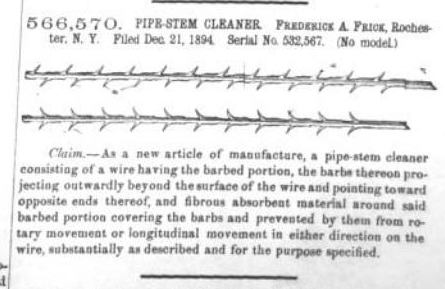
1895 Official Gazette of the United States Patent Office
Patent for Frederick A. Frick’s Pipe-Stem Cleaner
https://www.google.com/books/edition/Official_Gazette_of_the_United_States_Pa/p881AQAAMAAJ?hl=en&gbpv=0
Frederick A. Frick had a fairly unusual career. At the time of this patent, he was in partnership with Adelbert W. Mudge as undertakers at No. 31 North Fitzhugh. How work in the funerary industry may have inspired the pipe cleaner, I’d prefer not to imagine too vividly.

1895 City Directory
https://www.libraryweb.org/rochcitydir/images/1895/1895e-ga.pdf
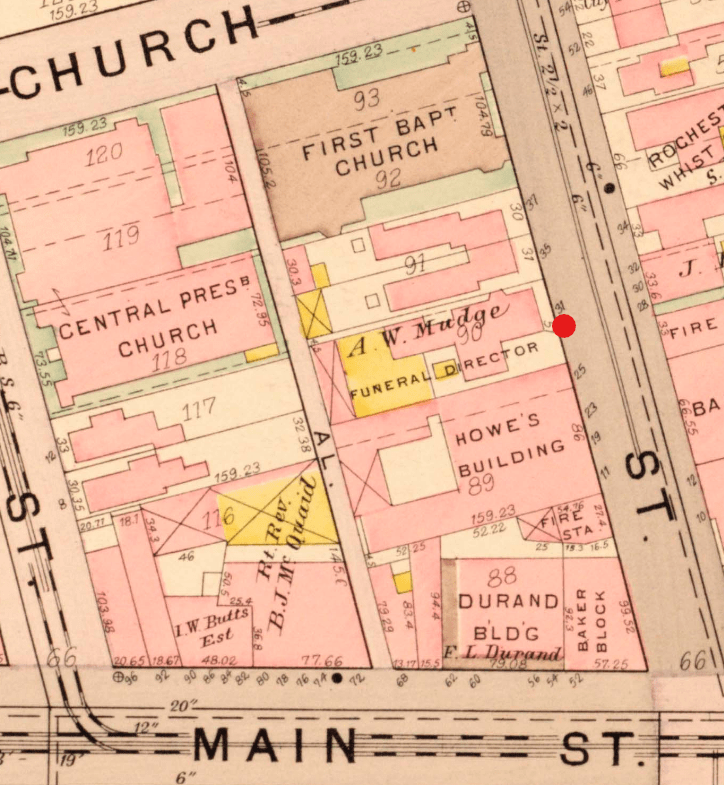
1900 Plat Map
Red: No. 31 North Fitzhugh Street, A. W. Mudge [formerly Mudge & Frick]
https://photo.libraryweb.org/rochimag/rpm/rpm00/rpm00164.jpg
In 1895, he dissolved this partnership and went into business with J. Louis Willard as The Willard & Frick Manufacturing Company.
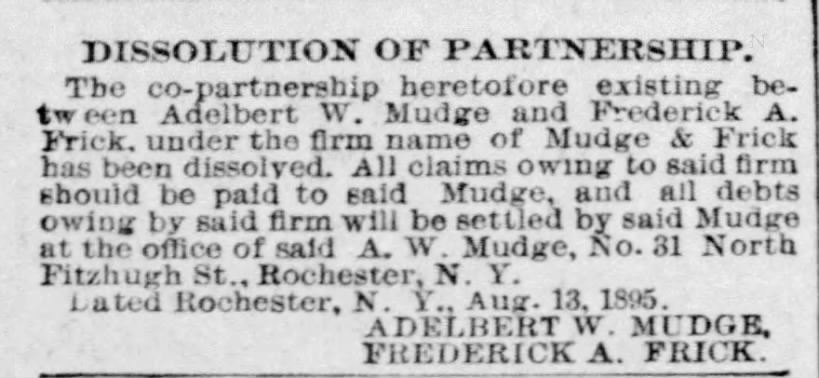
Thursday, August 15, 1895
https://www.newspapers.com/article/democrat-and-chronicle-mudge-frick/163017580/
The purpose of The Willard & Frick Manufacturing Company was to manufacture not only Frick’s “Rochester” pipe cleaner but another patent, the “Rochester Time Recorder”. This was a specialized clock for tracking the labor hours of multiple employees using a card system.
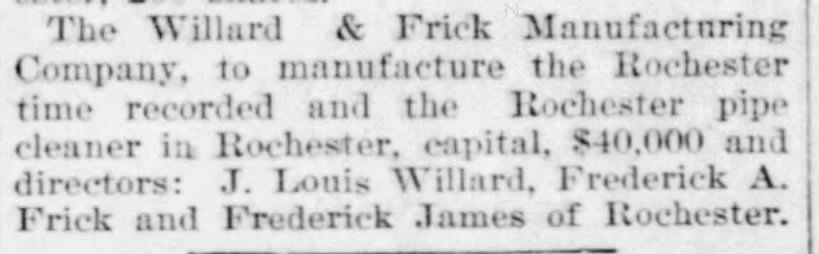
Sunday, March 17, 1895
https://www.newspapers.com/article/democrat-and-chronicle-willard-frick/162985045/
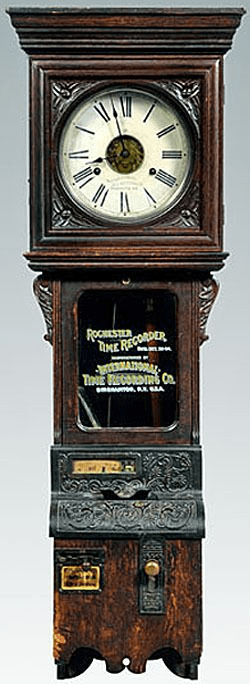
The Rochester Time Recorder, as produced by International Time Recording Co.
The considerable success of the time clock caused imitators. After Willard & Frick won a legal conflict with one such imitator, the Bundy Manufacturing Company of Binghamton, Bundy purchased the patent from Willard & Frick, and a larger company was conglomerated: The International Time Recording Company, headquartered in Binghamton. After a series of mergers, this path of progenitor companies eventually led to IBM.
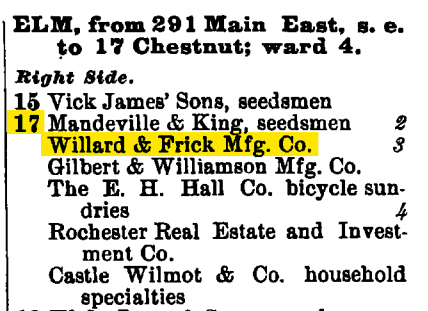
1899-1900 Directory
https://www.libraryweb.org/rochcitydir/images/1899/House_Directory_1899-1900.pdf
In 1900, Frederick A. Frick moved to New York City, where he would remain until his death in 1916.

1899-1900 Directory
https://www.libraryweb.org/rochcitydir/images/1899/1899e-ga.pdf
While I don’t have any direct proof of this, my hypothesis is that F. A. Frick sold his equipment and production rights for pipe cleaners to E. T. Gilbert; Gilbert’s company, Gilbert & Williamson Mfg. Co. shared the third floor of the building at No. 17 Elm Street with Frick’s.
E. T. Gilbert Mfg. Co. was incorporated in 1900 at No. 17 Elm Street and began production of pipe cleaners.
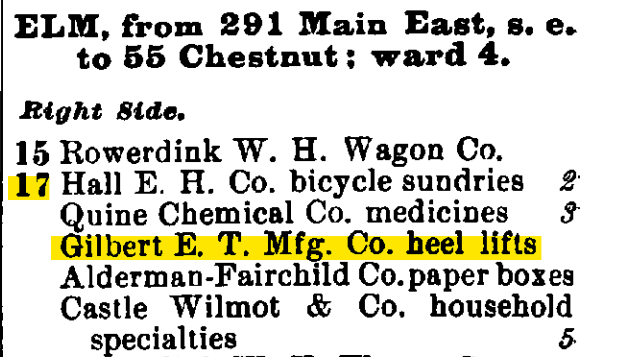
1900-1901 Directory
https://www.libraryweb.org/rochcitydir/images/1901/House_Directory_1901-1902.pdf

1900 City Directory
https://www.libraryweb.org/rochcitydir/images/1900/1900ge-ha.pdf
E. T. Gilbert Mfg. Co.
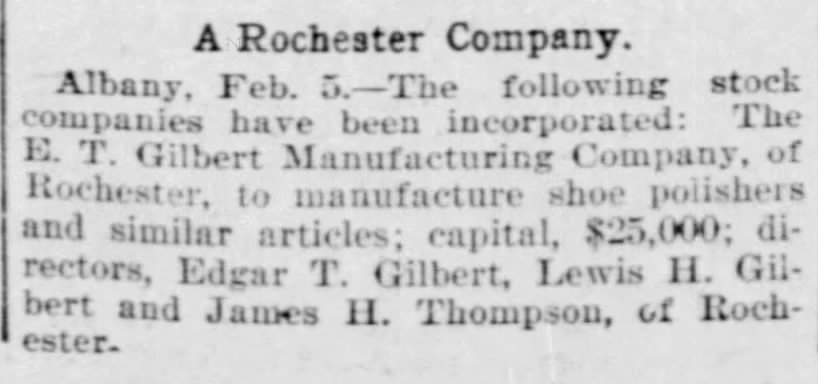
Tuesday, February 06, 1900
https://www.newspapers.com/article/democrat-and-chronicle-a-rochester-compa/163021433/
Incorporated 1900 at No. 17 Elm Street, in 1907 the E. T. Gilbert Manufacturing Company would move to No. 228 South Avenue, corner Capron Street.

1907 City Directory
https://www.libraryweb.org/rochcitydir/images/1907/1907ge-ha.pdf
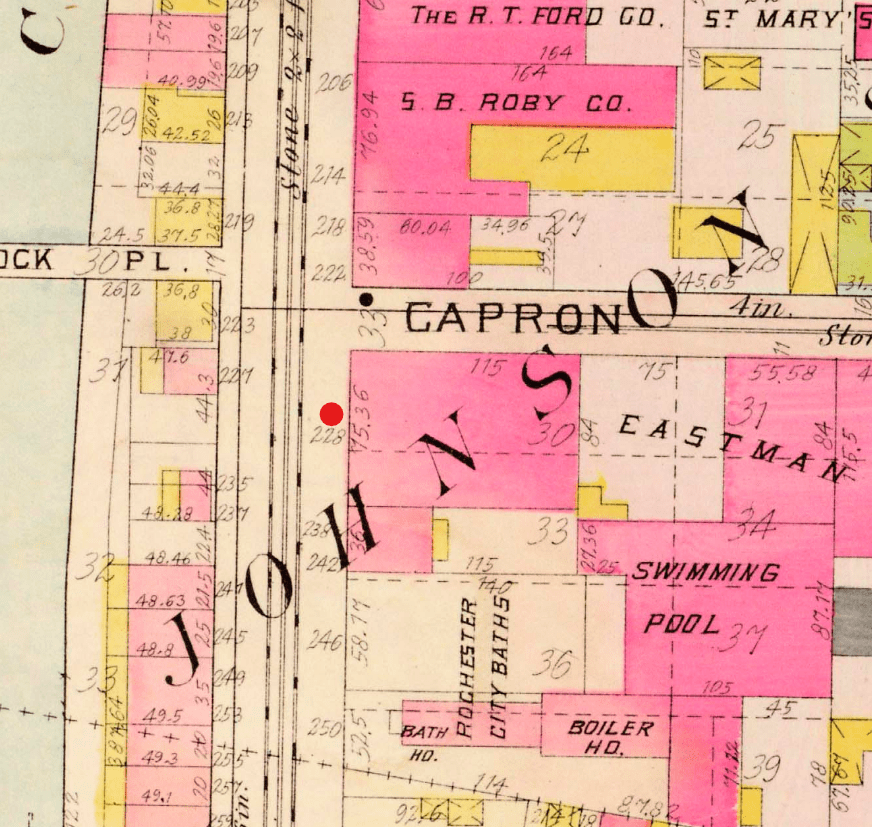
1910 Plat Map
Red: No. 228 South Avenue, E. T. Gilbert Mfg. Co., Inc.
https://photo.libraryweb.org/rochimag/rpm/rpm00/rpm00284.jpg
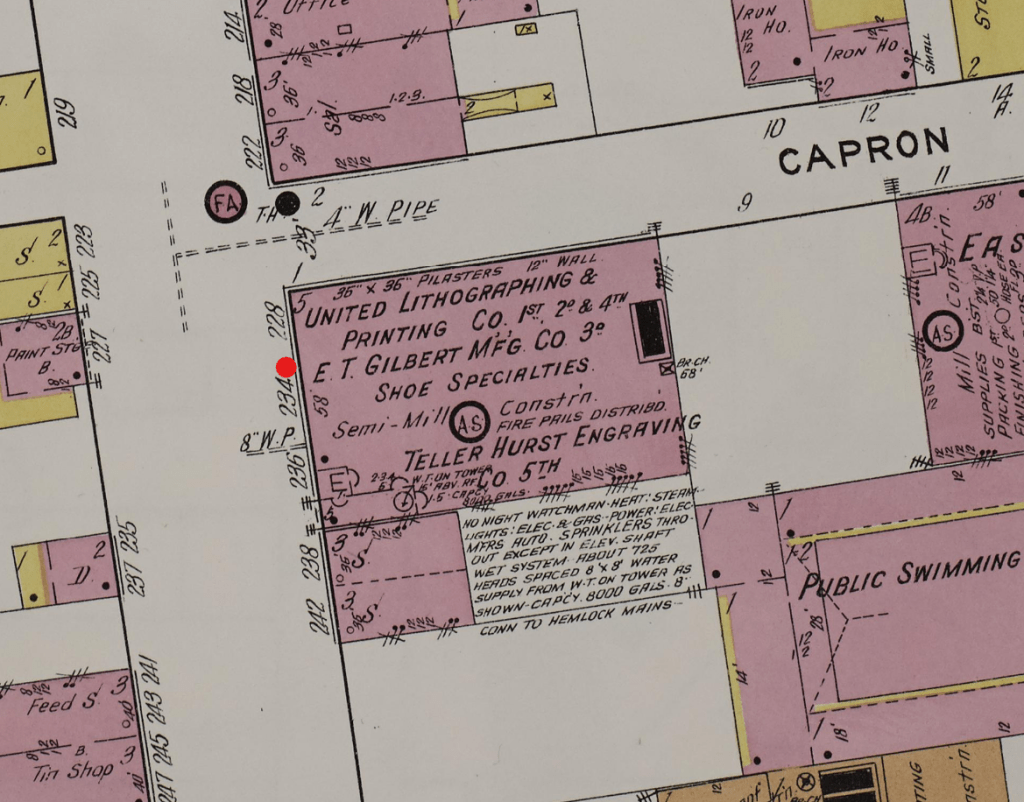
1911 Sanborn Map
Red: No. 228 South Avenue, E. T. Gilbert Mfg. Co.
https://www.loc.gov/resource/g3804rm.g3804rm_g06217191204/?sp=12&r=0.475,0.693,0.18,0.108,0
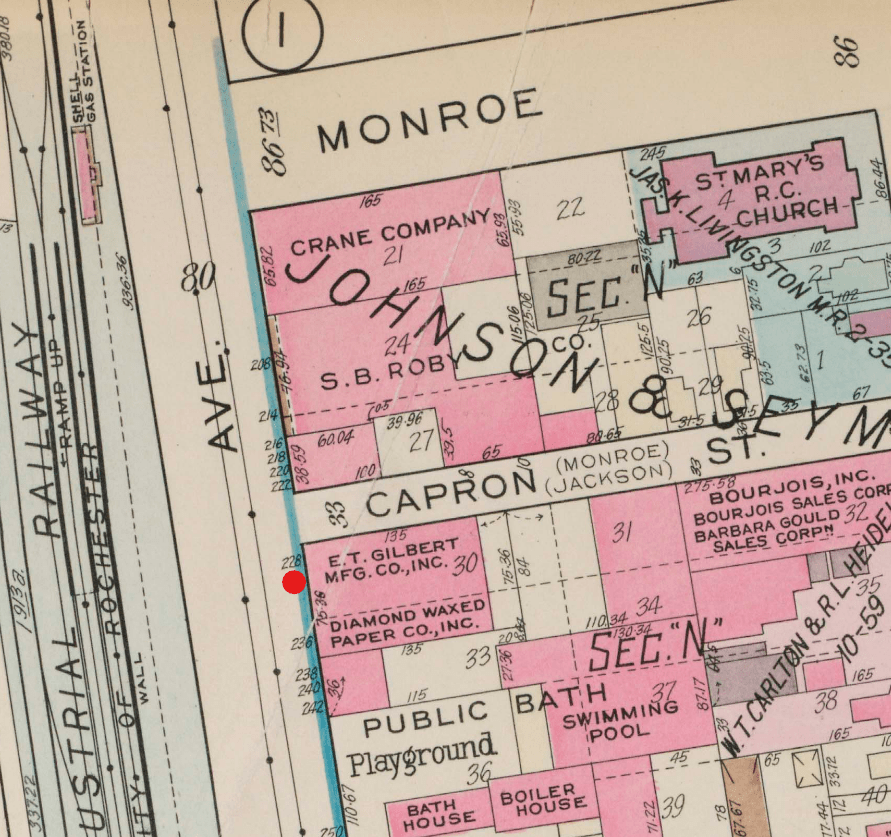
1935 Plat Map
Red: No. 228 South Avenue, E. T. Gilbert Mfg. Co., Inc.
https://photo.libraryweb.org/rochimag/rpm/rpm00/rpm00466.jpg
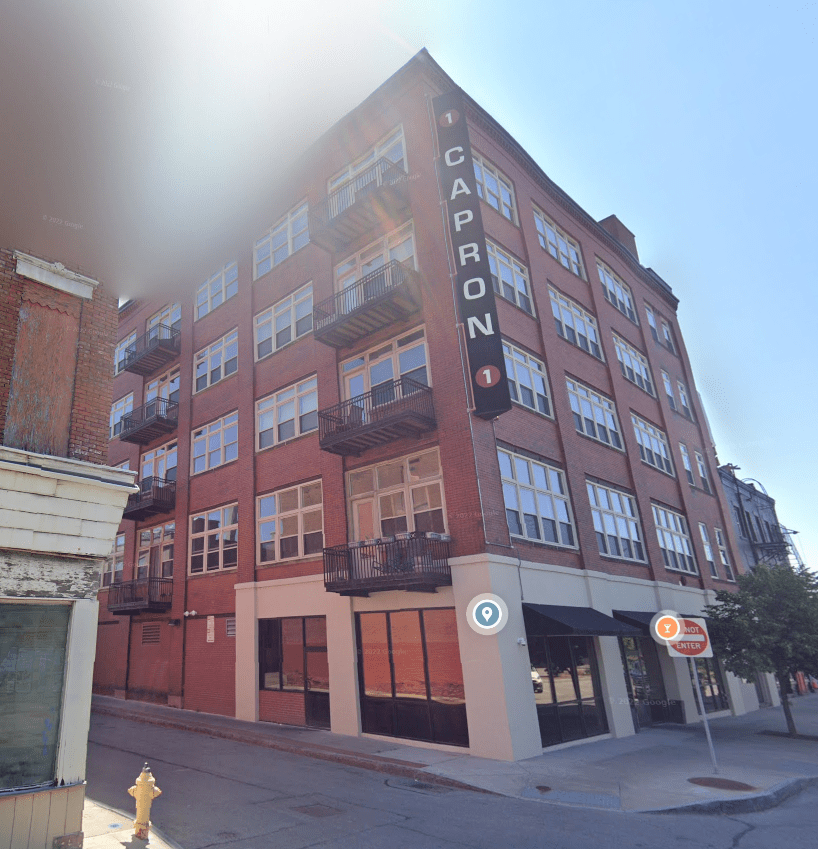
Google Maps
Nos. 228-236 South Avenue, former E. T. Gilbert Mfg. Co., Inc.
E. T. Gilbert’s Manufacturing Company is to be credited with a massive innovation in pipe cleaner technology: making one end slightly thicker than the other. Those wizards of chenille deserve every penny they got.
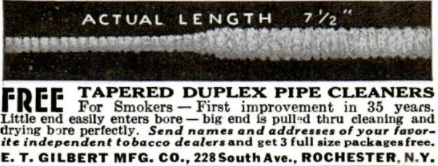
1932 Popular Mechanics
https://mycompanies.fandom.com/wiki/E._T._Gilbert_Manufacturing_Company
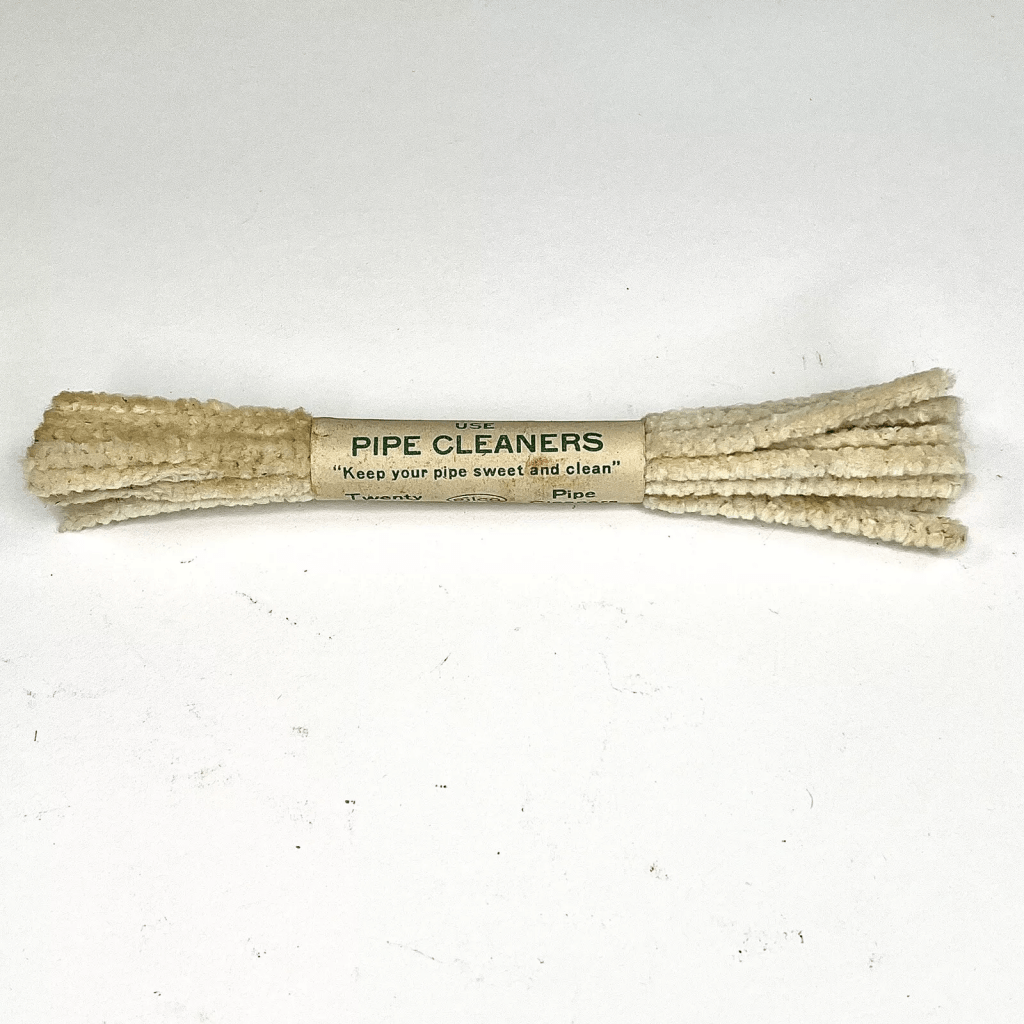
eBay.com
https://www.ebay.com/itm/256674300985?_trksid=p2332490.c101224.m-1
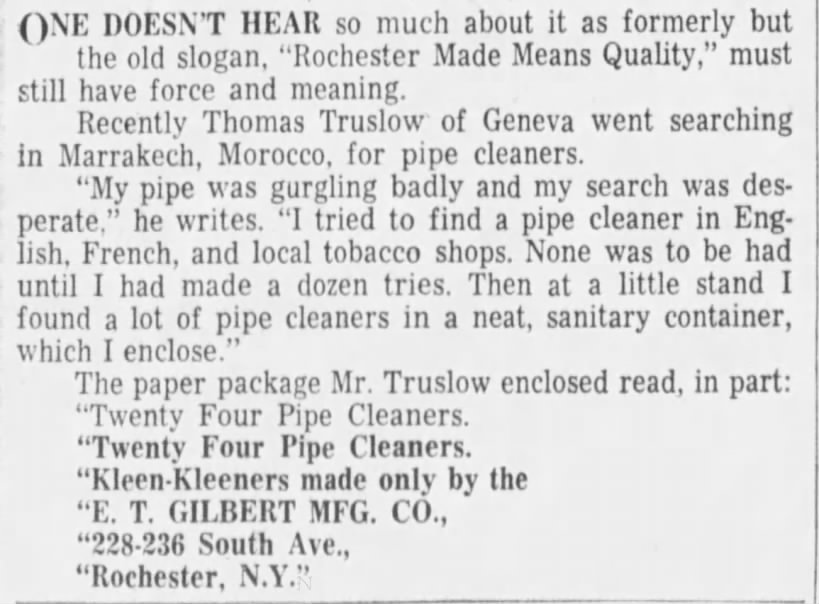
Saturday, April 07, 1962
https://www.newspapers.com/article/democrat-and-chronicle-pipe-cleaners/144425394/
In 1962, Wray Warner of Sodus purchased E. T. Gilbert Mfg. Co. and moved its operations to Old Ridge Road, Sodus.
Charles S. Lee
As an interesting aside, the E. T. Gilbert Manufacturing Company had another unusual tie with fame: in December 1954 then-owner Charles S. Lee was the first to drive across the newly-opened Troup-Howell Bridge.

1933 Directory
https://www.libraryweb.org/rochcitydir/images/1933/1933j-l.pdf
Charles S. Lee became president and treasurer of E. T. Gilbert Mfg Co., Inc. in 1933 taking over from his father, William R. Lee, who had owned the company since 1917.

1917 Directory
https://www.libraryweb.org/rochcitydir/images/1917/1917ge-ha.pdf
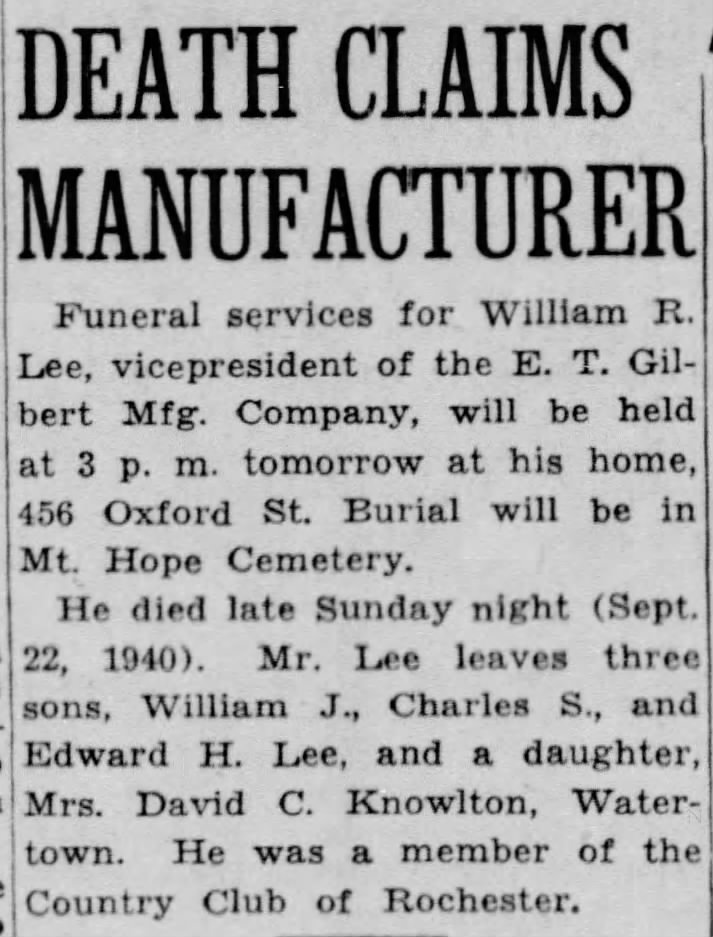
Tuesday, September 24, 1940
https://www.newspapers.com/article/democrat-and-chronicle-obituary-for-will/163180843/
On December 1st, 1954, the Troup-Howell Bridge was being opened to traffic for the first time. Unfortunately, vehicular traffic was thin on the ground. State Safety Engineer William Babcock ensnared a friend of his, Charles S. Lee, and cajoled him to cross the new bridge and be the famous first.
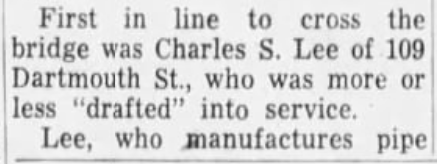
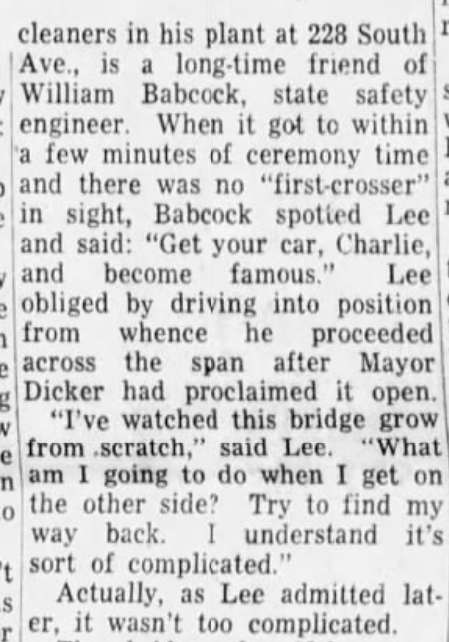
Thursday, December 02, 1954
https://www.newspapers.com/article/democrat-and-chronicle-bit-of-pomp-opens/163023067/
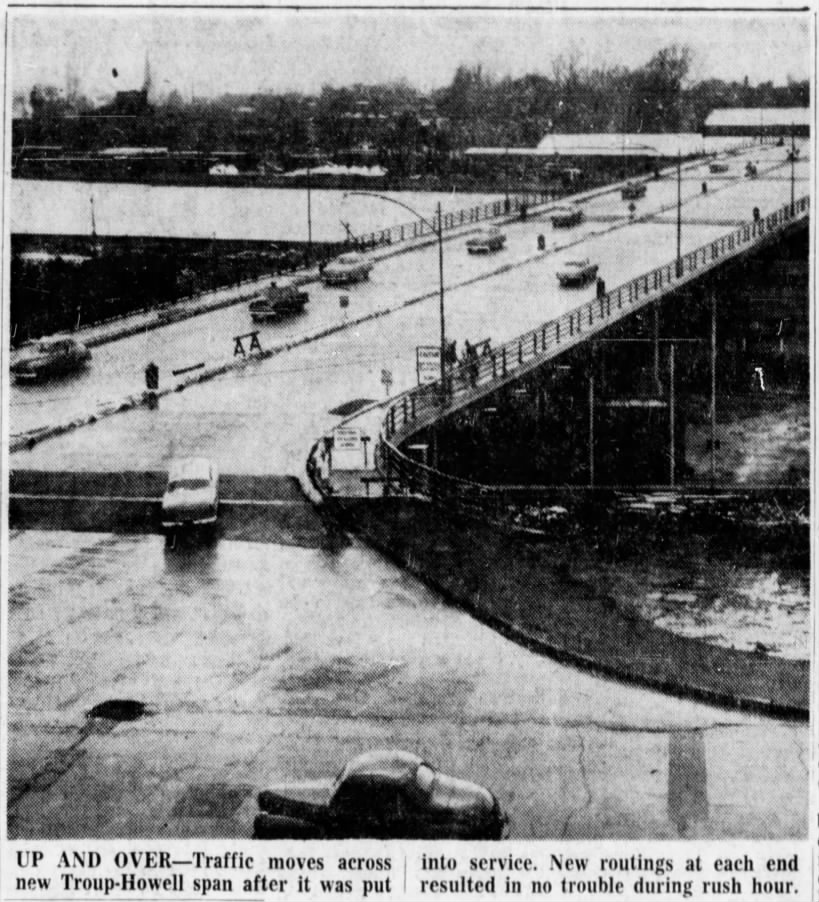
Thursday, December 02, 1954
https://www.newspapers.com/article/democrat-and-chronicle-new-troup-howell/163023179/
Fifty years later, when plans were presented to replace the Troup-Howell Bridge with a new span, a call went out from the Department of Transportation for help tracking down Charles S. Lee, so that he might repeat his feat of half a century prior. Given the span of time and the age of Lee at the original event, it was unlikely he was still alive to do so.

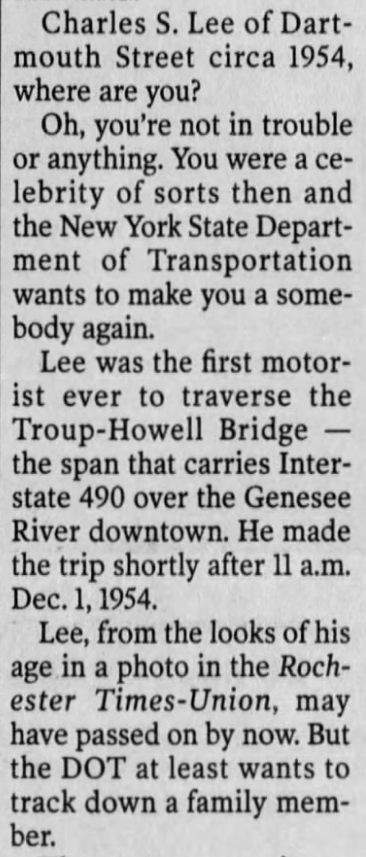
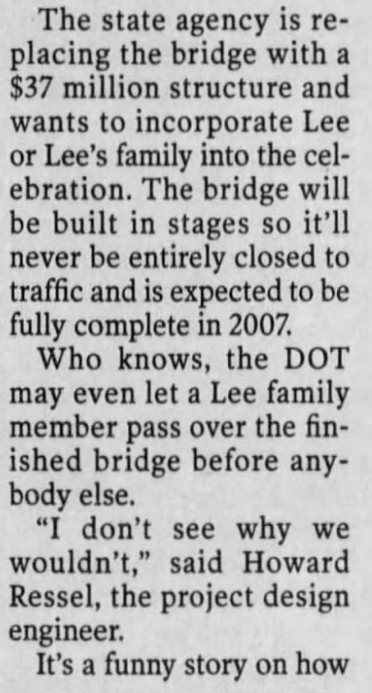
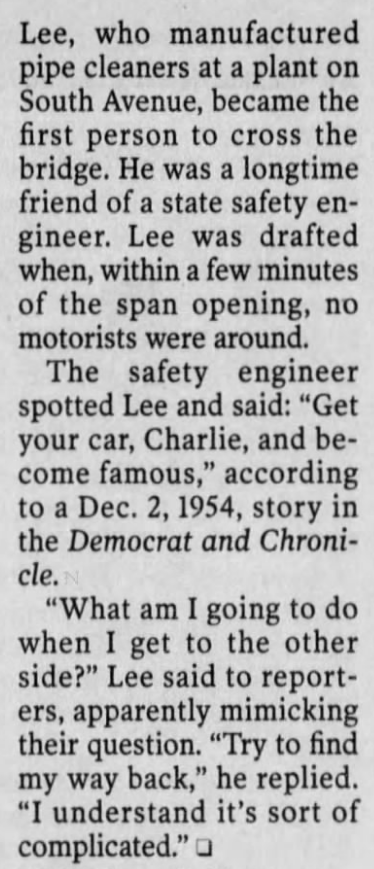
Monday, May 31, 2004
https://www.newspapers.com/article/democrat-and-chronicle-charles-s-lee/163022942/
The fears were realized as it turned out Charles S. Lee had died forty years prior, in 1964.
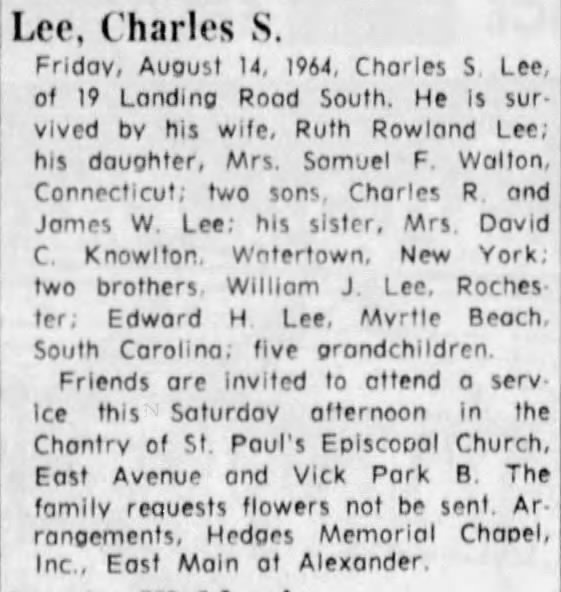
Saturday, August 15, 1964
https://www.newspapers.com/article/democrat-and-chronicle-obituary-for-char/163025136/
In retrospect, it does seem like the Democrat and Chronicle could have given their obituary archives a bit of a glance over before the big article.

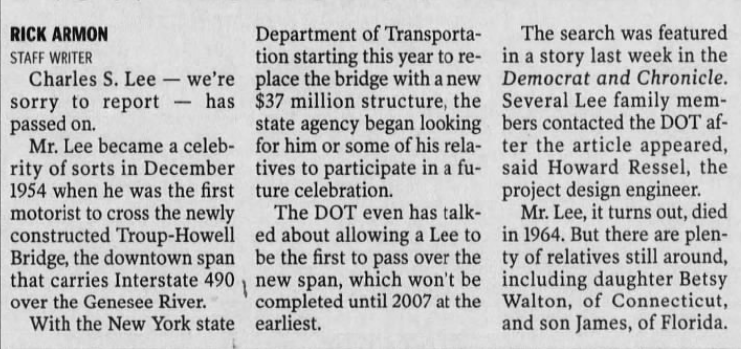
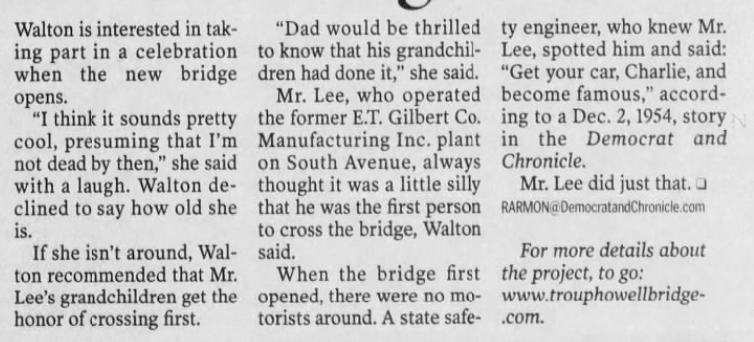
Tuesday, June 08, 2004
https://www.newspapers.com/article/democrat-and-chronicle-charles-s-lee-f/163022837/
American Pipe Cleaner Sales Co.
American Pipe Cleaner Sales Co. was founded in 1920 at No. 16 Rhine Street by Edward D. Stewart.

1944 Directory
https://www.libraryweb.org/rochcitydir/images/1944/1944a-b.pdf
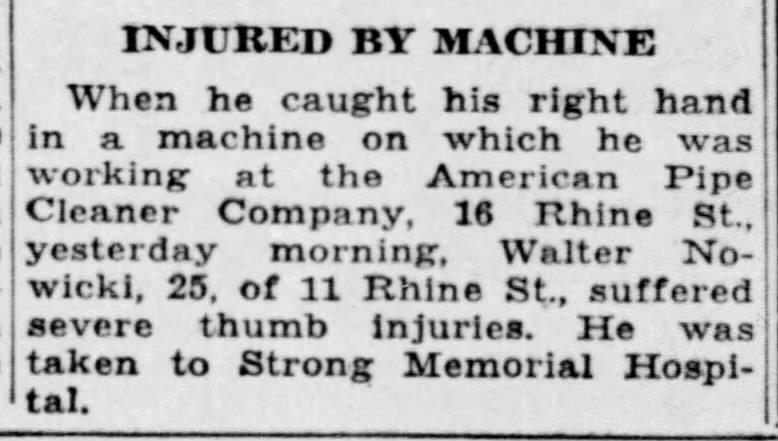
Friday, January 14, 1944
https://www.newspapers.com/article/democrat-and-chronicle-injured-by-machin/163227210/
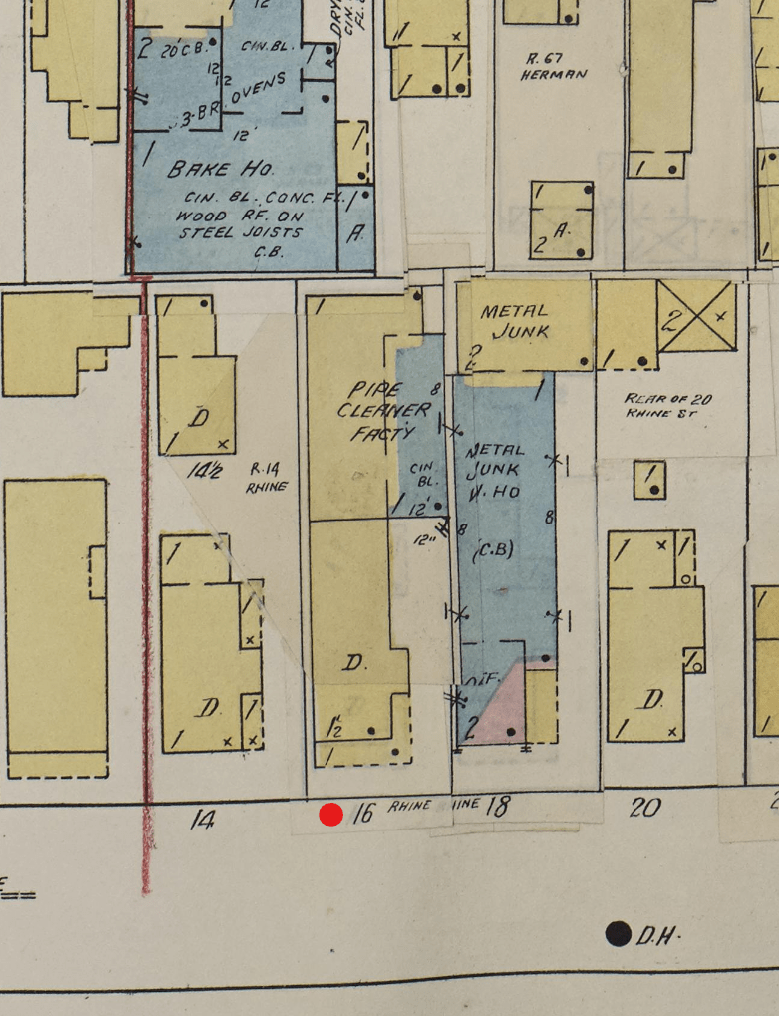
1950 Sanborn Map
Red: No. 16 Rhine Street, American Pipe Cleaners Sales Co.
https://www.loc.gov/resource/g3804rm.g3804rm_g06217195002/?sp=51&r=-0.073,0.853,0.476,0.268,0
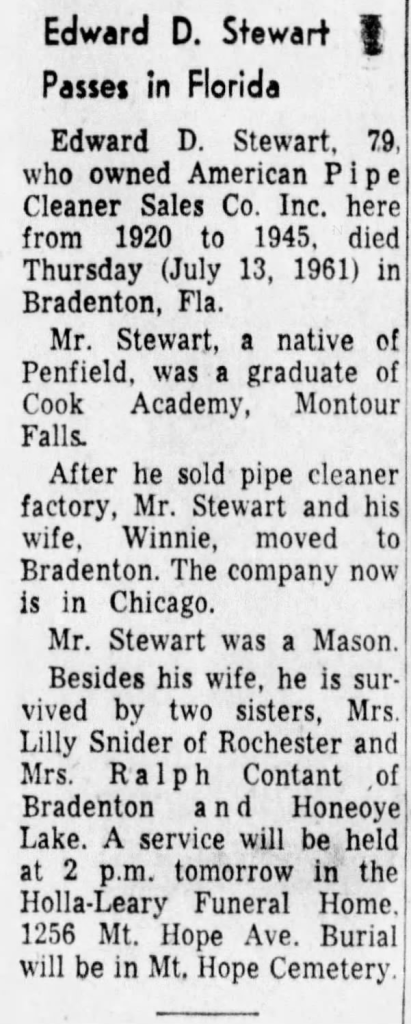
Monday, July 17, 1961
https://www.newspapers.com/article/democrat-and-chronicle-edward-d-stewart/163227142/
Rhine Street is no longer extant; the former location of American Pipe Cleaner Sales Co. is now in a baseball field at Baden Park, which was dedicated in June of 1964.
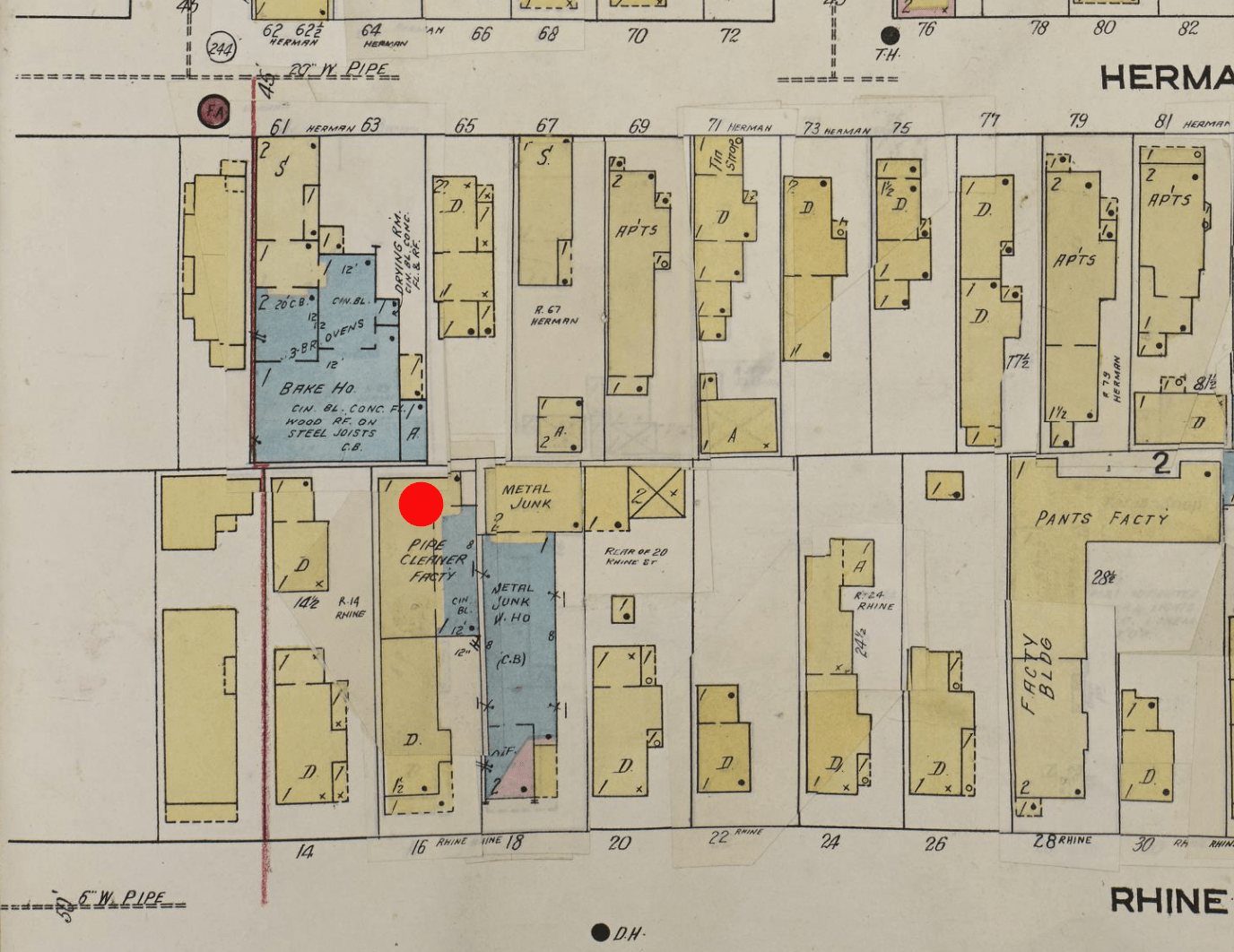
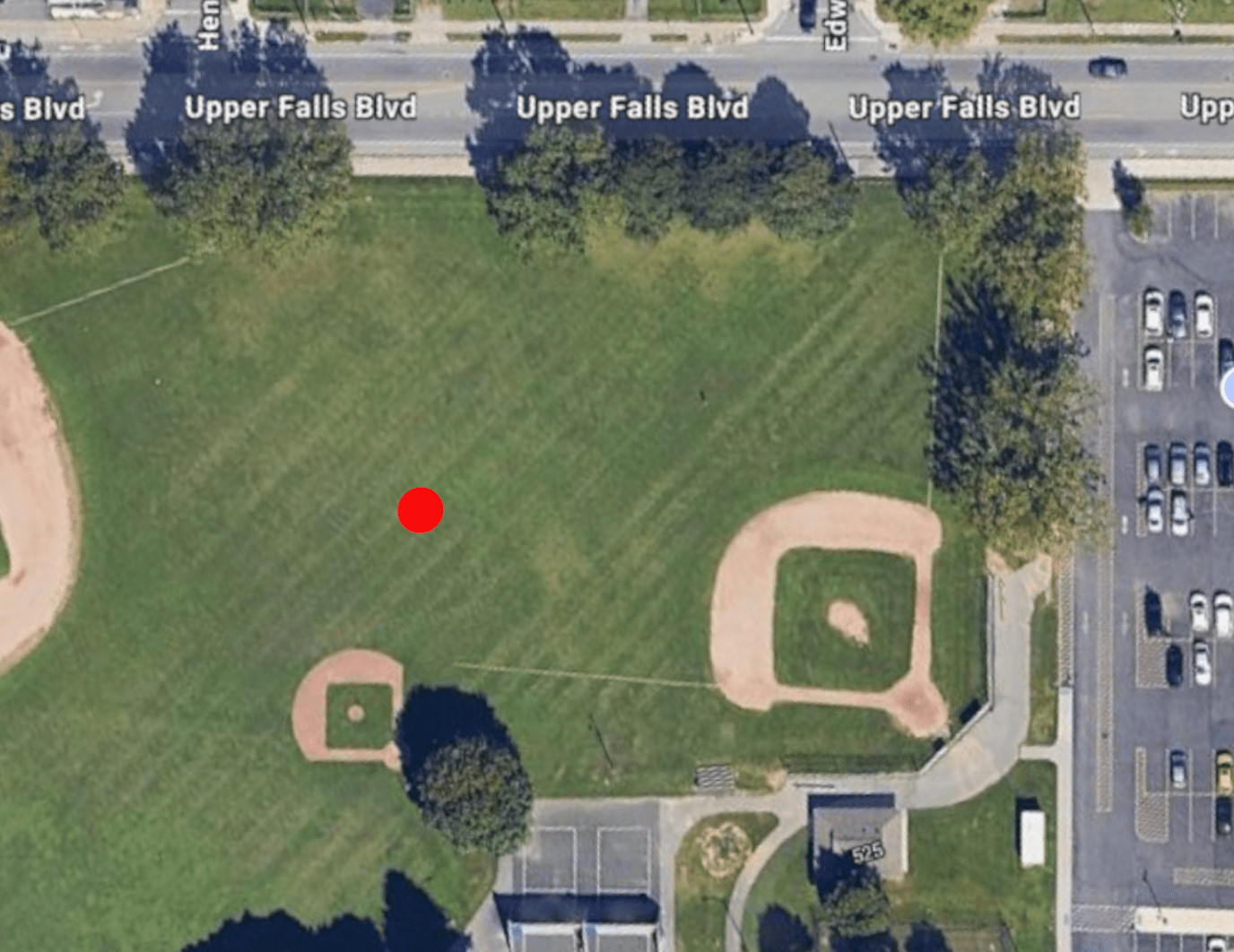
Comparative image showing 1950 Sanborn against modern map.
Trojan Sanitary Pipe Cleaner Co.
Trojan Sanitary Pipe Cleaner Co. began as two separate companies that both first appeared in the 1909 directory: Sanitary Pipe Cleaner Co., rear No. 61 Oakman and Trojan Mfg Co., at No. 33 Market.

1909 Directory
https://www.libraryweb.org/rochcitydir/images/1909/1909re-sh.pdf
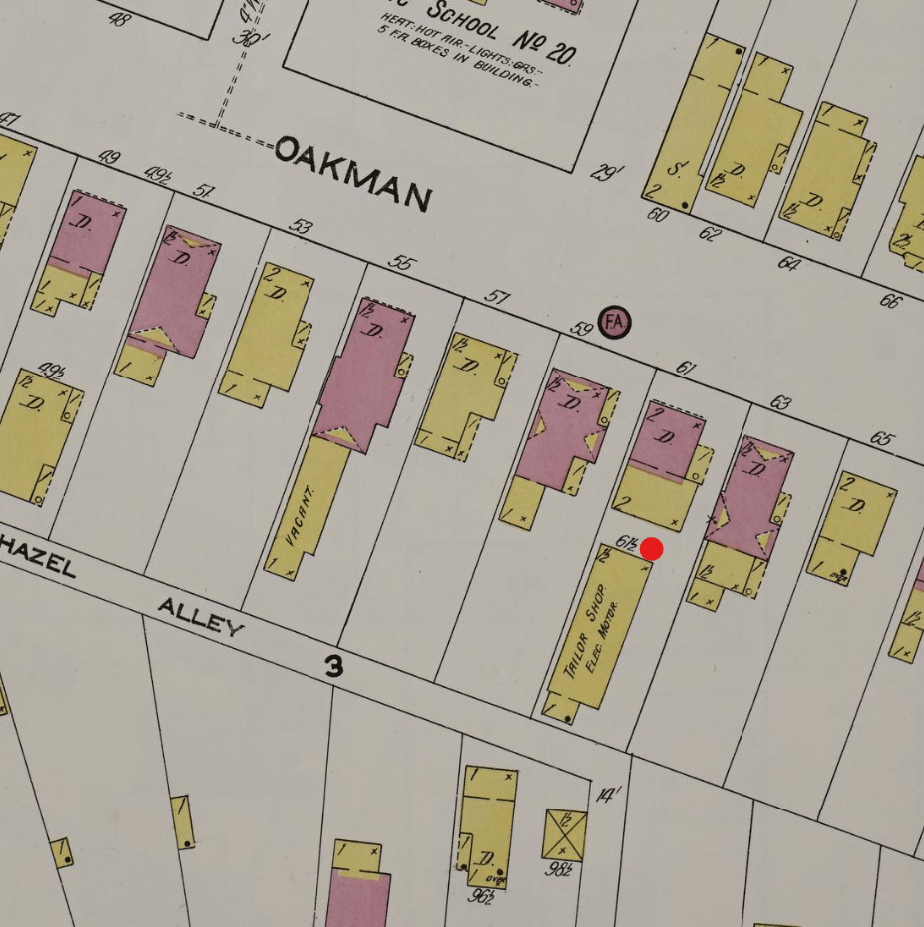
1911 Sanborn Map
Red: No. 61½ Oakman Street, Sanitary Pipe Cleaner Co.
https://www.loc.gov/resource/g3804rm.g3804rm_g06217191101/?sp=27&r=0.235,0.557,0.849,0.511,0
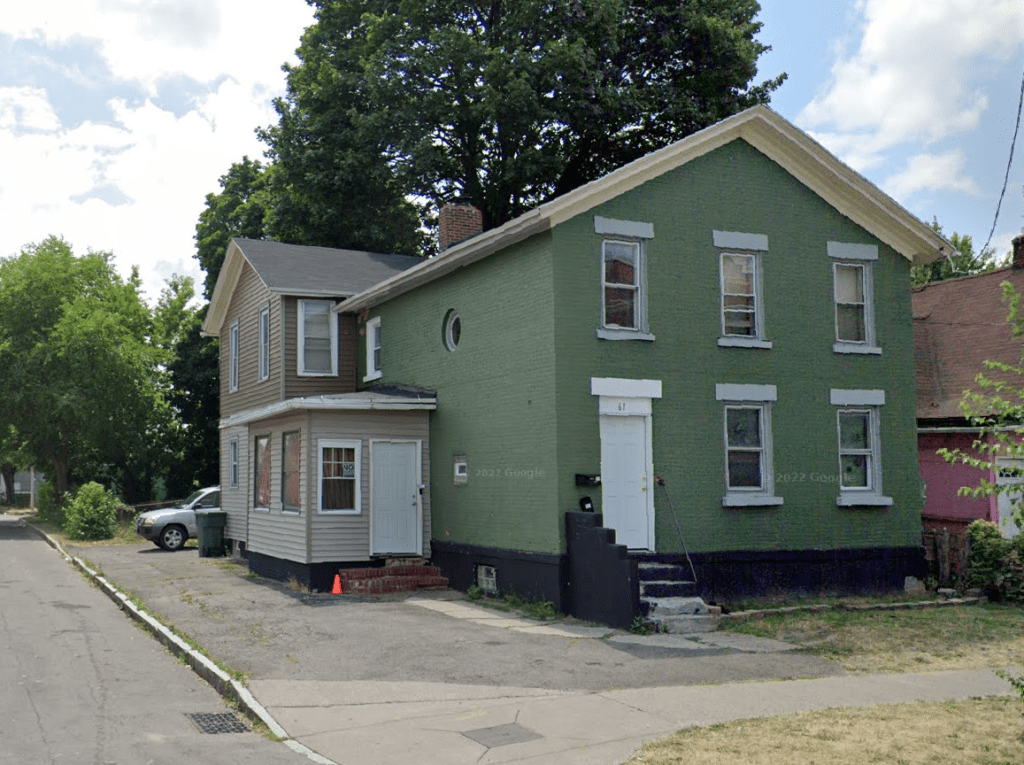
Google Maps
No. 61 Oakman Street as it appears today.
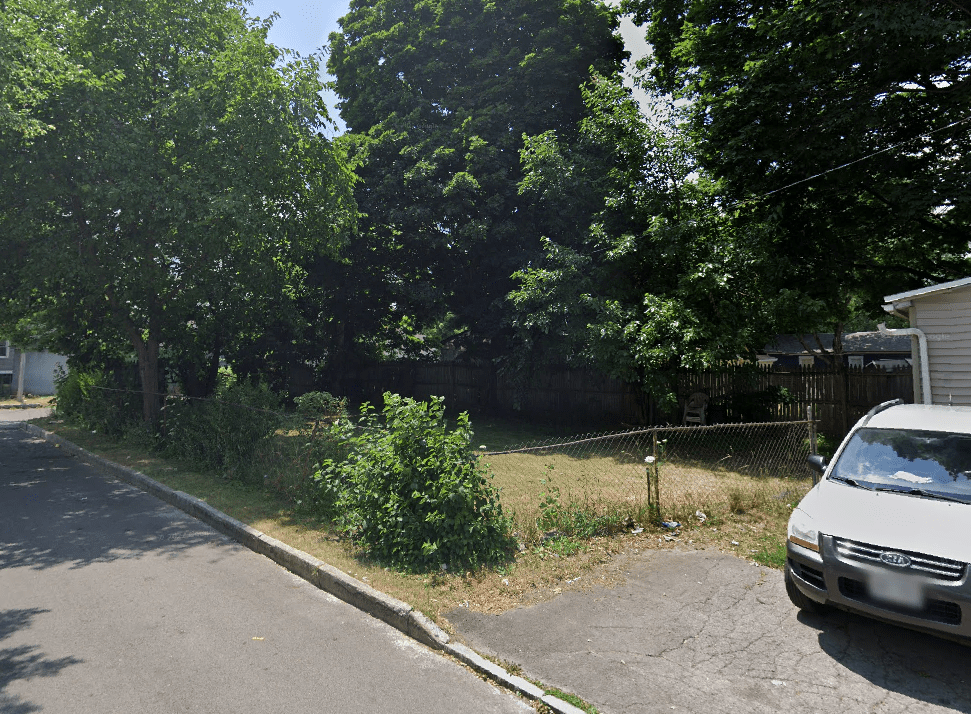
The building behind No. 61 Oakman Street, where the Sanitary Pipe Cleaner Co. was mostly centered, was torn down. Also torn down were the houses to the east of No. 61, in favor of the housing development known as Los Flamboyanes. Hazel Alley was extended north to Oakman Street.
Google Maps
Former site of Sanitary Pipe Cleaner Co. behind No. 61 Oakman Street, as it appears today.

1909 Directory
https://www.libraryweb.org/rochcitydir/images/1909/1909si-t.pdf
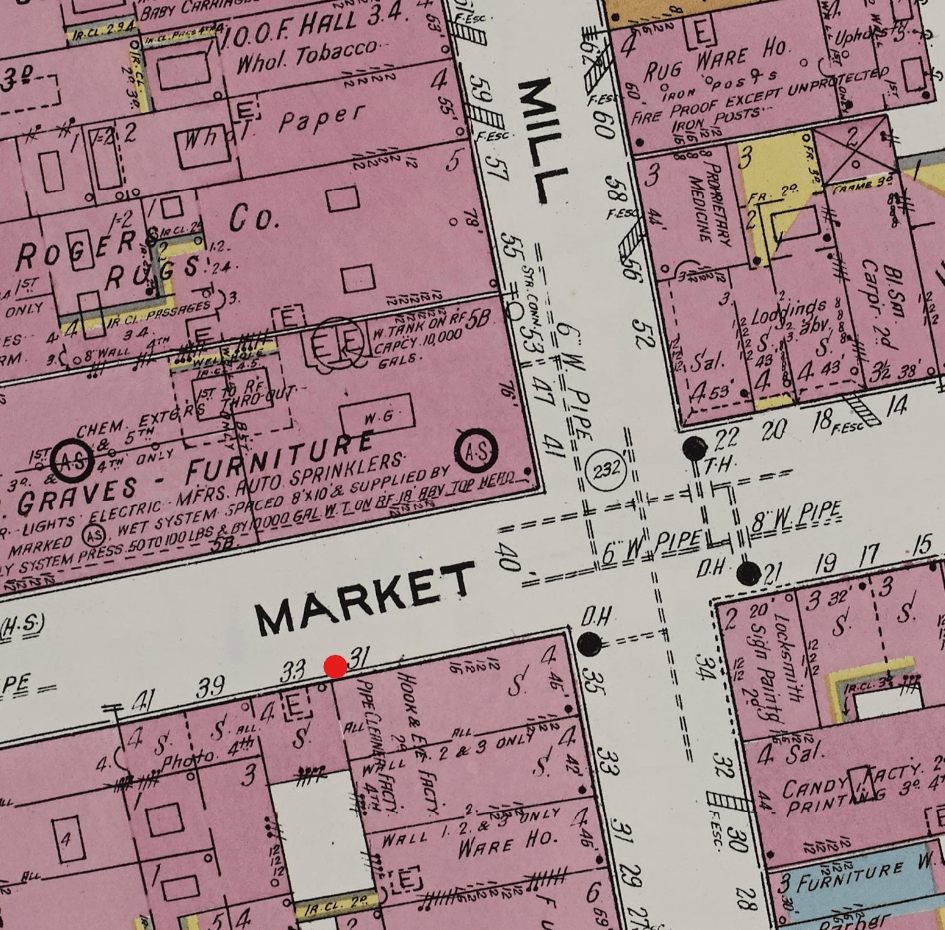
1911 Sanborn Map
Red: No. 33 Market Street, Trojan Mfg. Co.
https://www.loc.gov/resource/g3804rm.g3804rm_g06217191101/?sp=20&r=0.059,0.376,0.47,0.264,0
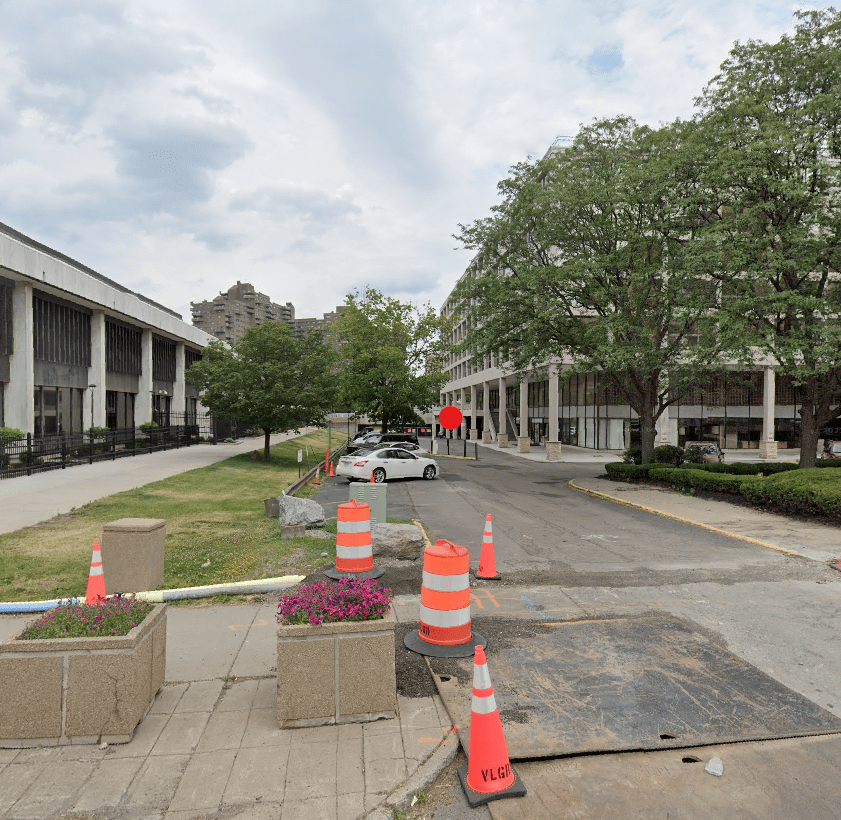
Google Maps
Red: Rough location of No. 33 Market Street, former site of Sanitary Pipe Cleaner Co., as it appears today.
As of 1912, Sanitary Pipe Cleaner Co. would move from No. 61 Oakman to the same quarters as Trojan Mfg. Co. at No. 33 Market Street.
No. 61 Oakman would be purchased by Louis Phénix Warner, who manufactured belting and, you guessed it, pipe cleaners under the Renack Mfg. Co. name.

1914 Directory
https://www.libraryweb.org/rochcitydir/images/1914/1914u-z.pdf

1914 Directory
https://www.libraryweb.org/rochcitydir/images/1914/1914complete.pdf
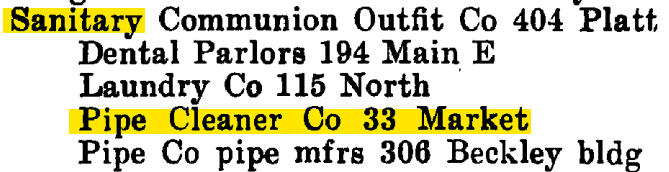
1912 Directory
https://www.libraryweb.org/rochcitydir/images/1912/1912re-sh.pdf
In 1914, Trojan and Sanitary would both would move to No. 205 Pansy Street, which would become No. 205 Bayclif Drive in 1935.

1914 Directory
https://www.libraryweb.org/rochcitydir/images/1914/1914si-t.pdf
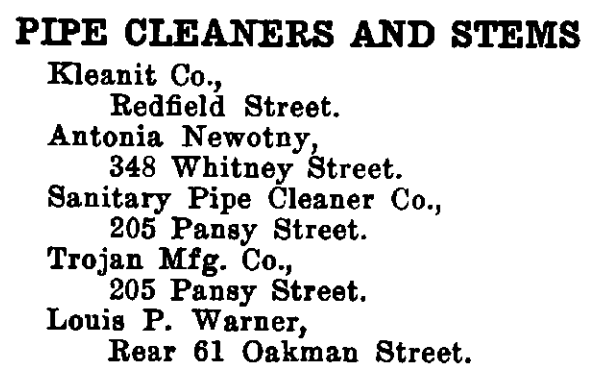
1916 Rochester NY The City of Varied Industries
https://www.seekingmyroots.com/members/files/H008028.pdf
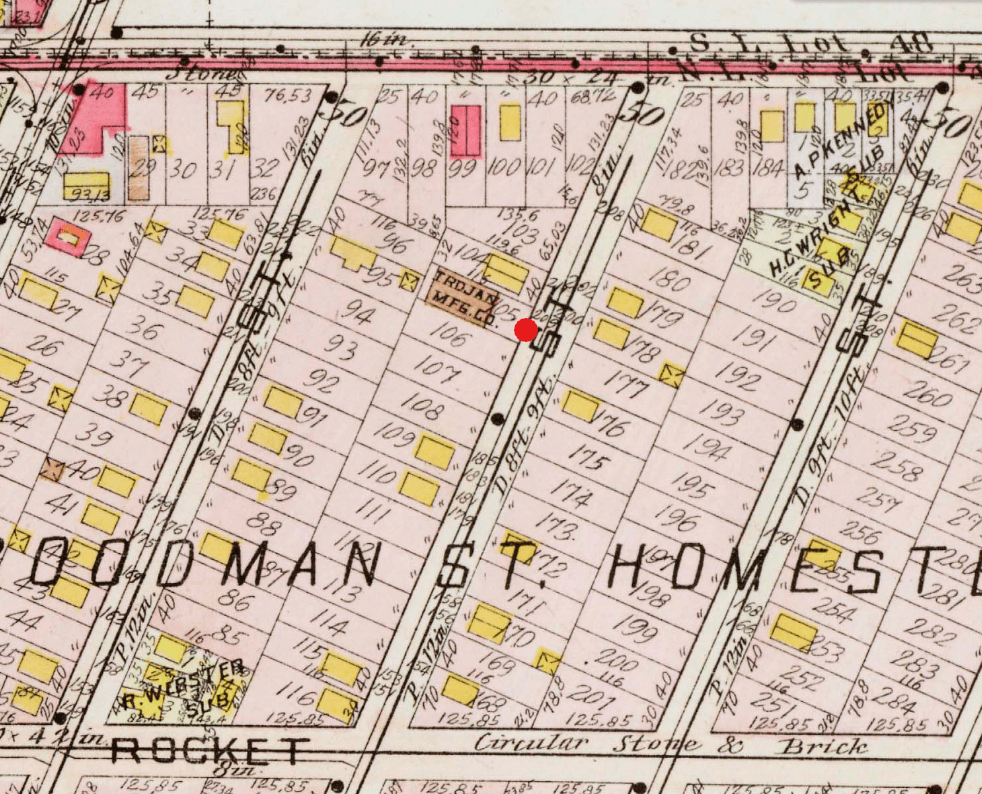
1918 Plat Map
Red: No. 205 Pansy Street, Trojan Mfg. Co.
https://photo.libraryweb.org/rochimag/rpm/rpm00/rpm00364.jpg
In 1925, Trojan and Sanitary merged to become Trojan Sanitary Pipe Cleaner Co.

1925 Directory
https://www.libraryweb.org/rochcitydir/images/1925/1925t-v.pdf
Pansy Street became Bayclif Drive in 1935, in honor of–uh, I don’t know, being a drive between Bay and Clifford. Most everyone writes it as Baycliff Drive, including the street signs, because it’s weird AF with just one F.

1935 Directory
https://www.libraryweb.org/rochcitydir/images/1935/1935streetsp-z.pdf
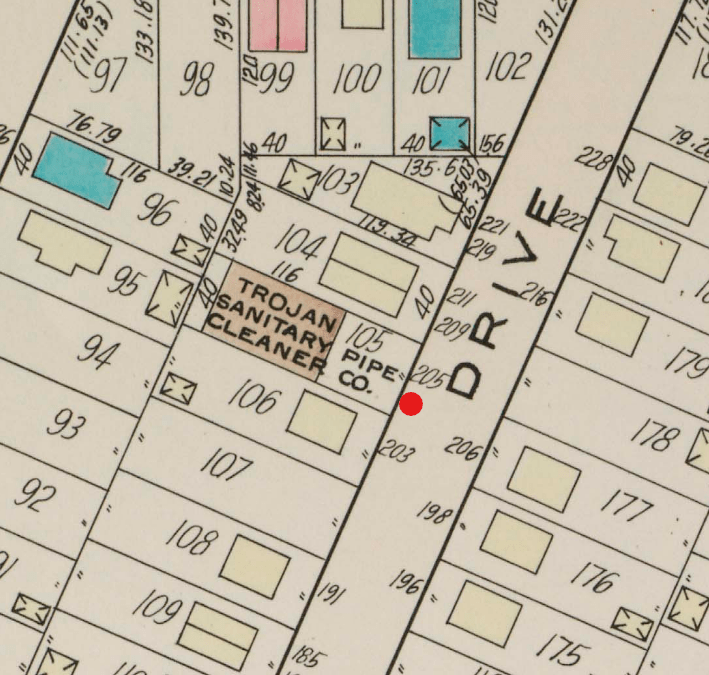
1935 Plat Map
Red: No. 205 Baycliff Drive, Trojan Sanitary Pipe Cleaner Co.
https://photo.libraryweb.org/rochimag/rpm/rpm00/rpm00478.jpg
Trojan sold colorful pipe cleaners for children’s crafts under the name Twisticks.
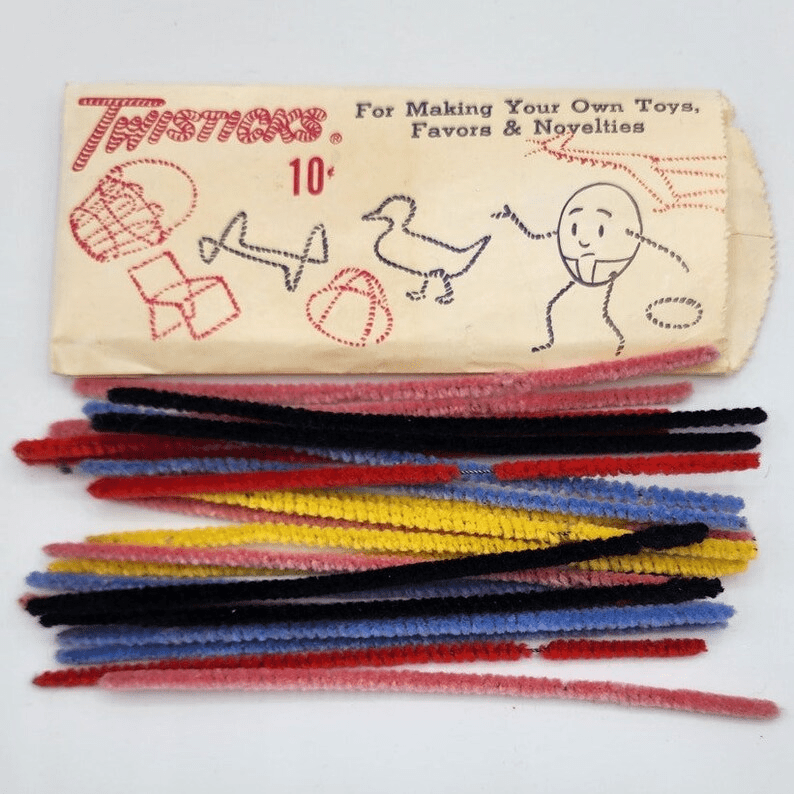
https://www.etsy.com/listing/1738083149/vintage-twisticks-multi-color-pipe
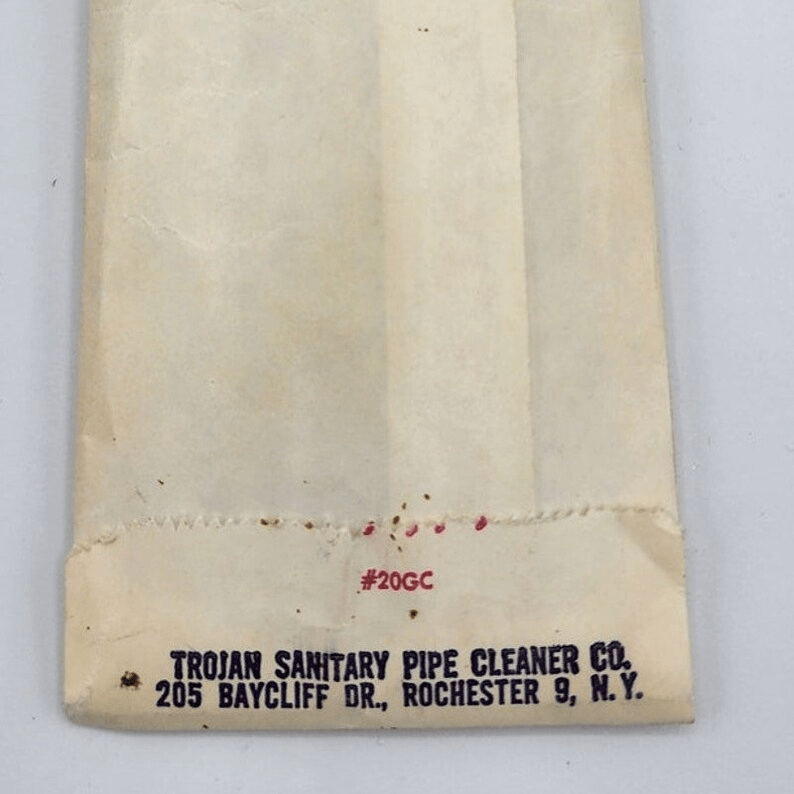
https://www.etsy.com/listing/1738083149/vintage-twisticks-multi-color-pipe
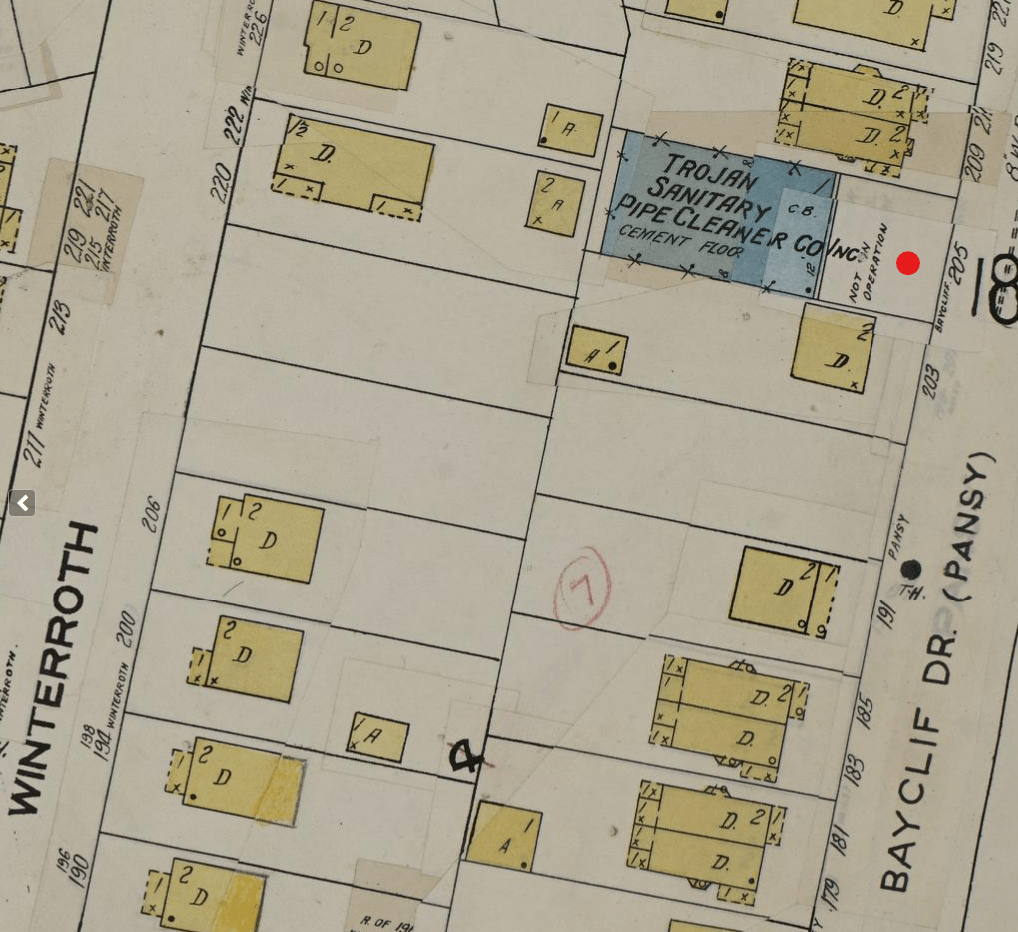
1950 Sanborn
Red: No. 205 Bayclif Drive, Trojan Sanitary Pipe Cleaner Co.
https://www.loc.gov/resource/g3804rm.g3804rm_g06217195002/?sp=74&r=0.653,0.419,0.571,0.321,0
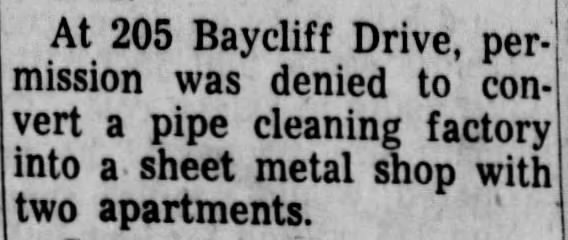
Friday, May 22, 1964
https://www.newspapers.com/article/democrat-and-chronicle-205-baycliff-driv/163137537/
At some point between 1953 and 1959, Trojan Sanitary Pipe Cleaner Co. was purchased by Edward A. Rudy, owner of Rochester Livingstone, Inc.
The factory building at No. 205 Bayclif was torn down some time later.
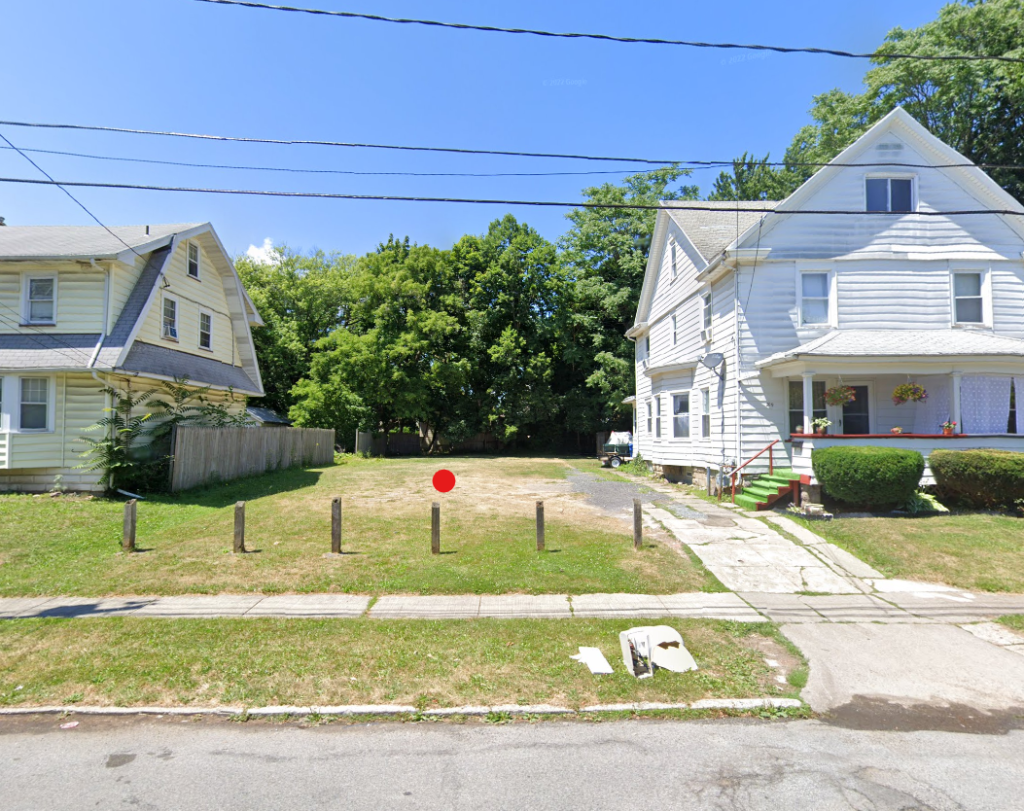
Google Maps
Red: Former site of No. 205 Bayclif Drive.
Rochester Pipe Cleaner Company
In 1935, Edward J. Morley founded Rochester Pipe Cleaner Co., Inc. at No. 320 Andrews Street.

1935 Directory
https://www.libraryweb.org/rochcitydir/images/1935/1935busdir.pdf
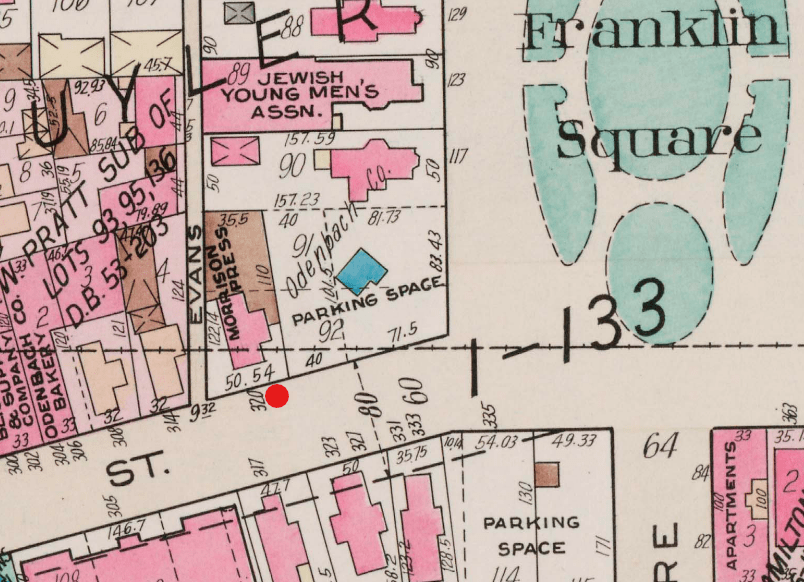
1935 Andrews Street
Red: No. 320 Andrews Street, first location of Rochester Pipe Cleaner Co., Inc.
https://photo.libraryweb.org/rochimag/rpm/rpm00/rpm00465.jpg
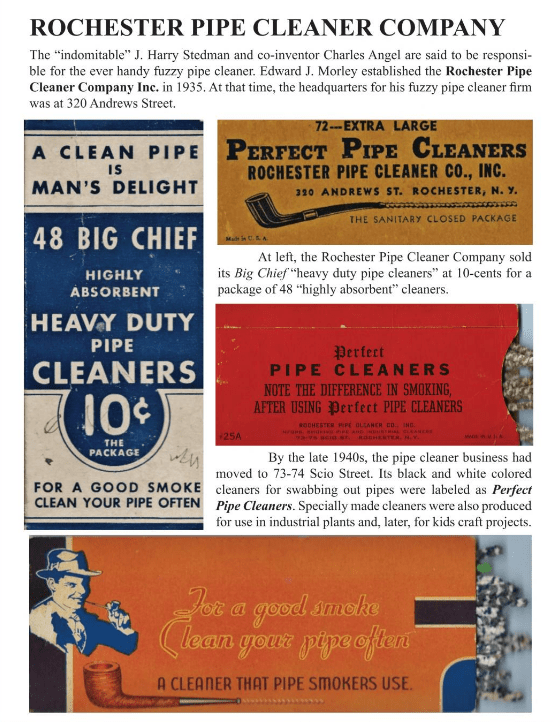
“Made in Rochester” Donovan A. Schilling [p.206]
https://www.google.com/books/edition/Made_in_Rochester/rCauCAAAQBAJ?hl=en&gbpv=0
In 1940, Clarence L. Grow purchased the Rochester Pipe Cleaner Company from Edward J Morley. Morley would die four years later.
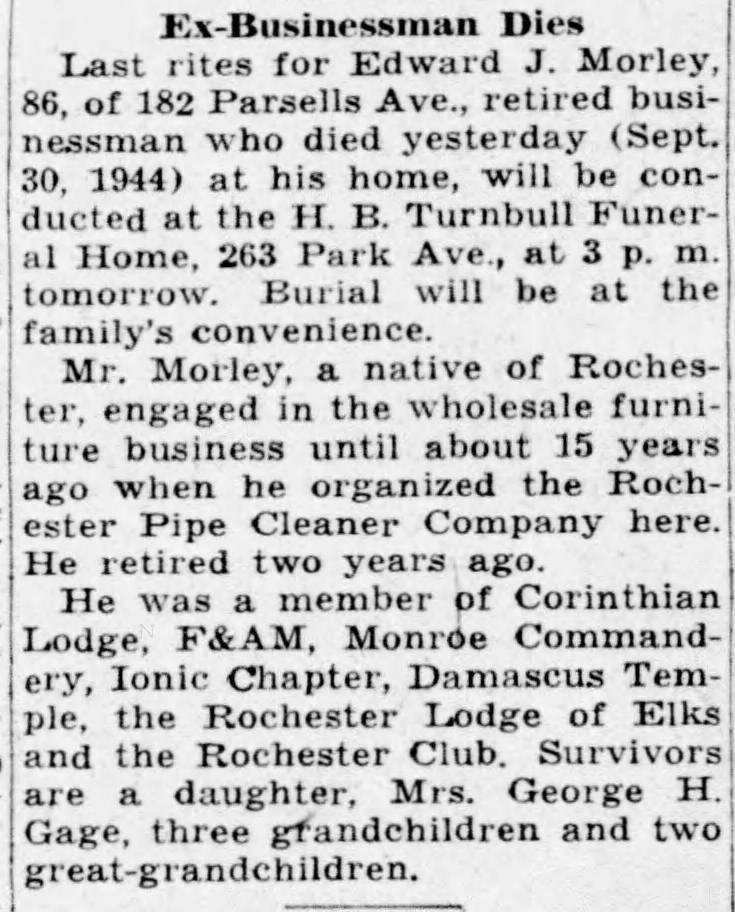
Sunday, October 01, 1944
https://www.newspapers.com/article/democrat-and-chronicle-edward-j-morley/163073537/
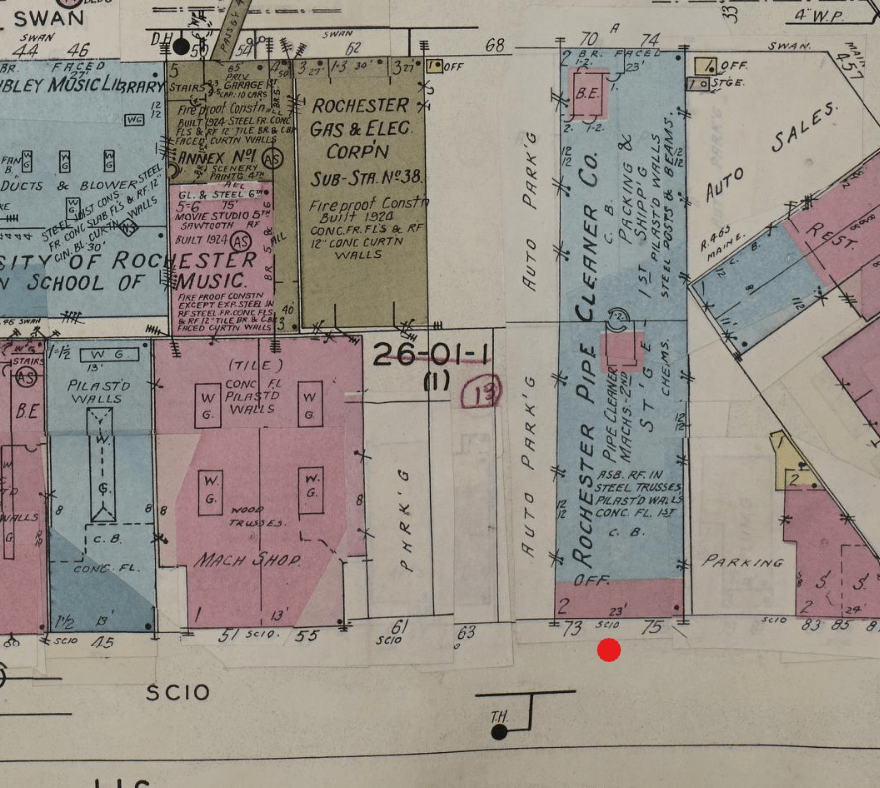
1950 Sanborn Map
Red: Nos. 73-75 Scio Street, Rochester Pipe Cleaner Co.
https://www.loc.gov/resource/g3804rm.g3804rm_g06217195001S/?sp=24&r=0.274,0.746,0.69,0.388,0
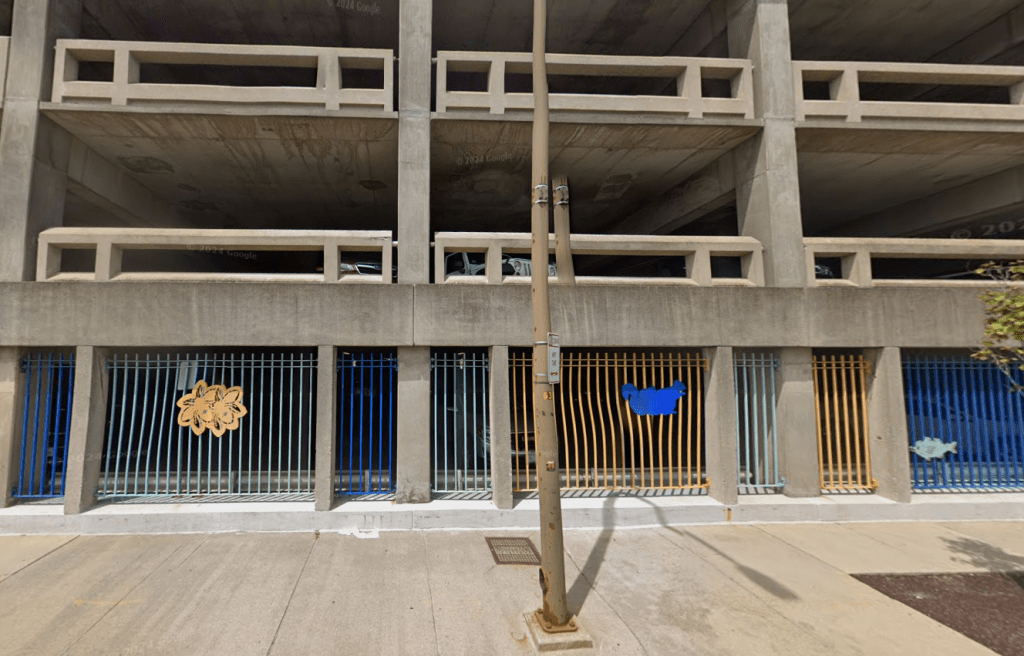
Google Maps
Present-day location of Nos. 73-75 Scio Street, formerly Rochester Pipe Cleaner Co.
Though the Rochester Pipe Cleaner Co. and the Rochester Livingstone, Inc. were apparently at first separate entities with different products–the former being pipe cleaners, naturally, and the latter wooden tobacco paraphernalia–they seem to have merged into a single corporation under the name Rochester Livingstone, Inc.
B. J. Long, future founder of the B. J. Long Co., was a junior partner of the Rochester Pipe Cleaner Co./Rochester Livingstone, Inc. during the World War II.
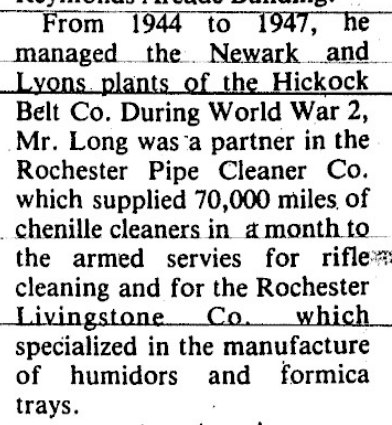
https://nyshistoricnewspapers.org/?a=d&d=bpp19800925-01.1.21&e=——-en-20–1–txt-txIN———-
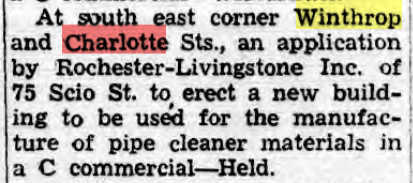
The Daily Record
Friday, April 14, 1949
In 1950, Rochester Livingstone, Inc. would build a new factory building onto the back of an extant house at No. 81 Charlotte Street.
Rochester Livingstone, Inc.
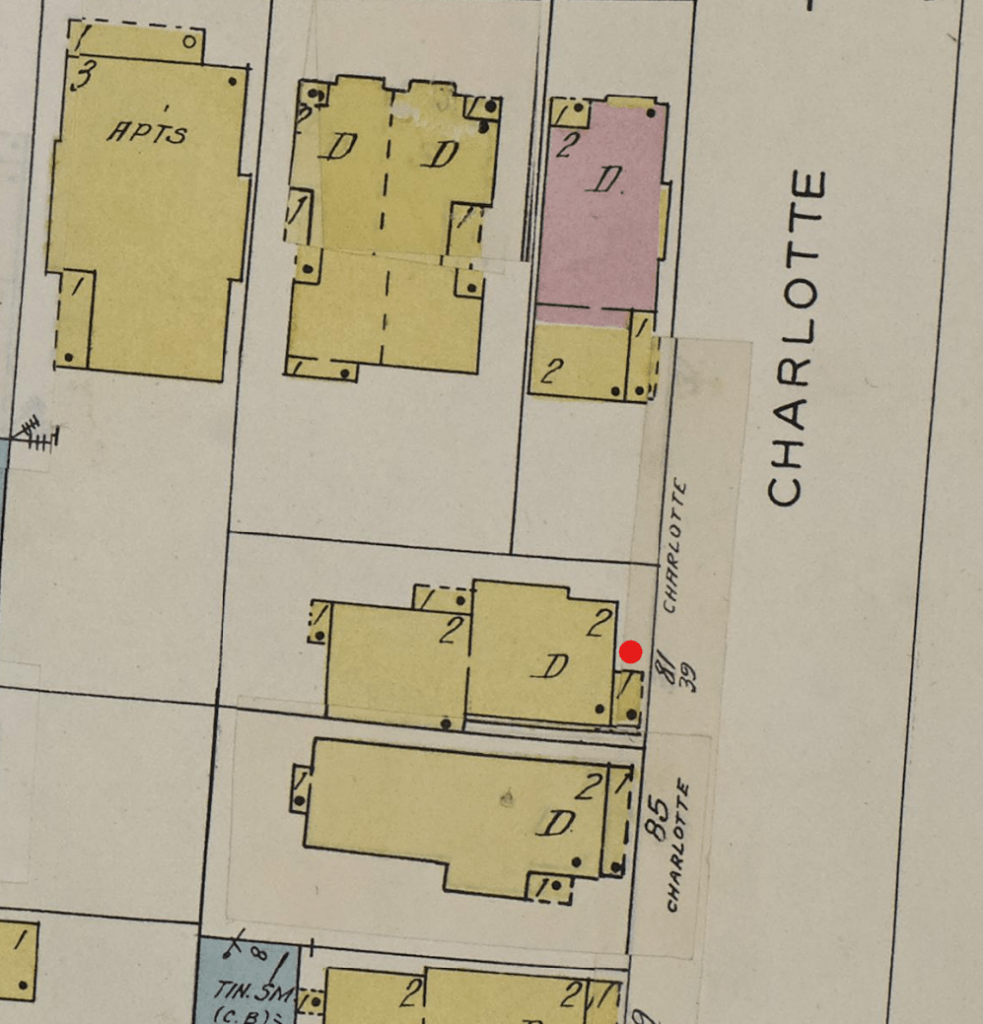
1950 Sanborn Map
Red: No. 81 Charlotte Street, location of Rochester Livingstone, Inc.
https://www.loc.gov/resource/g3804rm.g3804rm_g06217195001S/?sp=26&r=0.573,0.67,0.334,0.188,0
The house and factory addition would later be replaced by a cinder-block building taking up lots 2 and 3 of the Vineyard Tract.
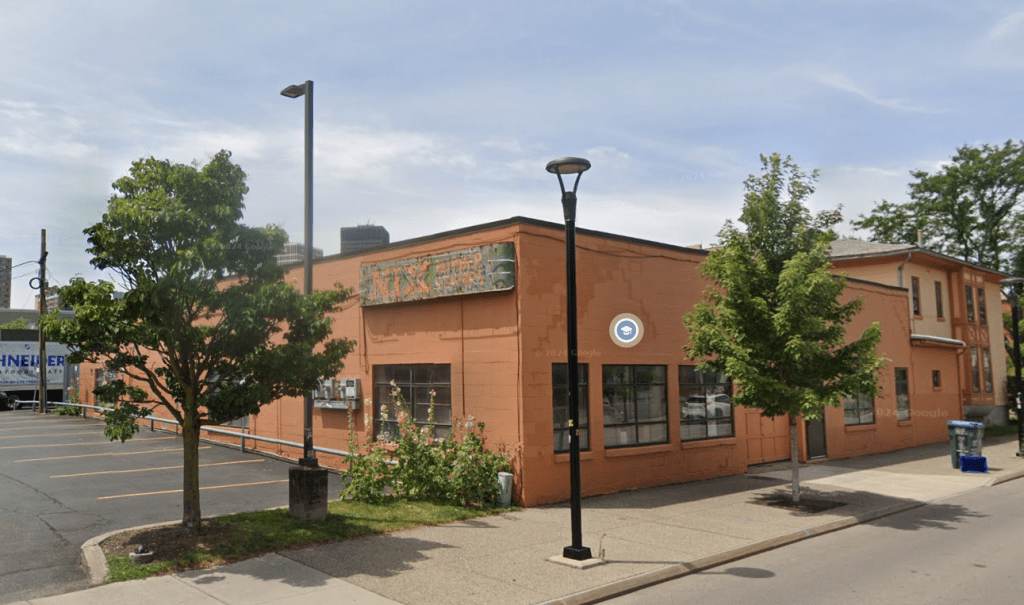
Google Maps
No. 81 Charlotte Street, present building at former location of Rochester Livingstone, Inc.
As one can see from the sign, the building was briefly occupied by NIX Rubber Stamps.
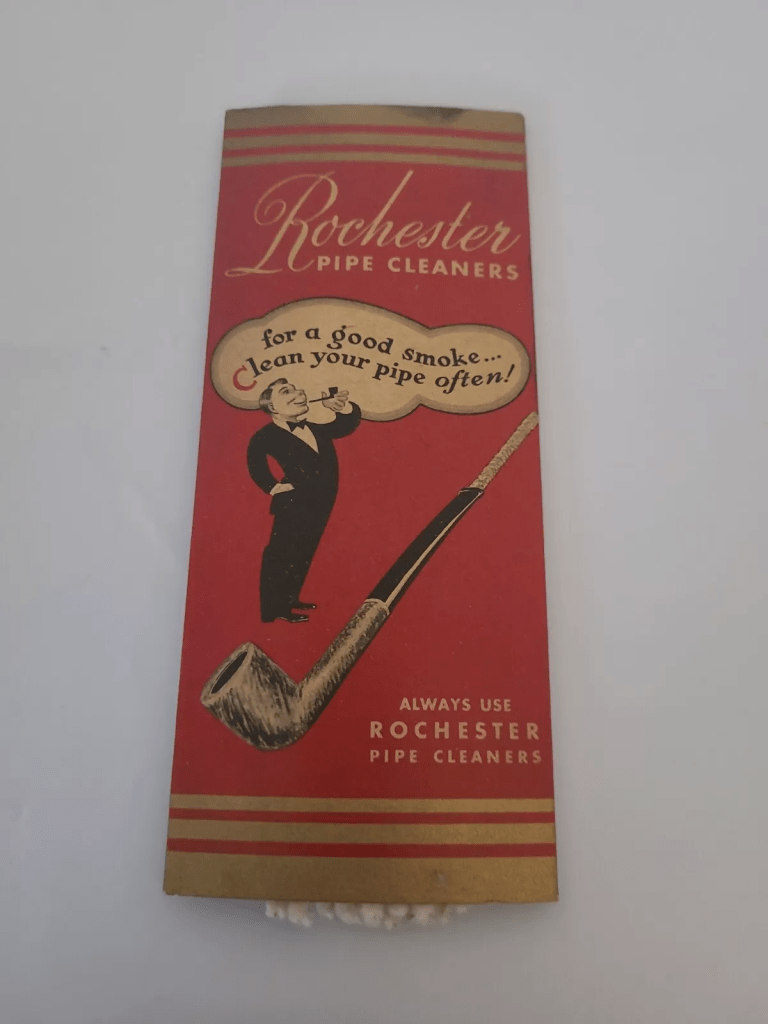
https://www.ebay.com/itm/334643152342
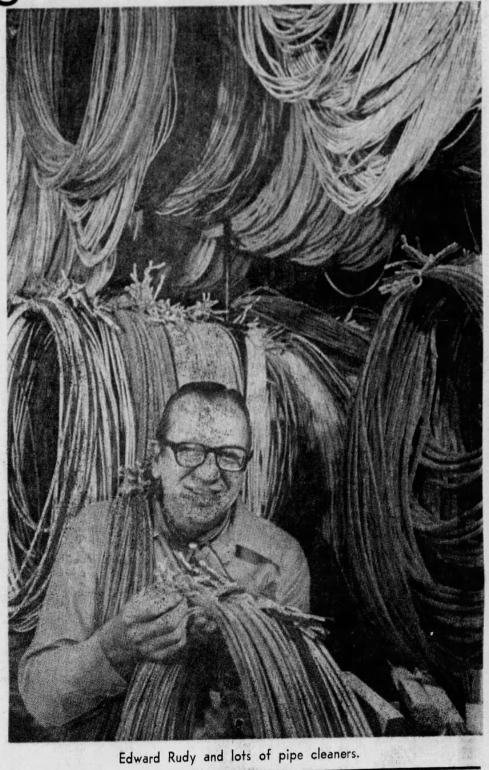
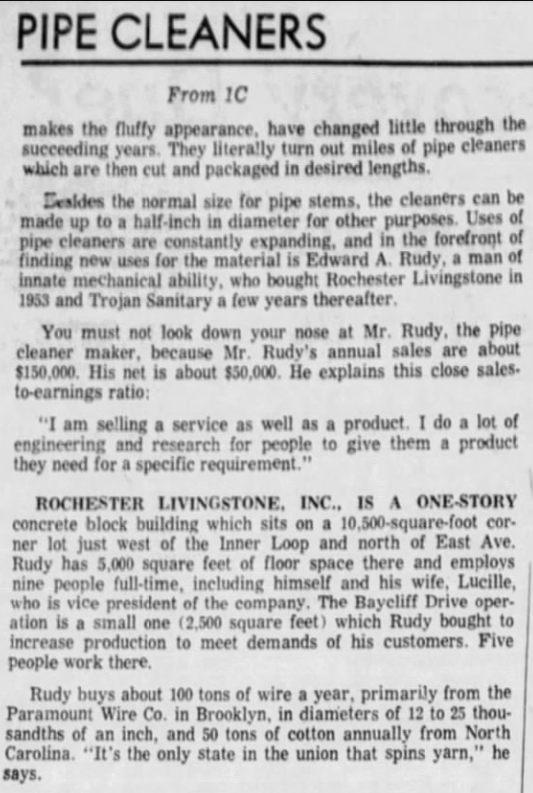
In 1953, Edward A. Rudy purchased Rochester Livingstone, Inc.
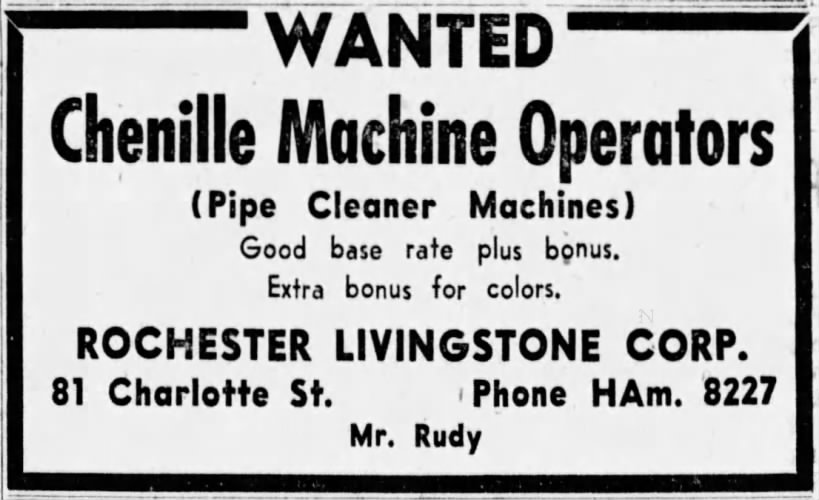
Tuesday, February 16, 1954
https://www.newspapers.com/article/democrat-and-chronicle-chenille-machine/159356423/
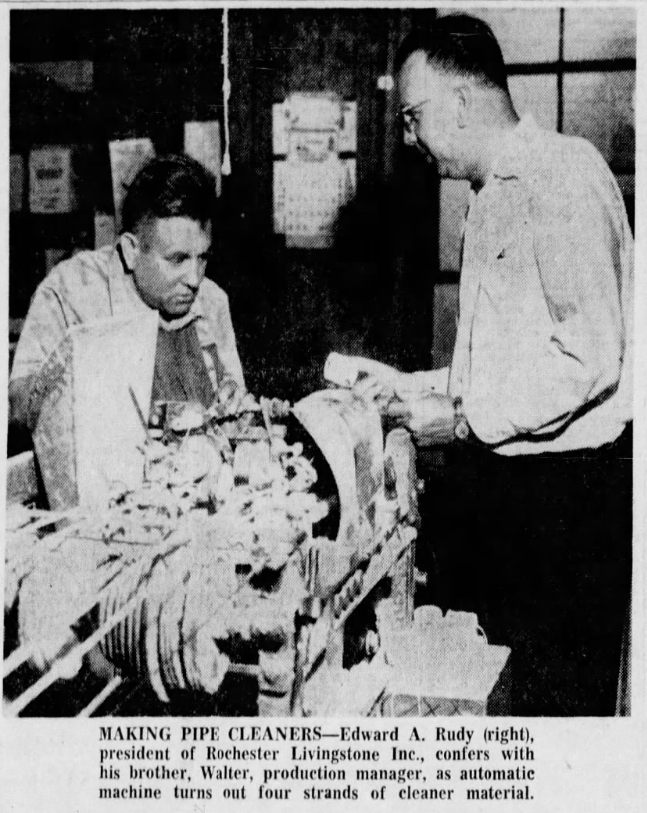

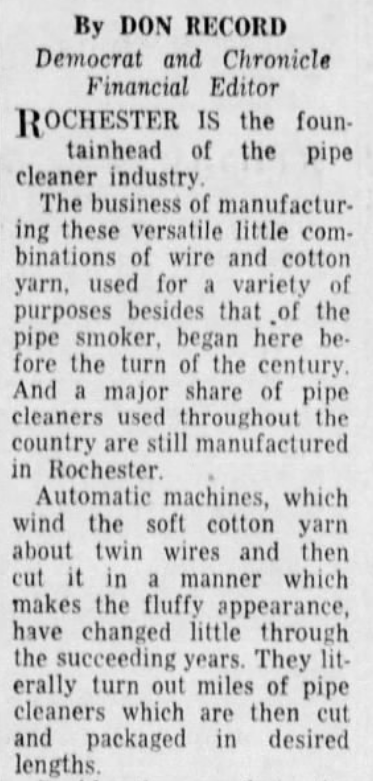
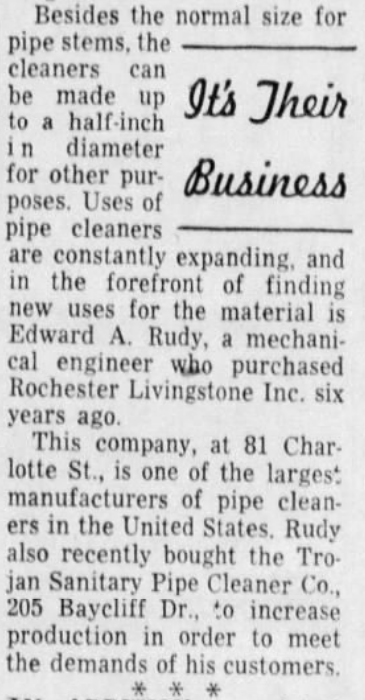
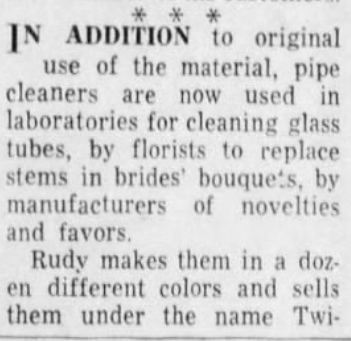
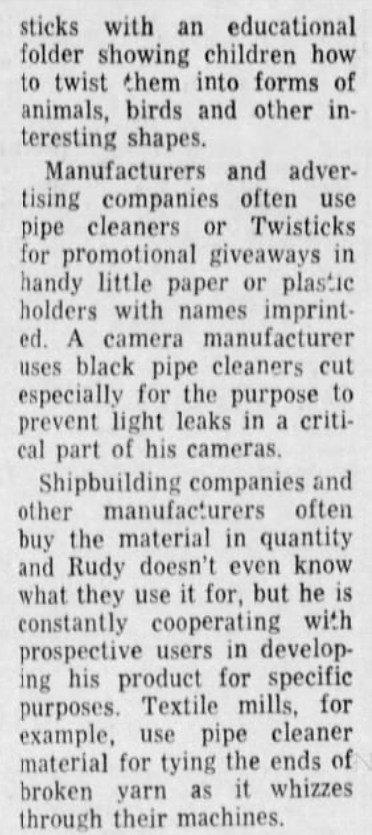
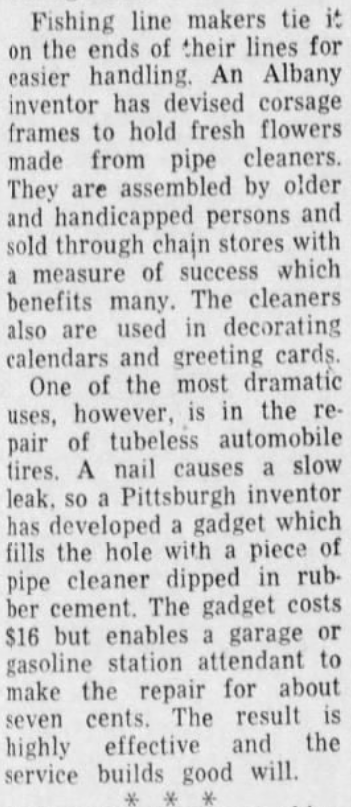
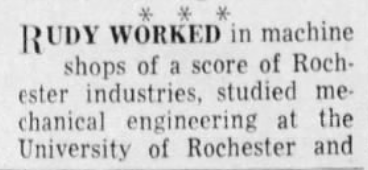
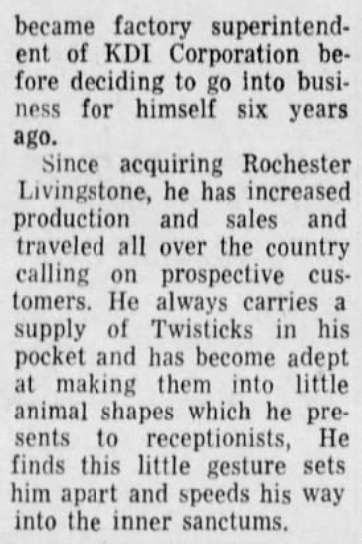
Sunday, July 05, 1959
https://www.newspapers.com/article/democrat-and-chronicle-pipe-cleaners/144424904/
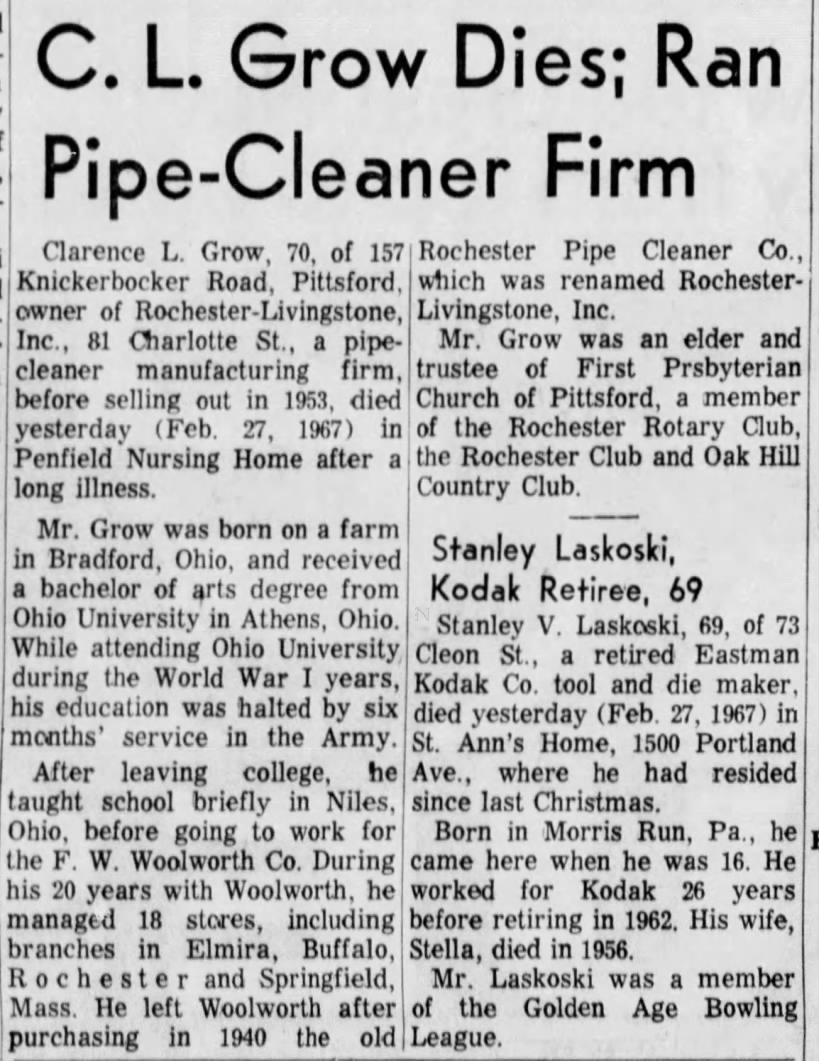
Tuesday, February 28, 1967
https://www.newspapers.com/article/democrat-and-chronicle-obituary-for-c-l/144424753/
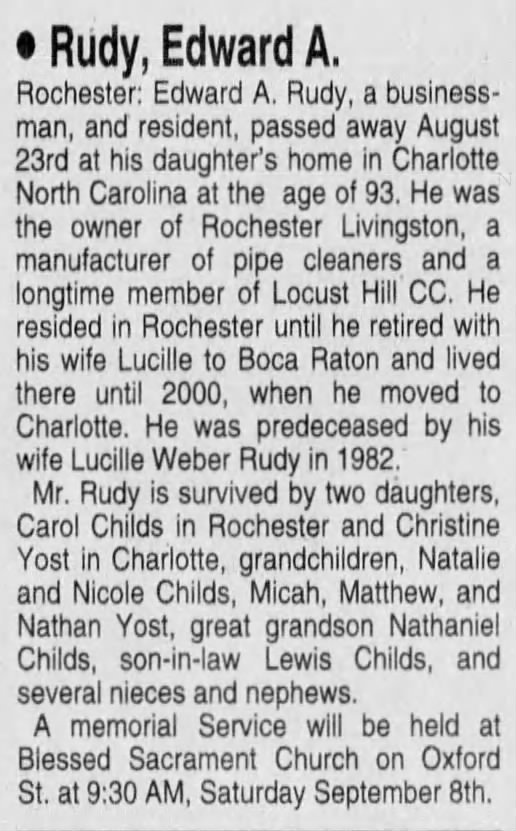
Wednesday, September 05, 2007
https://www.newspapers.com/article/democrat-and-chronicle-obituary-for-edwa/163156996/
The J. Harry Stedman Question
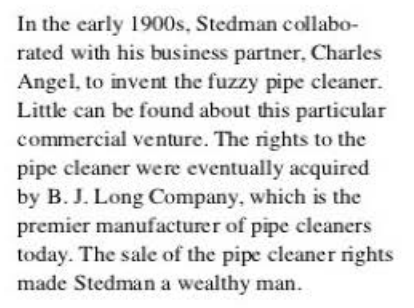
Over and over I saw attestations to the fact that John Harry Stedman collaborated with his business partner Charles Angel to patent the fuzzy pipe cleaner. However, primary sources to that effect are difficult to find. Many sources are presented for his other inventions, but the invention of the pipe cleaner is presented offhandedly, like a curiosity, without any sources.
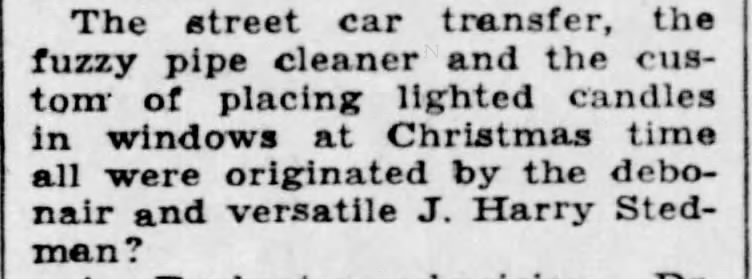
Sunday, July 28, 1946
https://www.newspapers.com/article/democrat-and-chronicle-j-harry-stedman/163112023/
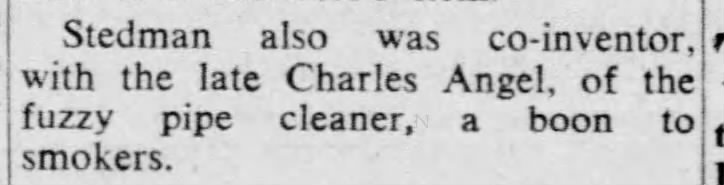
Sunday, December 25, 1949
https://www.newspapers.com/article/democrat-and-chronicle-pipe-cleaners/163113117/
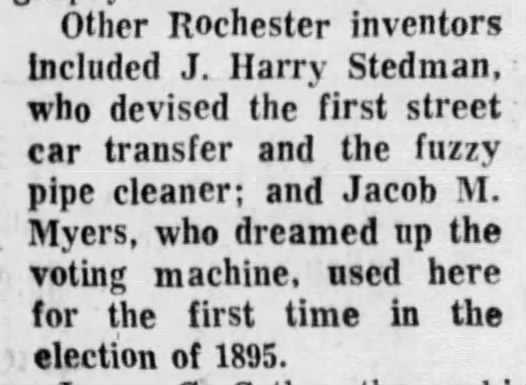
Sunday, February 12, 1967
https://www.newspapers.com/article/democrat-and-chronicle-the-fuzzy-pipe-cl/157009899/
2011 Epitaph
https://www.lib.rochester.edu/IN/RBSCP/Epitaph/ATTACHMENTS/31_3.pdf
You see the pattern. I found dozens more like this, tossing off the fact. The Wikipedia article on pipe cleaners references the RocWiki entry on John Harry Stedman, which, in turn references a broken link on a defunct version of the B. J. Long website.
At this point, I’d relish a source that truly confirmed the fact. If you happen to know of a primary document that confirms this patent or its eventual sale, please let me know!
It was Stedman’s patent that supposedly made its way to Benjamin J. Long. Again, I have my doubts; in theory, Stedman’s patent could have been the one held by Morley when he founded Rochester Pipe Cleaner Co., and it was subsequently passed on to Long.
B. J. Long Co.

1942 Directory
https://www.libraryweb.org/rochcitydir/images/1942/1942j-l.pdf
Benjamin Joel Long began in the pipe cleaner business as a partner in the Rochester Pipe Cleaner Co. In 1953, Long founded the B. J. Long Co.
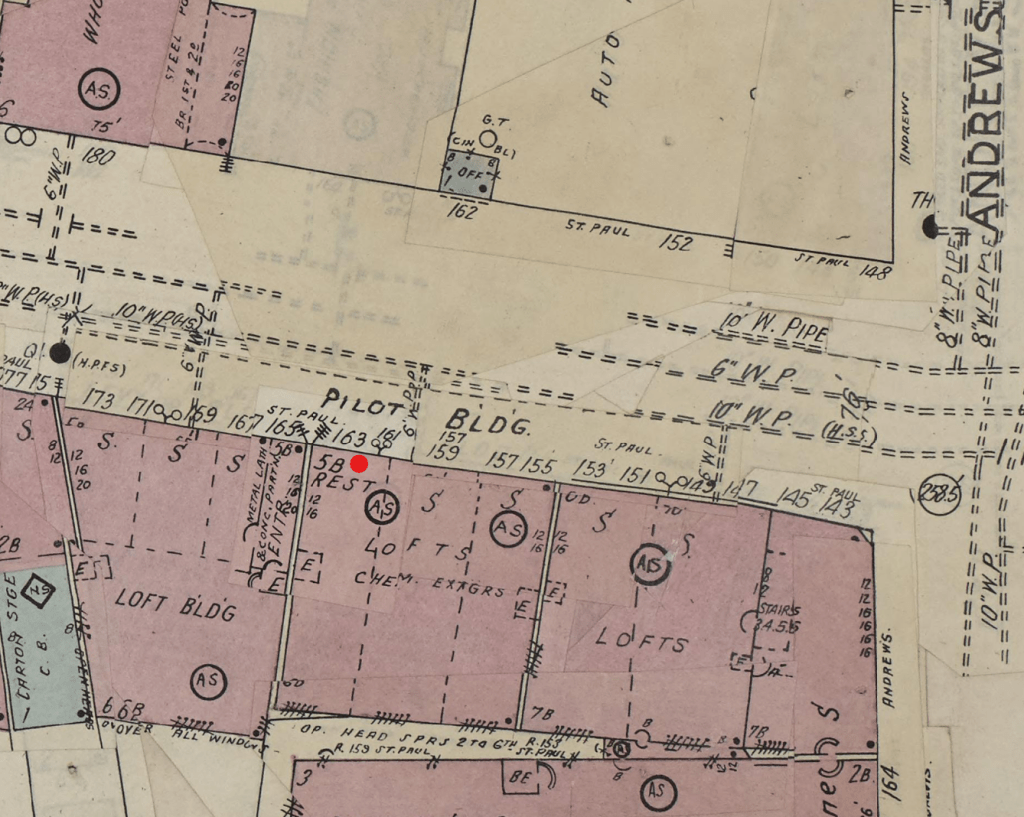
Initially, B. J. Long Co. occupied a floor in No. 163 St. Paul Street, the “Pilot Building”; at first, the fifth floor and then the fourth.
1950 Sanborn Map
Red: No. 163 St. Paul Street, location of B. J. Long Co.
https://www.loc.gov/resource/g3804rm.g3804rm_g06217195001/?sp=14&r=0.633,0.563,0.397,0.223,0

Zillow.com
Now No. 155, previously No. 163 St. Paul Street, former location of B. J. Long Co.
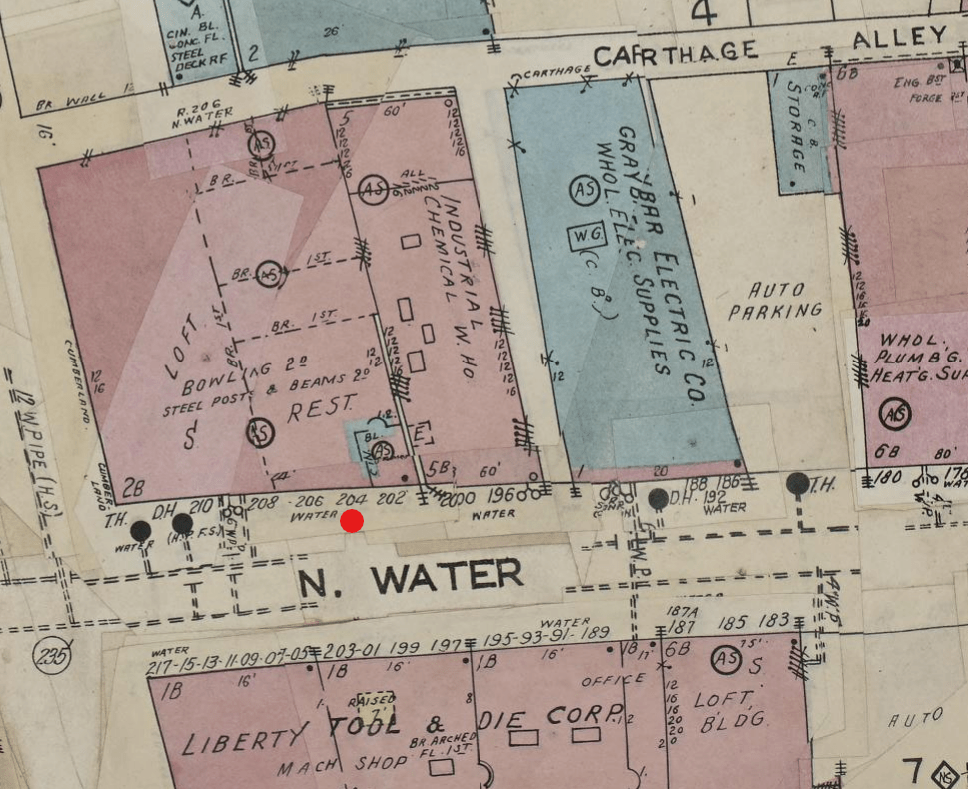
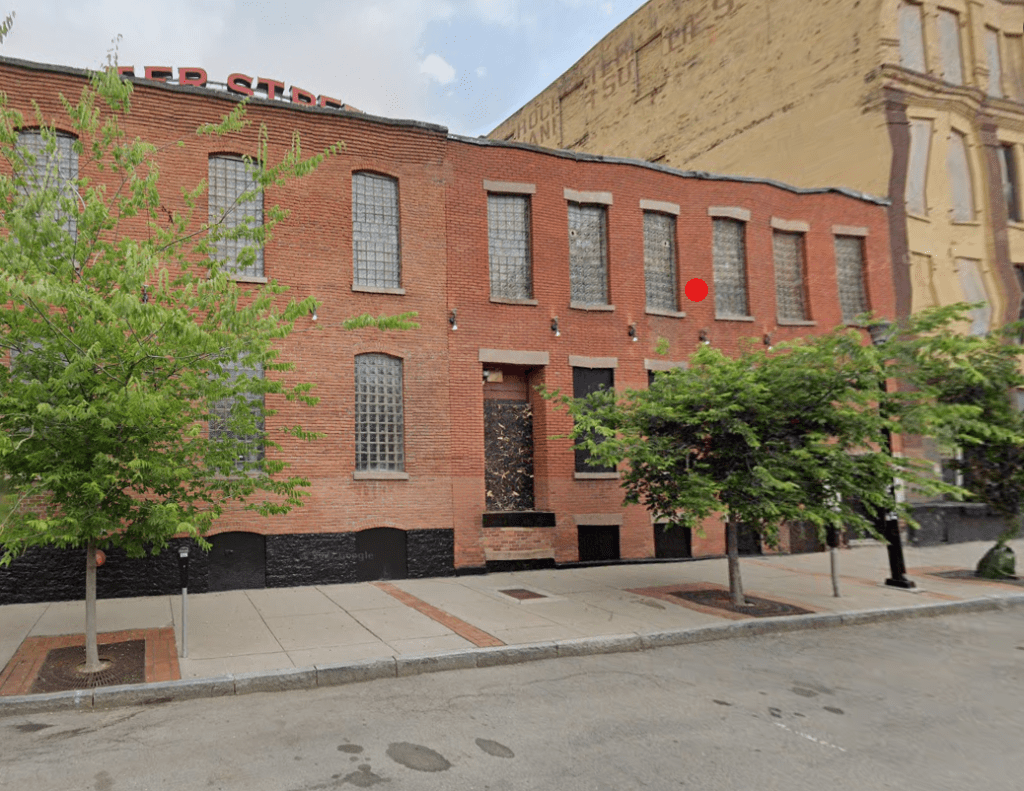
By 1977, B. J. Long Co. was at No. 204 North Water Street.
1950 Sanborn Map
No. 204 North Water Street, former site of B. J. Long. Co.
https://www.loc.gov/resource/g3804rm.g3804rm_g06217195001/?sp=14&r=0.477,0.756,0.285,0.16,0
You may be more familiar with this building as Water Street Music Hall, as I am.
Google Maps
Red: No. 204 North Water Street, first site of B. J. Long Co.
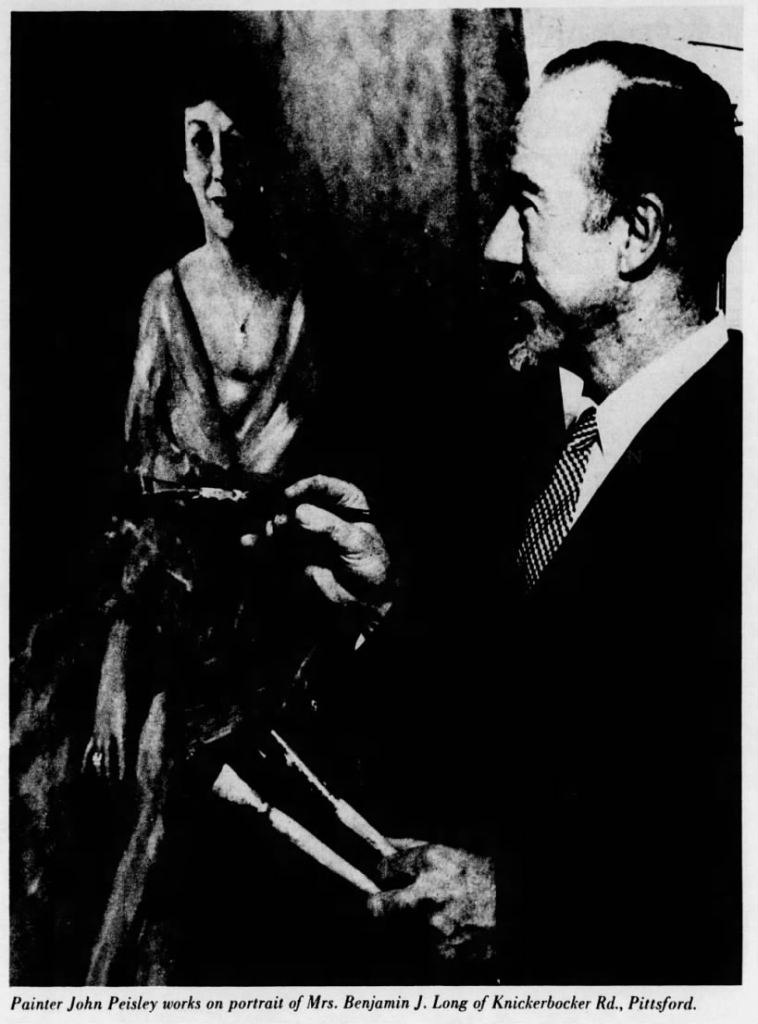
Sunday, February 09, 1969
https://www.newspapers.com/article/democrat-and-chronicle-mrs-benjamin-j/163250696/
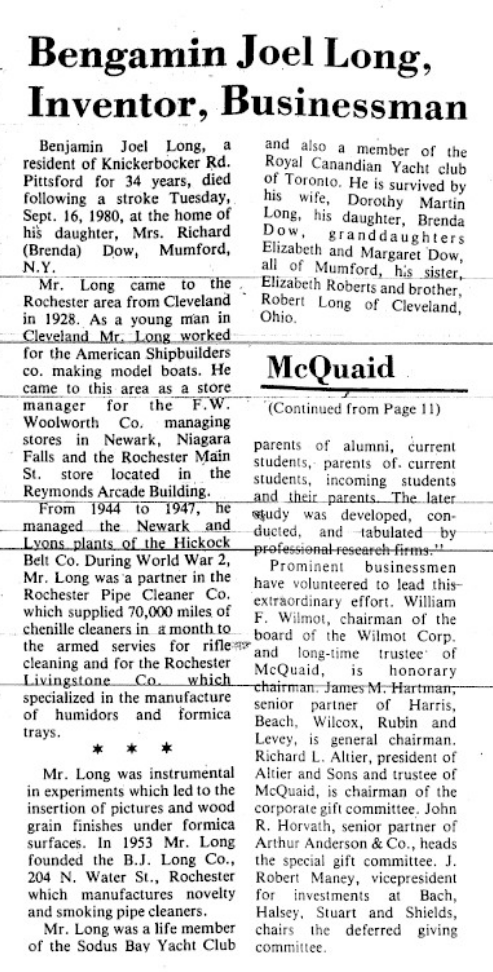
The Brighton-Pittsford Post
25 September 1980
https://nyshistoricnewspapers.org/?a=d&d=bpp19800925-01.1.21&e=——-en-20–1–txt-txIN———-
B. J. Long Co. still makes the twistable sticks of chenille wire we all know and love. I attempted to contact the company to discuss their history a bit, but nobody got back to me. It was an AOL email account, so maybe their entire computer exploded when I sent that, who knows?
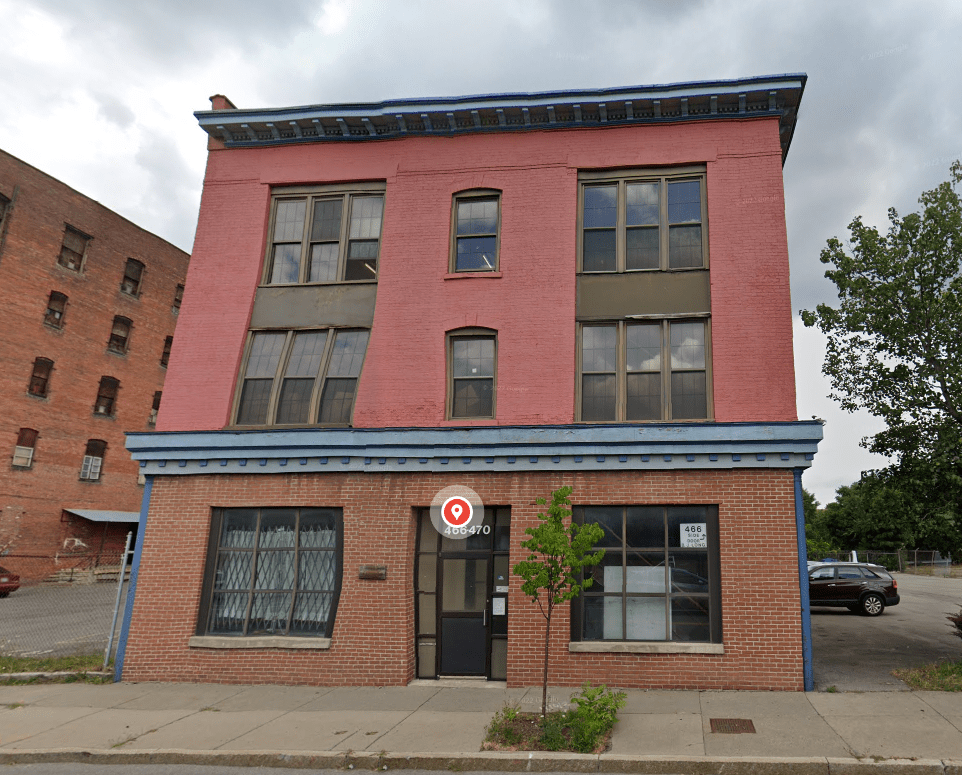
Google Maps
The B. J. Long Co., Nos. 466-470 Central Avenue.
Pipe Cleaners Galore
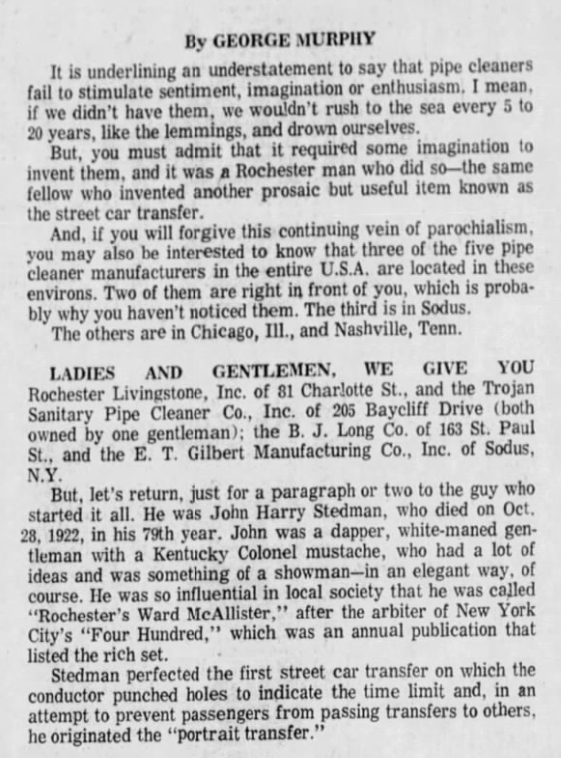
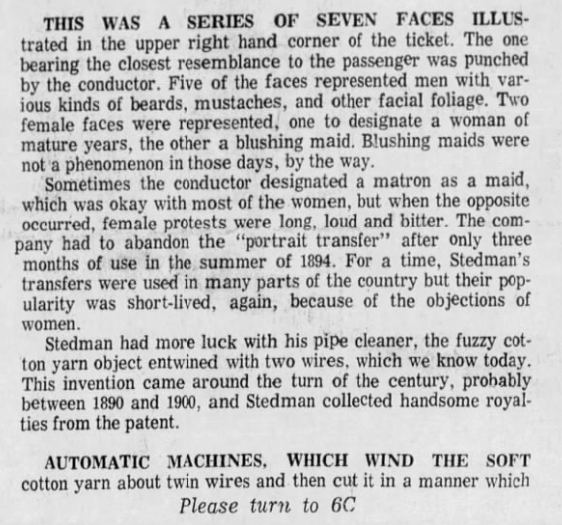
A 1972 article probed into these productive pipe cleaner plants. After again giving the usual account of J. Harry Stedman’s invention, the article visits Rochester Livingstone, Inc., B. J. Long Co., and E. T. Gilbert Manufacturing Co., Inc.
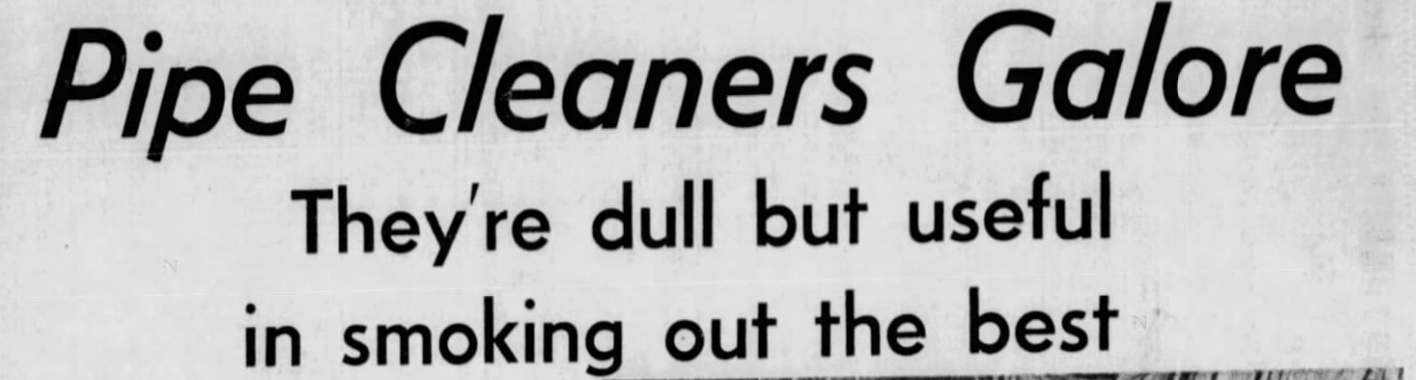
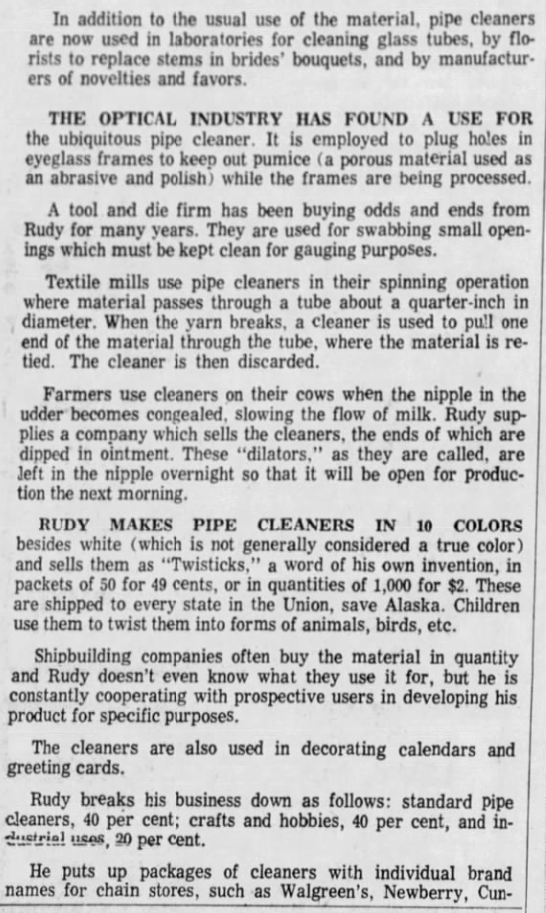
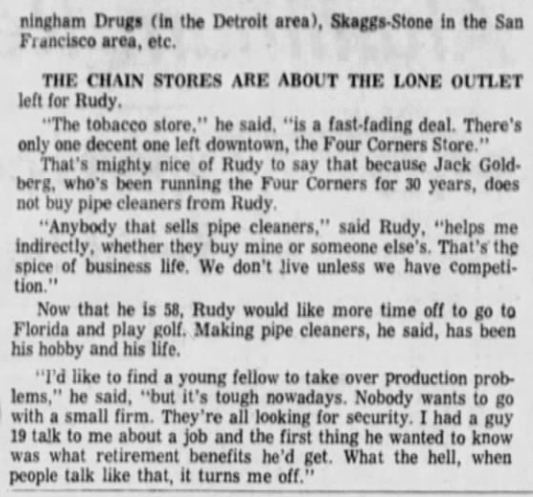
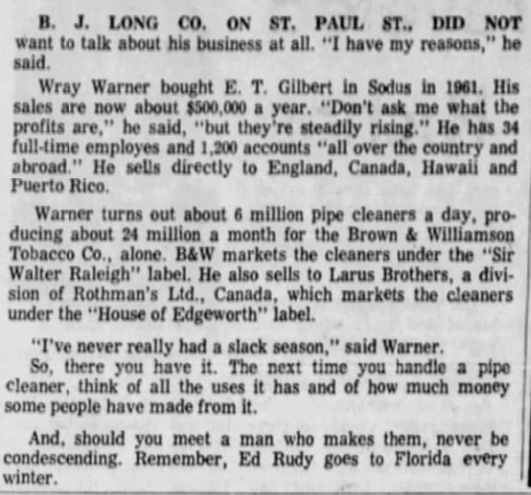
Sunday, November 19, 1972
https://www.newspapers.com/article/democrat-and-chronicle-pipe-cleaners-gal/144425441/
That sums things up nicely, in my opinion.
I’d been intrigued at the outset of this essay by the story of J. Harry Stedman and Charles Angel and their invention; I had hoped to dig into it a bit more. The lack of evidence is a bit staggering to me; for such an oft-repeated fact, I’d have thought there would be a wealth of sources.
However–given what I’ve uncovered in my research–I personally believe Mr. Frederick A. Frick gets the honors. I find it particularly compelling that a through-line can be drawn from Frick to the E. T. Gilbert Manufacturing Co.
Though a lot of Rochester’s pipe cleaner past is entirely gone, a fraction does continue into the present day. The fibrous wires run through the veins of our city as surely as flour or flowers or film. So next time you’re making, I don’t know, turtles or spiders or dragons or whatever out of pipe cleaners, take a moment to think about the people and the places involved in their long history.
Supporting Gonechester
Did you enjoy what you read? Consider giving me a little tip at buymeacoffee.com/Gonechester, by way of saying “thanks!” It’s not necessary, but it certainly helps!
Want to publish a guest post?
Subscribe to Our Monthly Update
Enjoy our once-monthly newsletter highlighting our efforts to beautify downtown Rochester
Want to be a ROCstar?
Please consider supporting the work of Downtown ROCs with a tax-deductible gift. Every dollar directly funds awesome projects that beautify & energize our city.
Thank you for your support! 🙏🏼