The Old Liberty Pole
- Geoffrey Zeiner
Reposted with permission from the Gonechester blog
Few sights are more familiar to the Rochesterian than the Liberty Pole. A central spot of celebration and of protest, people have loved and hated this iconic structure since it was erected in 1965. However, this famous Liberty Pole was not the first liberty pole to stand on this spot. Apparently it’s the third, albeit the longest-lived by far.
Two liberty poles of wood were raised and came down during the course of the 19th century. The first, a 118-foot pole topped with a gilded ball, was erected in July of 1846, and stood until it was removed for safety purposes after an 1859 storm. (Although accounts differ, of course.)
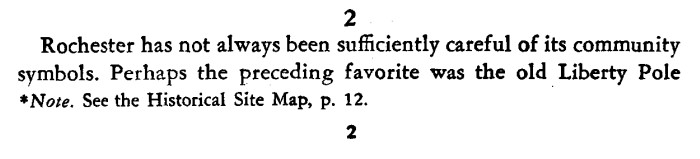
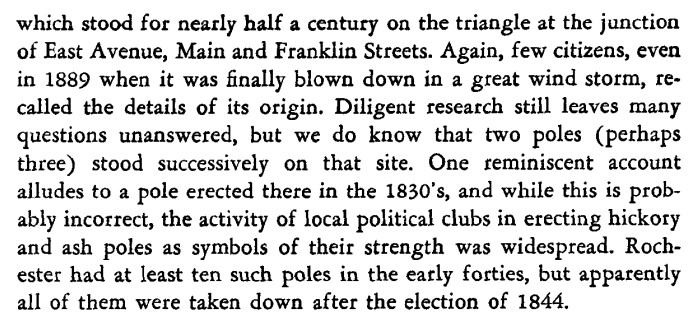
[https://www.libraryweb.org/~rochhist/v12_1950/v12i2-3.pdf] (pp. 2-3)
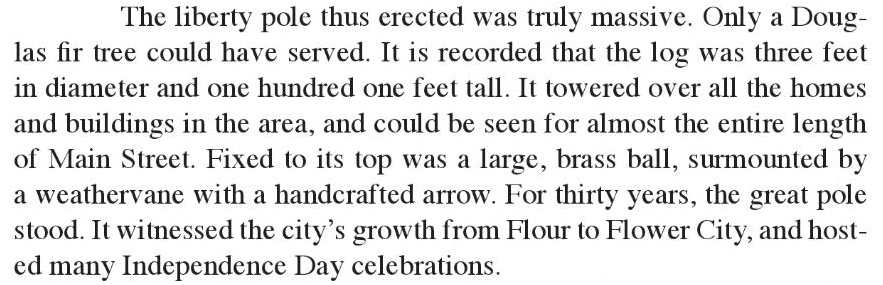
[https://www.google.com/books/edition/A_Rochester_Ramble/z8sfRFPeeyUC?hl=en&gbpv=0] (p. 86)
The second pole, 120 feet tall, was erected on either April 20th, 1861 [Shilling] or July 3rd, 1859 [D&C]. July 3rd, as the Democrat & Chronicle claims, makes more sense to me but I’m a mere amateur historian, my opinion holds little weight here.
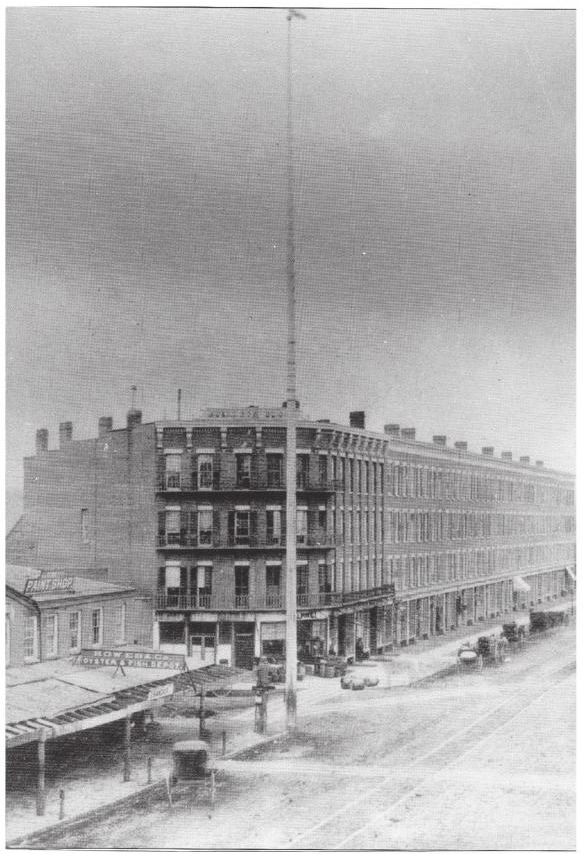
[https://www.google.com/books/edition/A_Rochester_Ramble/z8sfRFPeeyUC?hl=en&gbpv=0] (p. 86)
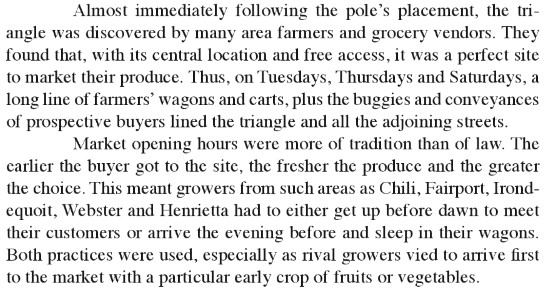
At left: The Old Liberty Pole, standing at the southeast corner of the Triangle Block. The raising of this pole made the block an easy point of reference from a distance, being visible for most of the length of Main Street. This visibility and the multiple cross-roads made the Triangle Block an attractive place for produce farmers to set up an impromptu public market, which would continue even after the creation of the official Public Market in 1905.
[https://www.google.com/books/edition/A_Rochester_Ramble/z8sfRFPeeyUC?hl=en&gbpv=0] (p.87)
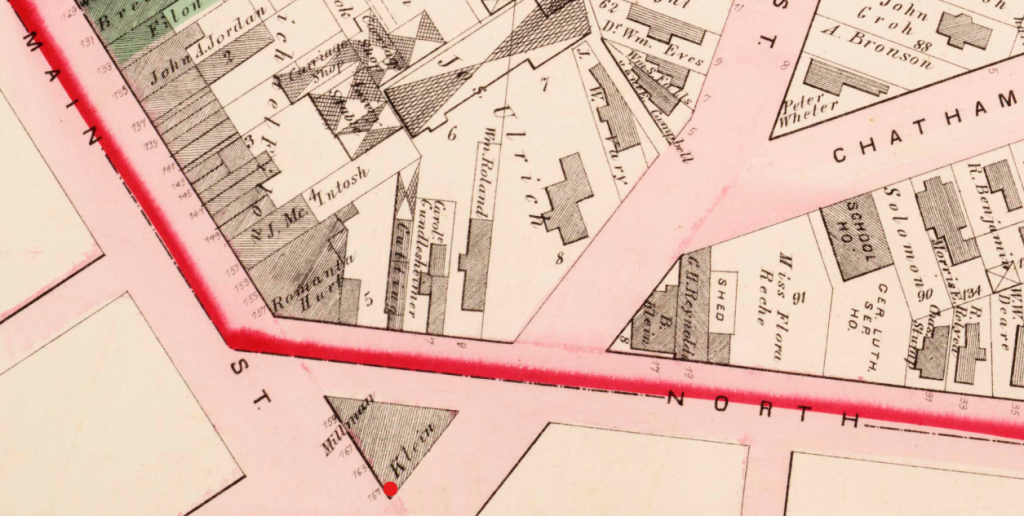
1875 Atlas
The location of the Old Liberty Pole in 1875, at the corner of East Main Street, North Avenue, and Franklin Street, on the Triangle Block.
[https://catalogplus.libraryweb.org/?section=resource&resourceid=1116154430]
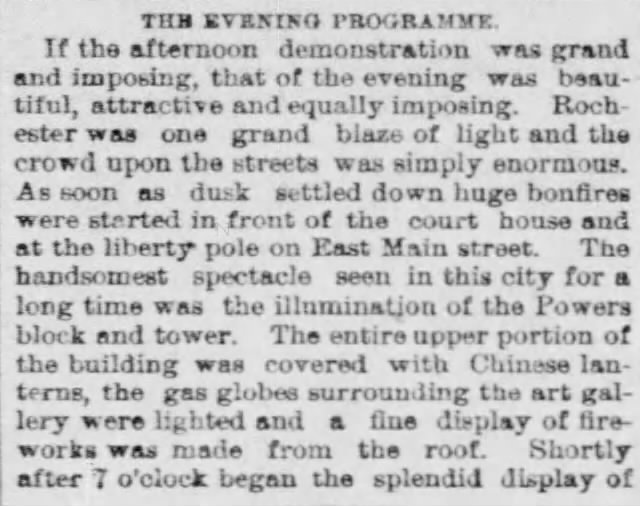
31 Oct 1876, Tue
[https://www.newspapers.com/clip/116792148/bonfire-at-liberty-pole/]
Above: An account of Halloween spectacles in 1876, including a bonfire[!] in front of the Liberty Pole. The Liberty Pole served as a place to convene for numerous public events due to its central location, its visible landmark, its numerous cross-streets, and vistas of several major buildings and public structures including the impressive Powers Building across the river.
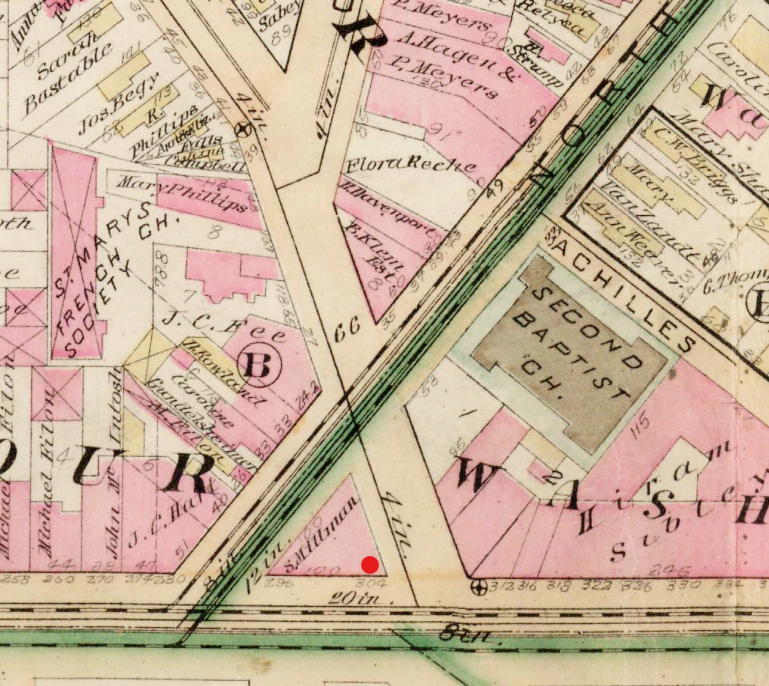
1888 Plat Map
The location of the Old Liberty Pole and Triangle Block approximately a year before the Old Liberty Pole toppled.
[https://catalogplus.libraryweb.org/?section=resource&resourceid=1116154430]
The Toppling of the Old Liberty Pole
On December 26th, 1889, unusually strong winds accompanied a winter storm, and the Liberty Pole–already prone to unstable motion–began to waggle more perilously than ever before. Firemen from the Stillson Street firehouse were on the scene, attempting to secure the swaying structure with guy lines–to no avail. Midway through their attempts the pole came crashing to the cobblestones, bringing with it dozens of power lines and narrowly avoiding a carriage bearing Alexander Lindsay of the Sibley, Lindsay & Curr Company [better known as Sibley’s department store].
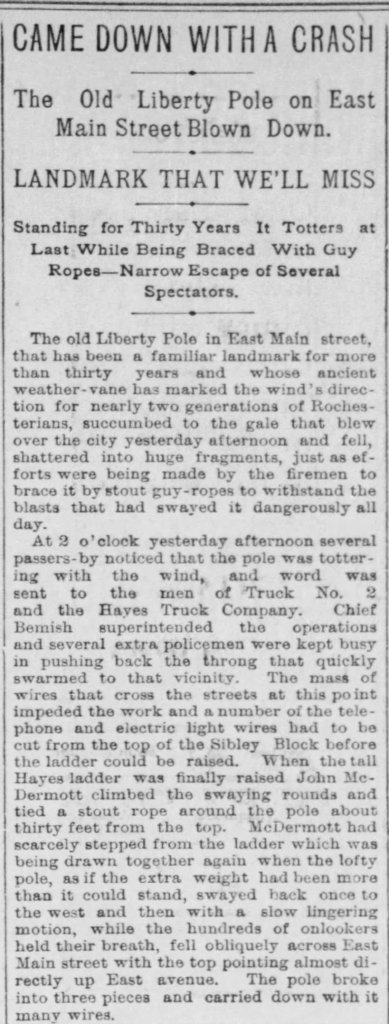
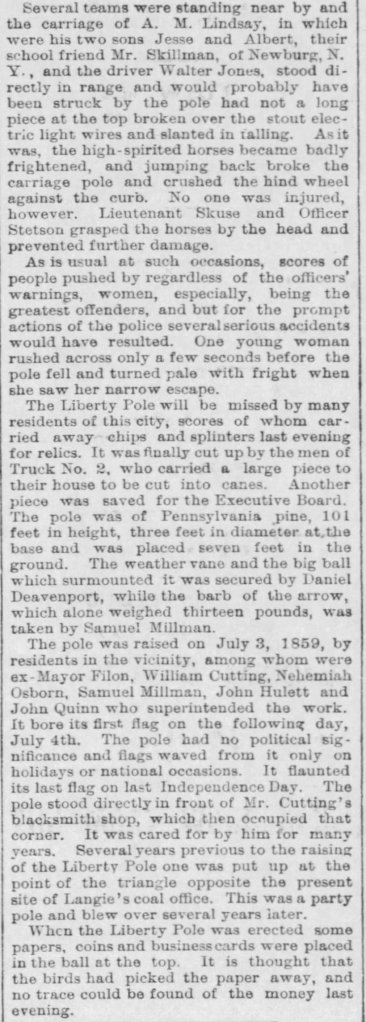
27 Dec 1889, Fri
[https://www.newspapers.com/clip/9426470/liberty-pole-blown-down-dec-1889/]
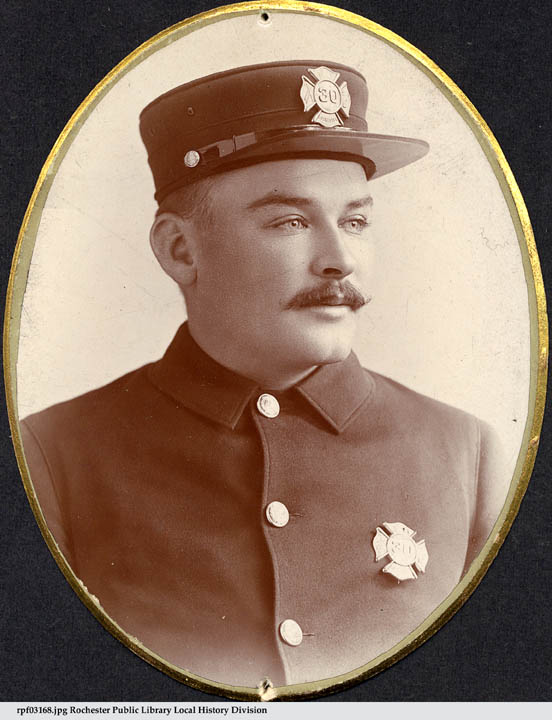
Fire Chief George Bemish, was in charge of the failed operation to reinforce the Liberty Pole.
[https://catalogplus.libraryweb.org/?section=resource&resourceid=1116965335]
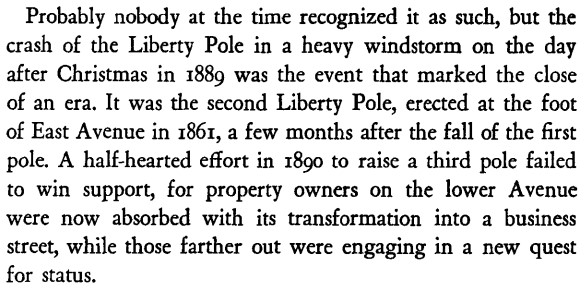
[https://libraryweb.org/~rochhist/v28_1966/v28i2-3.pdf] (p. 2)
A Replacement Pole?
It didn’t take long for people to start proposing a replacement for the iconic pole. People were throwing all sorts of ideas out there, from such simple concepts as a steel pole with a possible electric lamp, to ludicrous things like detachable arc lamps, sculptures holding out glowing lanterns, and distastefully massive flags.
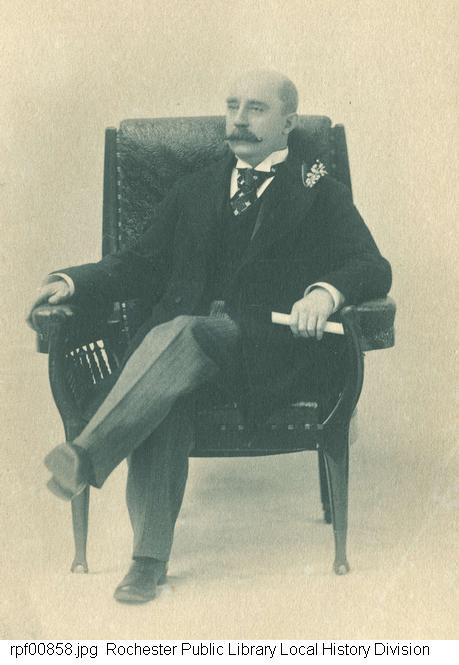
Mayor Cornelius Parsons, proposed a replacement pole.
[https://en.wikipedia.org/wiki/Cornelius_R._Parsons]
[https://catalogplus.libraryweb.org/?section=resource&resourceid=1115973056]
At this point in time there were reportedly a number of other liberty poles; it was a common enough expression of civic or patriotic fervor for organizations to raise them up. There were many of them on unstable foundations, like the one mentioned at the corner of West Main and Fitzhugh streets in the article at right.
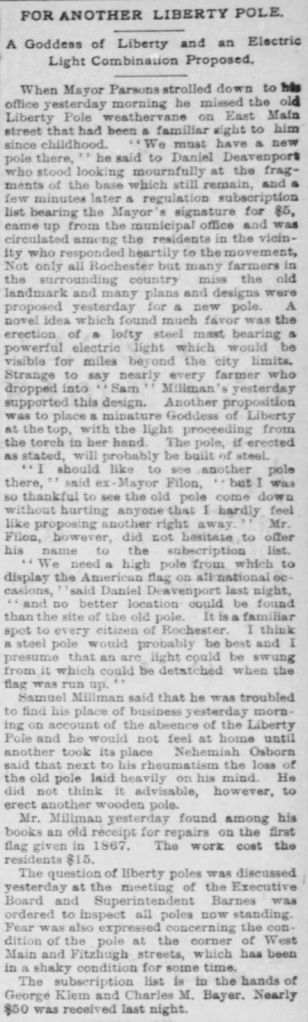
28 Dec 1889, Sat
[https://www.newspapers.com/clip/116703356/proposal-for-new-pole/]
Mementos from the Mayhem
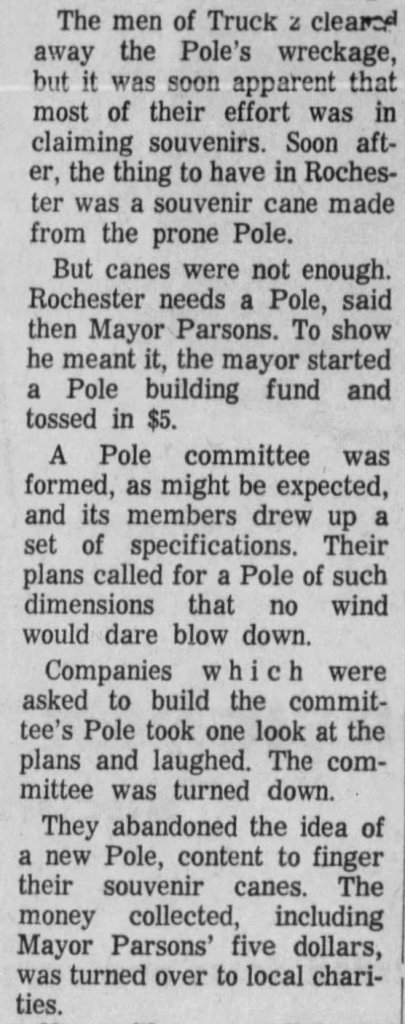
26 Dec 1965, Sun
[https://www.newspapers.com/clip/116718346/new-pole-canes/]
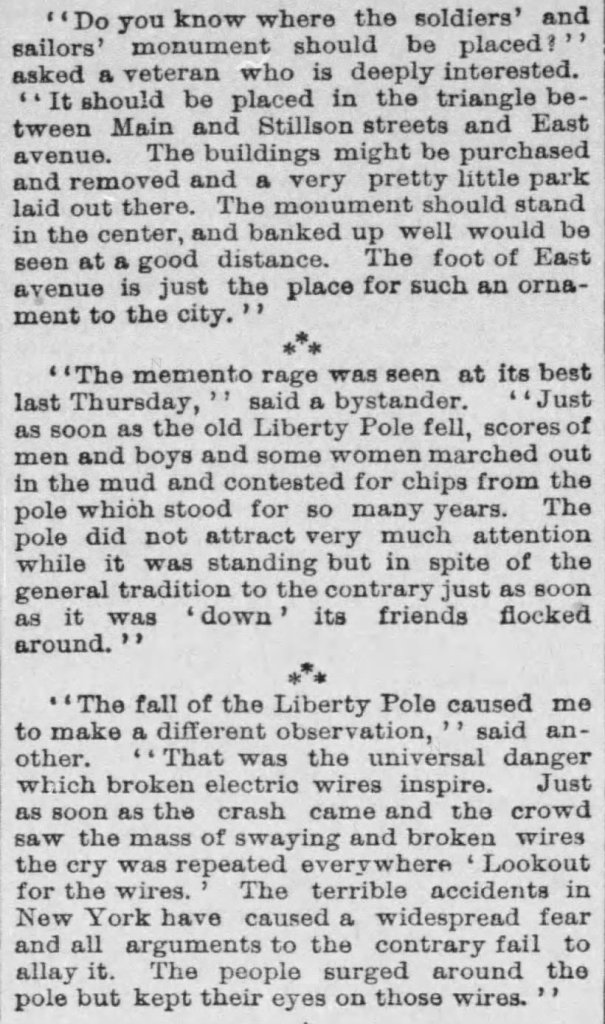
30 Dec 1889, Mon
[https://www.newspapers.com/clip/116712826/observations-on-pole-falling/]
The above left article contained the first of multiple mentions I encountered of souvenir canes having been made from the large splinters of the fallen pole. These mementos were known as “Liberty Canes” and became very fashionable for the movers and shakers of the city for a spell. Thought entirely lost, one example of these canes turned up forty years later, in 1930:
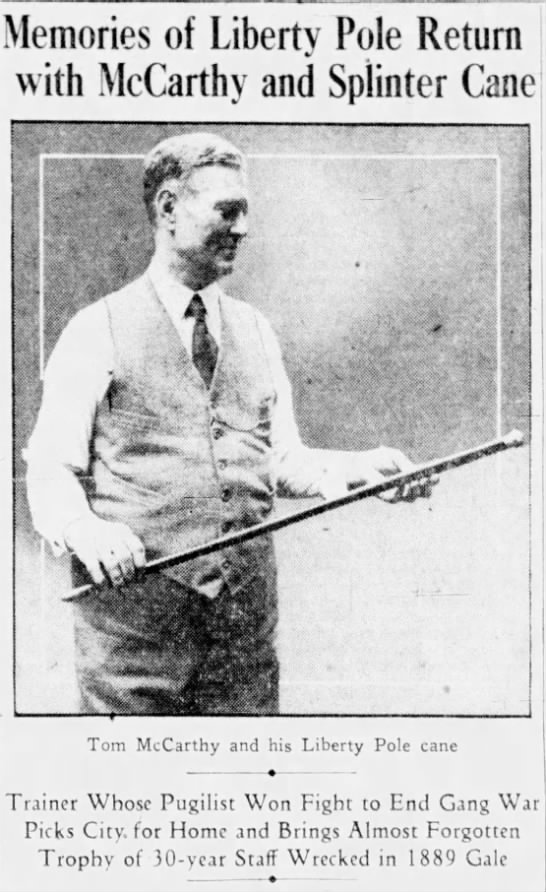
06 Jul 1930, Sun
[https://www.newspapers.com/clip/116806070/tom-mccarthy-liberty-pole-cane/]
Boxing trainer Tom McCarthy found himself in possession of one of the Liberty Canes, the only one yet known to exist by that point. The above article tells the unusual tale of how he came to have it, which I’ve typed out since the text is a bit faded:
“Splinters Made Into Canes – From the splinters a limited number of canes were fashioned, known as Liberty Canes. Until the re-appearance of Mr. McCarthy in Rochester a few years ago, it was believed all the canes had vanished. Mr. McCarthy’s part in the story came years after the destruction of the Liberty Pole. During the last years of the Nineteenth and the first years of the Twentieth Century, Rochester witnessed a feud rivaling in greatness, if not in viciousness, the historic feuds of old Kentucky. The participants were a downtown gang led by William E. Spillings, former fireman and policeman, and the Lyell Avenue gang.
William F. McQuire[sic], who later was destined to become a Rochester detective and to run for sheriff, was a strong adherent of the Spillings gang. Feeling between the two factions was climaxed when some member suggested that each gang chose a fighter who should meet in the prize ring at an assigned time.
A small village in Monroe County contributed a likely lad to uphold the honor of the Spilling’s-McGuire faction, but to assure victory McGuire cast about to obtain a trainer for the youth. Mr. McCarthy then was an “up and coming” young fighter in Boston. As a matter of fact, the science known in prize fight circles as “blocking” has been attributed jointly to Mr. McCarthy and McFadden, the fighter. McGuire heard of Mr. McCarthy and made a successful bid for his services.
Awarded Cane for Victory – Mr. McCarthy trained his man, who won the fight and the $1,000 wager for the Spilling’s-McGuire faction. Mr. McGuire, pleased beyond bounds, presented Mr. McCarthy with the Liberty Cane which had been given McGuire by Truck 2 in Stillson Street.”
Democrat and Chronicle
Rochester, New York • Sun, Jul 6, 1930 Page 13
Ball Contents Recovered
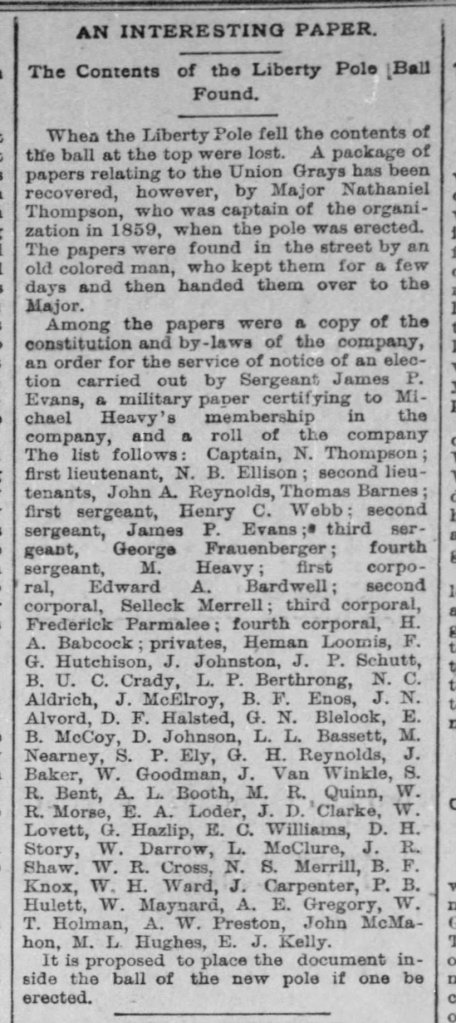
01 Jan 1890, Wed
[https://www.newspapers.com/clip/111434159/liberty-pole-ball-contents-roster-of-un/]
Left: Also thought lost were all the contents of the ball atop the pole, which had held a number of curios and documents ensconced within from the time of the pole’s erection.
The Rochester Union Grays were organized on November 19, 1838 as an independent military company. Its first captain was Lansing B. Swan. Although they did not enter any military conflict as a unit, they became a noteworthy social organization in Rochester, sponsoring balls and social events.
[https://www.google.com/books/edition/Semi_centennial_History_of_the_City_of_R/6tUwAQAAMAAJ?hl=en&gbpv=0] (pp.432-433)
A later article claims the metal ball was recovered and–as of 1940–was in The Rochester Historical Museum, 100 Lake Avenue. The Rochester Historical Society only used said building as a museum space for three years.
A Segment Re-Erected
Right: A section of the fallen pole would be re-erected by Thirteenth Ward grocer William Erler on January 1st, 1890, at a corner adjacent to his store at 111 Hudson Street.
The inclusion of the office clock from the Steam Gauge and Lantern Works in the pole-raising was in honor of the victims of a horrific industrial fire a little over a year before:
“The Steam Gauge and Lantern Works Fire occurred on November 9th, 1888 when a horrific fire ripped through the Steam Gauge and Lantern Works in the High Falls area of Rochester. The fire claimed 35 lives. Of the 35 killed, 6 were burnt beyond recognition. These six were buried in Mt. Hope Cemetery. A monument remembering their lives and the lives of all 35 men lost that night serves as their grave marker.”
Somewhat bizarrely, William Erler would die a little more than two weeks after this pole-raising ceremony:
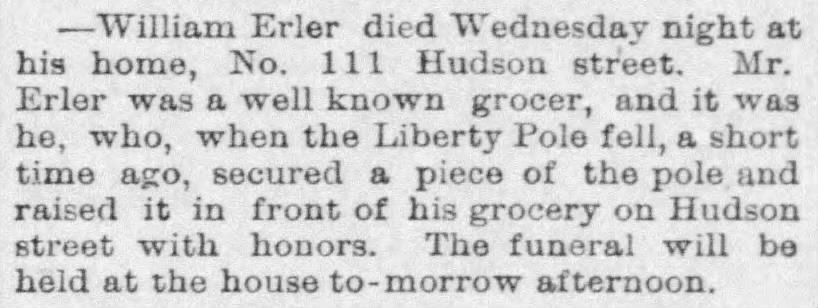
Fri, Jan 17, 1890
[https://www.newspapers.com/clip/116712199/william-erler-dies/]
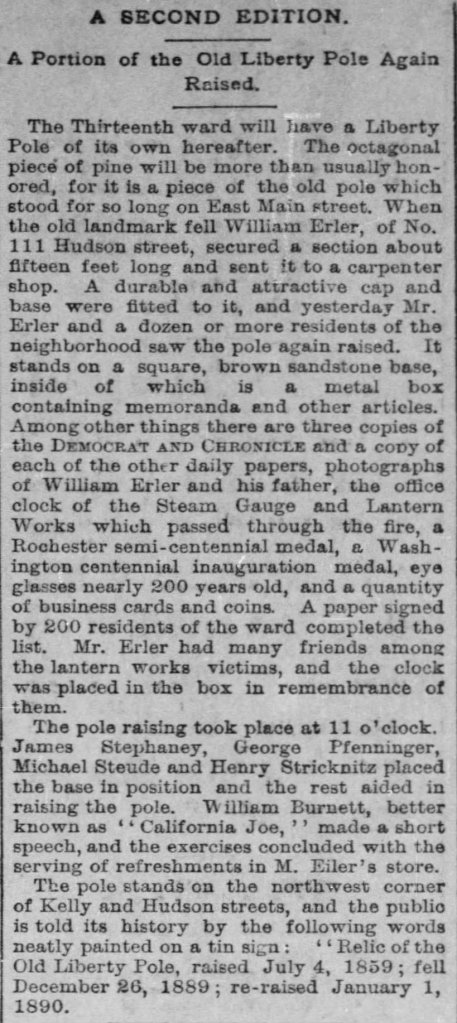
02 Jan 1890, Thu
[https://www.newspapers.com/clip/116696310/re-raising-a-section-of-liberty-pole/]
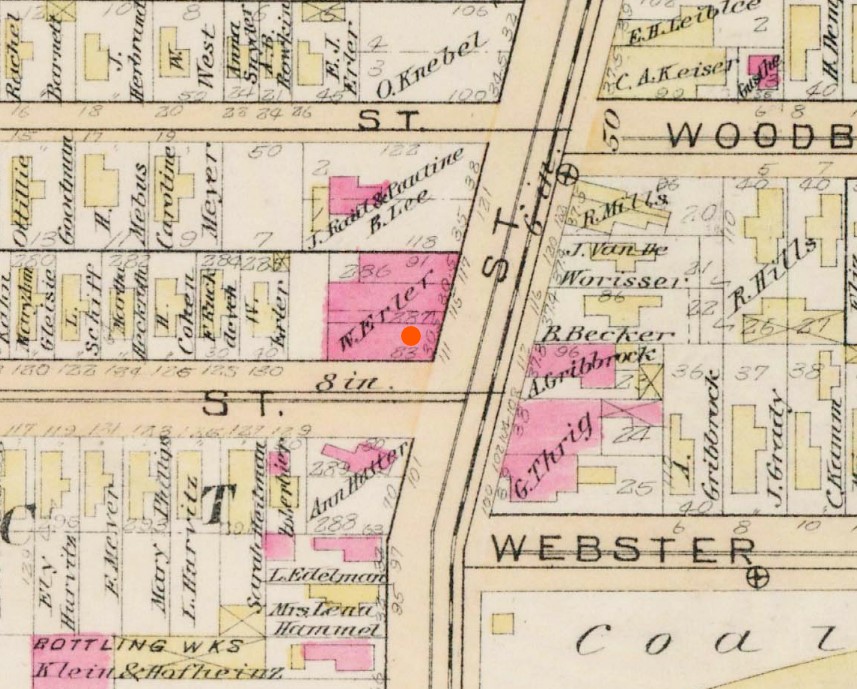
1888 Plat
Northwest corner of Kelly St. (east-west) and Hudson St. (north-south)
Location of William Erler’s store and the re-raised Liberty Pole section,
[http://photo.libraryweb.org/rochimag/rpm/rpm00/rpm00256.jpg]
Triangle Block, Post-Pole
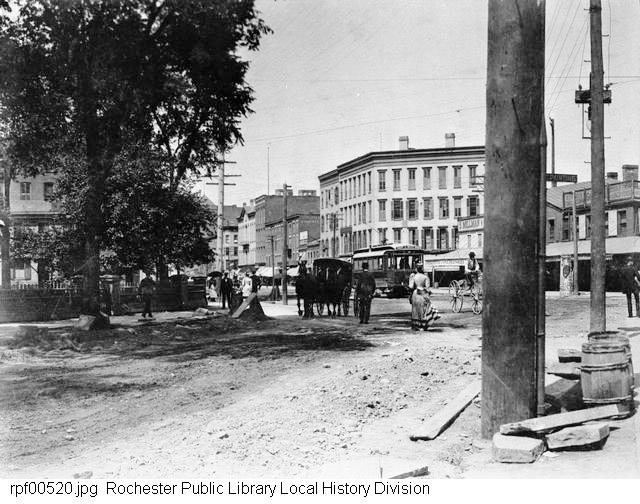
1890’s
View from East Avenue onto East Main Street, looking west.
[https://catalogplus.libraryweb.org/?section=resource&resourceid=1115947222]
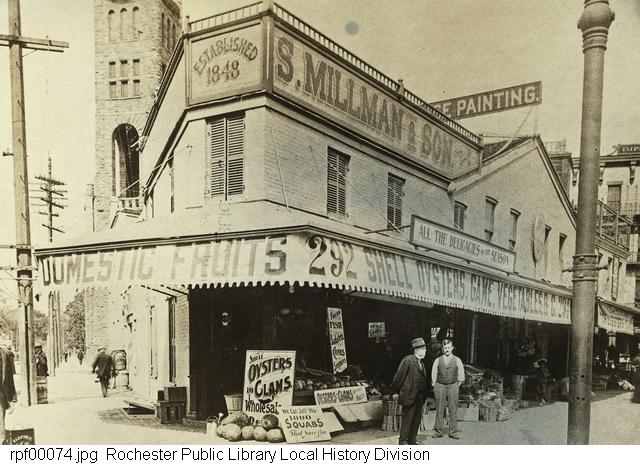
c.1892-1895
[https://catalogplus.libraryweb.org/?section=resource&resourceid=1115918096]
A photograph of the Triangle Block, after the Old Liberty Pole was long gone. The steadfast market of the Millmans stood still, bereft its iconic landmark.
“The S. Millman & Son grocery store at 292 East Main Street, corner of North Street. S. Millman is in a suit and hat on the sidewalk. He is talking to Scully (Andrew?) Young, a clerk at the same address. The man walking down the left sidewalk is Mr. (Theodore?) Kenning, a grocer. Many store signs are visible. All the Delicacies of the Season sign is above the awning which lists domestic fruits, shell oysters, game, vegetables …. The tower in the left is from the Second Baptist Church at North and Franklin.”
rpf00074.jpg Rochester Public Library Local History Division
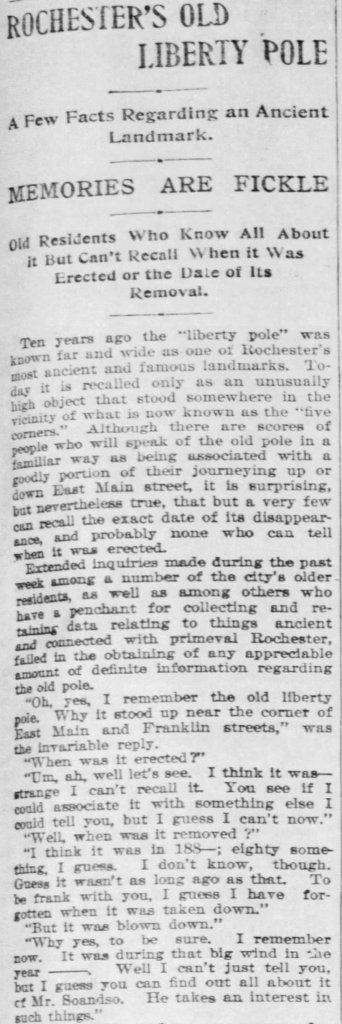
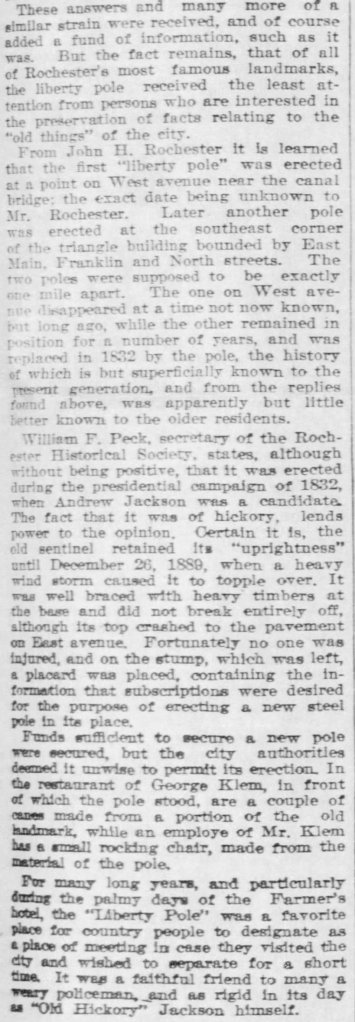
19 Mar 1898, Sat
[https://www.newspapers.com/clip/116695961/memories-of-liberty-pole/]
Querying the older citizens of Rochester in 1898 regarding the pole, the Democrat and Chronicle received various and vague answers. Allusions were made to a second pole a mile’s distance from the Franklin and East Main site, on West Avenue near the bridge over the Erie Canal–since lost. The remaining pole at the triangle was supposedly replaced in 1832 with the predecessor to the Old Liberty Pole, or perhaps even a generation prior: the grandaddy of the Old Liberty Pole. How many poles actually had been erected on this site!? Records pin down only three for certain, but perhaps further ancestors of the pole rose and fell in the shadows of early Rochester history.
Mention is made again of the canes made from Liberty Pole wood, belonging to George Klem, as well as a small rocking chair owned by one of Klem’s restaurant employees.
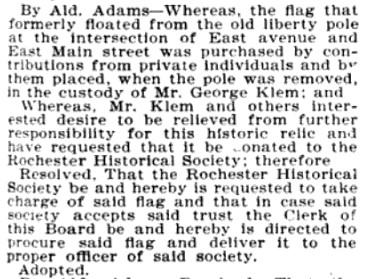
Left: The flag which formerly flew from the Old Liberty Pole was in the custody of George Klem for nearly a decade before being transferred into the care of the Rochester Historical Society in 1898.
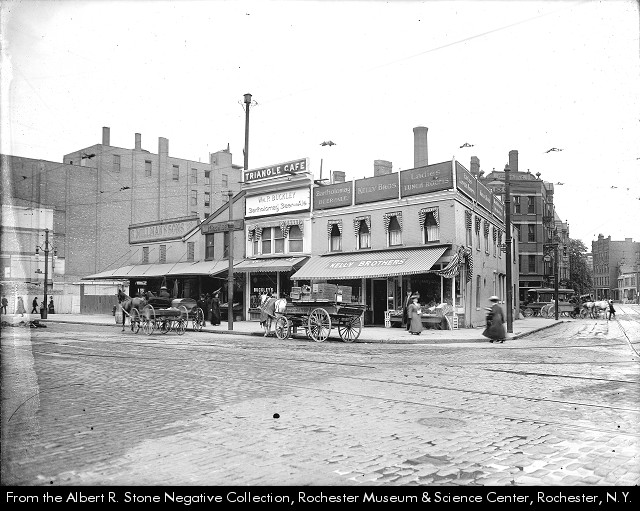
c.1911
[https://catalogplus.libraryweb.org/?section=resource&resourceid=1116533937]
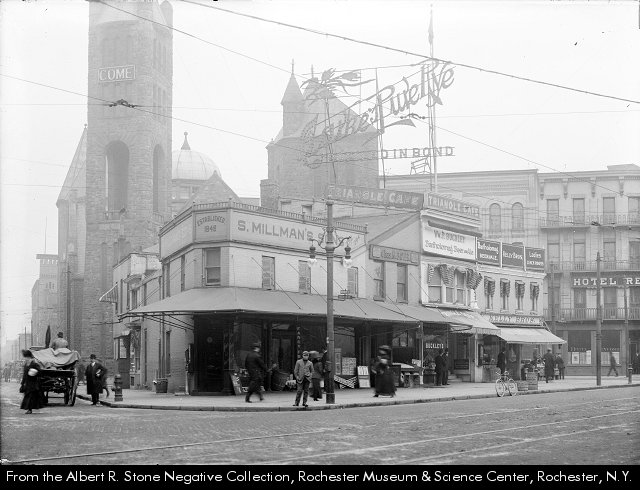
c.1911
[https://catalogplus.libraryweb.org/?section=resource&resourceid=1116157133]
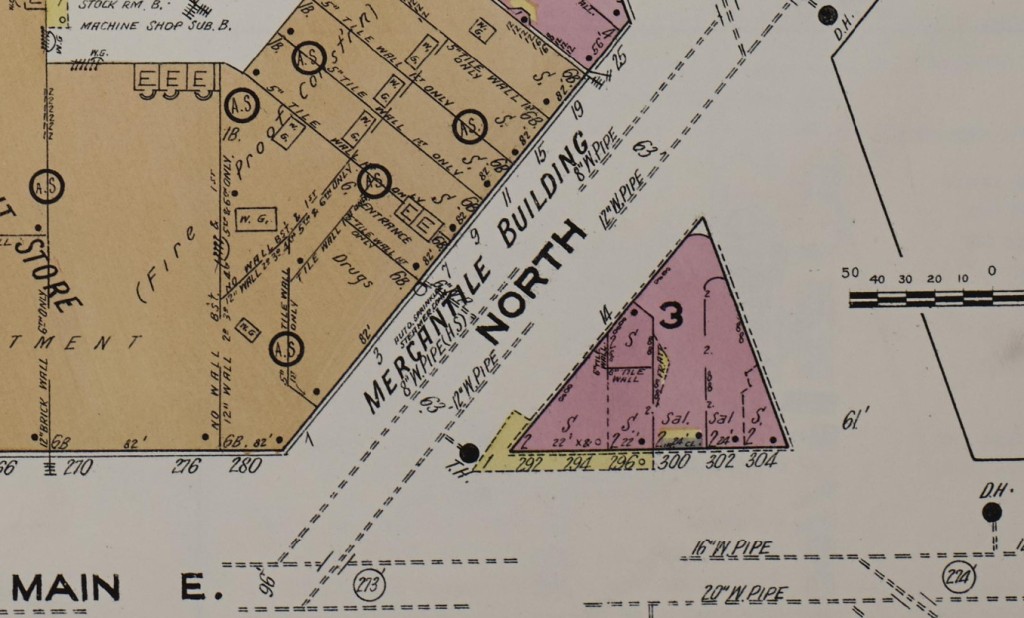
1911 Sanborn Map
[https://www.loc.gov/resource/g3804rm.g3804rm_g06217191102/?sp=2&r=0.536,0.913,0.318,0.195,0]
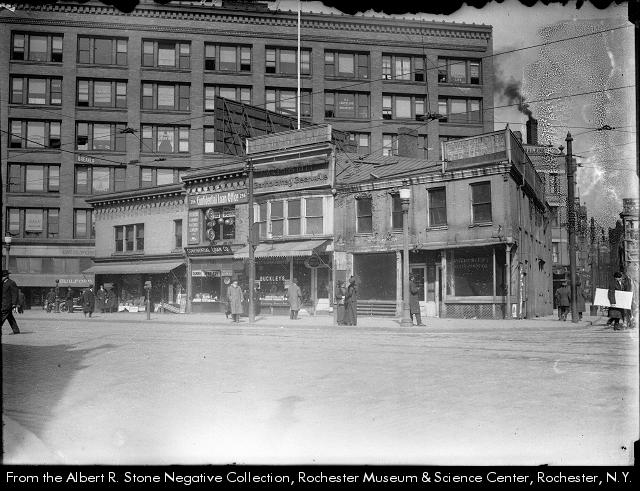
c.1914
[https://catalogplus.libraryweb.org/?section=resource&resourceid=1116149381]
An image of the Triangle Block in 1914, looking northwest. The large building in the background is the newly-constructed Sibley’s Mercantile Building.
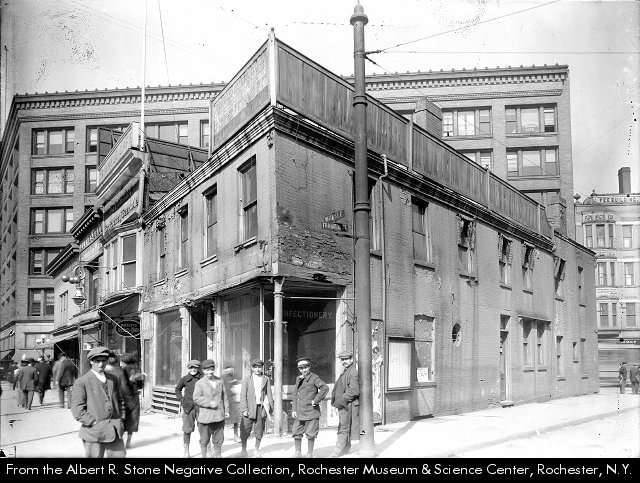
c.1914
[https://catalogplus.libraryweb.org/?section=resource&resourceid=1116516281]
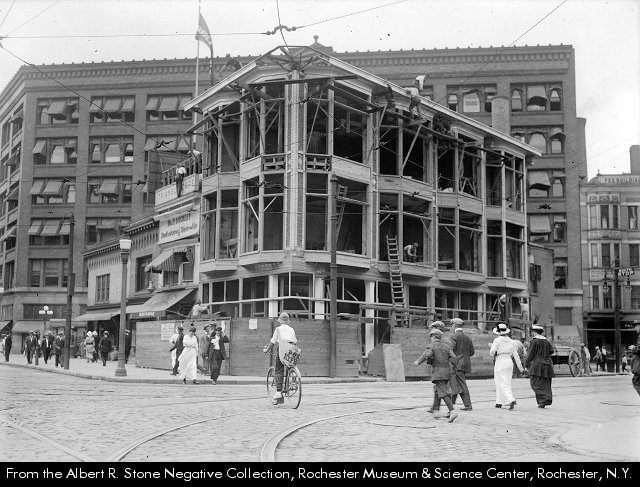
New construction on the Triangle Block, c.1914
[https://catalogplus.libraryweb.org/?section=resource&resourceid=1116565911]
Geodetic Survey Marker
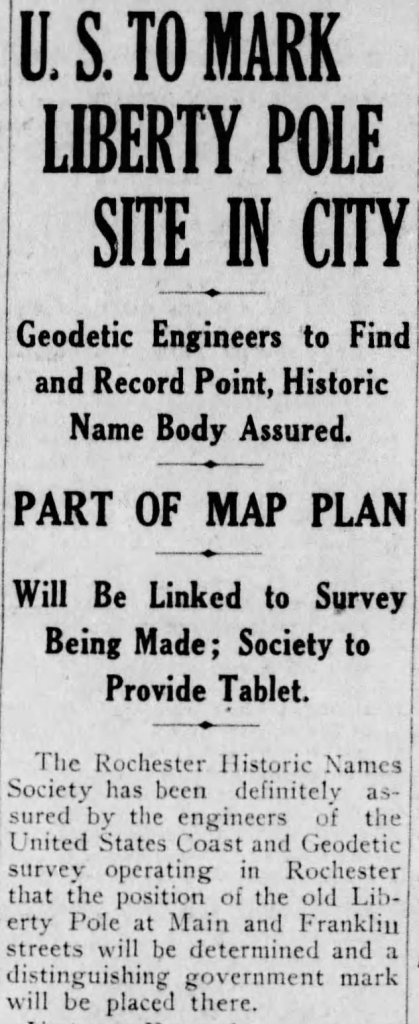
13 Apr 1925, Mon
[https://www.newspapers.com/clip/116728996/us-to-mark-liberty-pole/]
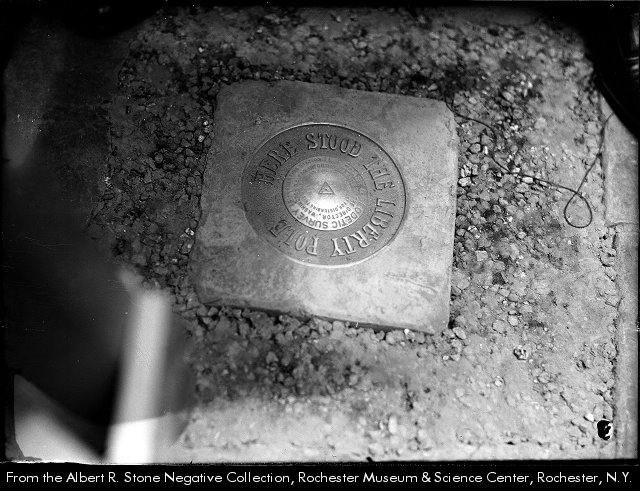
The Geodetic Survey marker at the site of the former Old Liberty Pole.
[https://catalogplus.libraryweb.org/?section=resource&resourceid=1116632390]
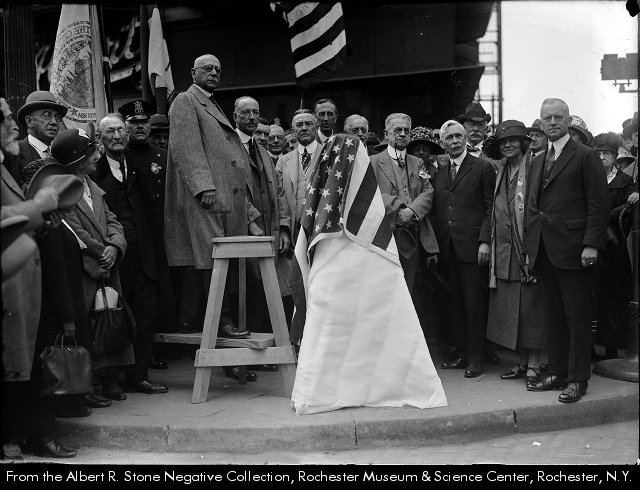
Mayor Clarence D. Van Zandt stands ready to unveil the new pavement marker upon the spot the Old Liberty Pole once stood.
[https://catalogplus.libraryweb.org/?section=resource&resourceid=1116632332]
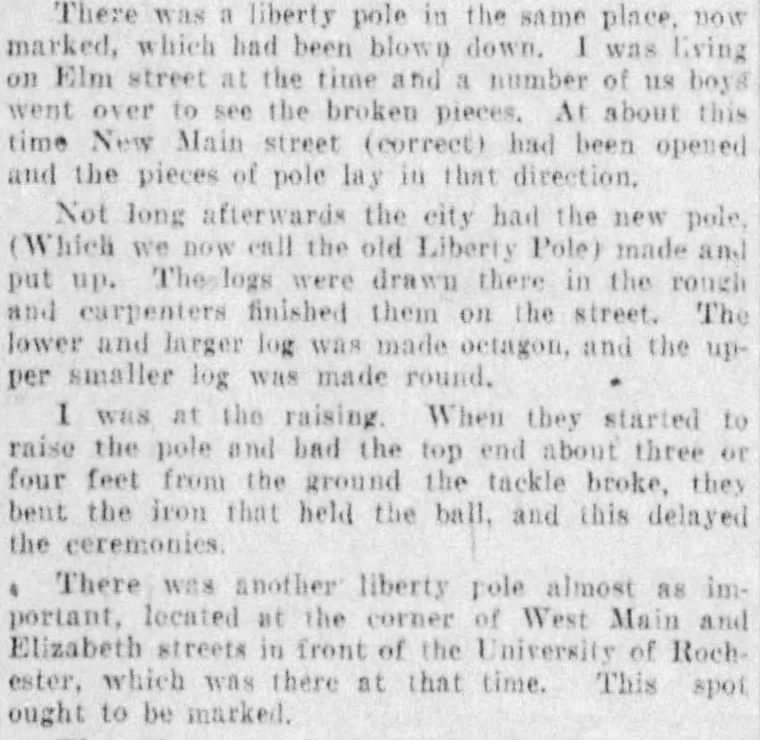
16 May 1925, Sat
[https://www.newspapers.com/clip/116709273/rememberences-of-liberty-pole/]
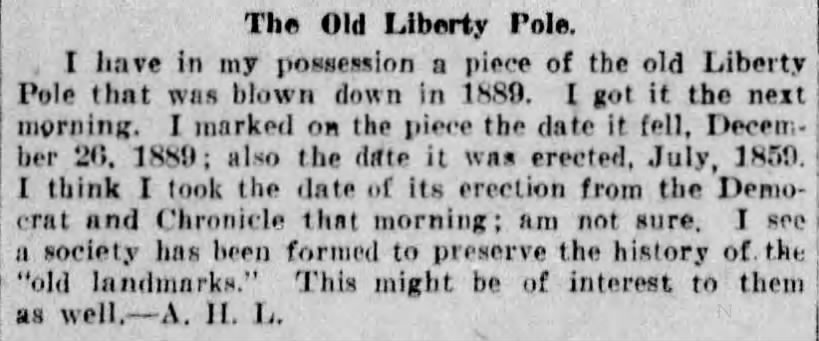
Right: Someone with the initials A. H. L. writes into the paper claiming to own a piece of the Old Liberty Pole.
Left: Two men present at the raising of the original pole would attend the dedication of the marker; they shared some memories.
Oddly, according to one, a previous Liberty Pole on the spot had blown down, and not merely been dismantled at the threat of toppling as other accounts suggest.
Another corroborated the existence of a second Liberty Pole at the corner of West Main Street and Elizabeth Street (now Clarissa Street). This would have to have been between 1850-1861, when the University of Rochester operated out of the building which had previously been the United States Hotel. No visual evidence exists of this pole.
23 Jan 1925, Fri
[https://www.newspapers.com/clip/116804222/piece-of-liberty-pole/]
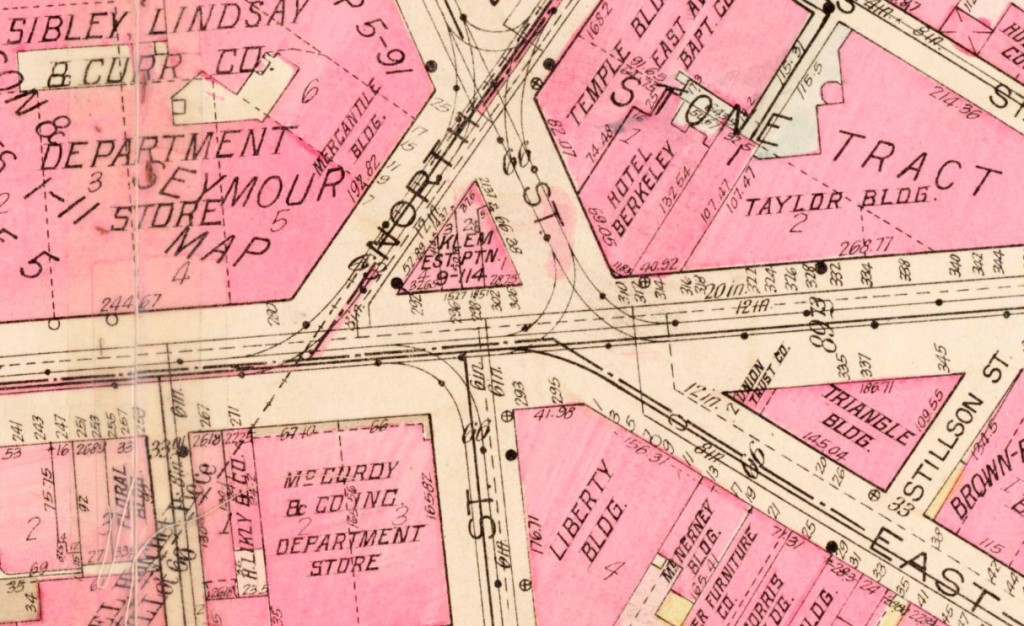
1926 Plat Map
[https://catalogplus.libraryweb.org/?section=resource&resourceid=1116136455]
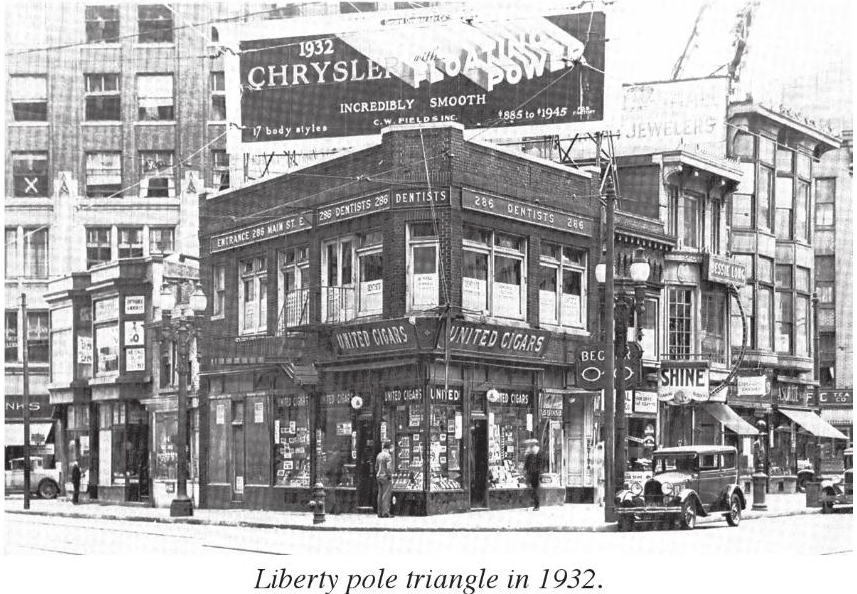
[https://www.google.com/books/edition/A_Rochester_Ramble/z8sfRFPeeyUC?hl=en&gbpv=0] (p. 89)
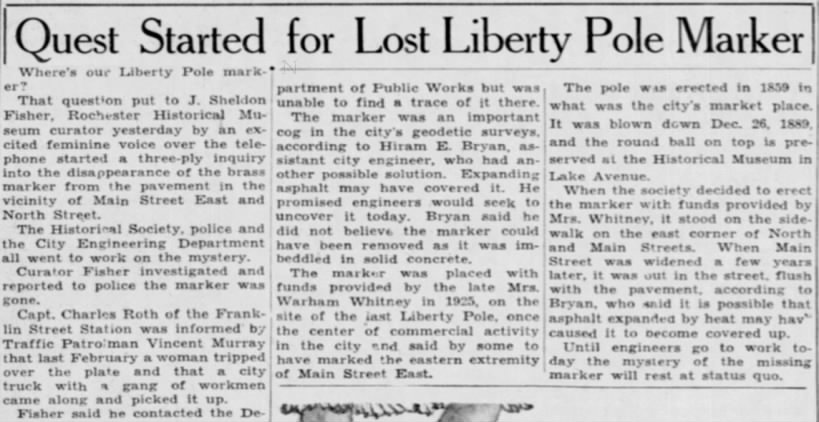
01 Jun 1940, Sat
[https://www.newspapers.com/clip/116729426/quest-for-missing-marker/]
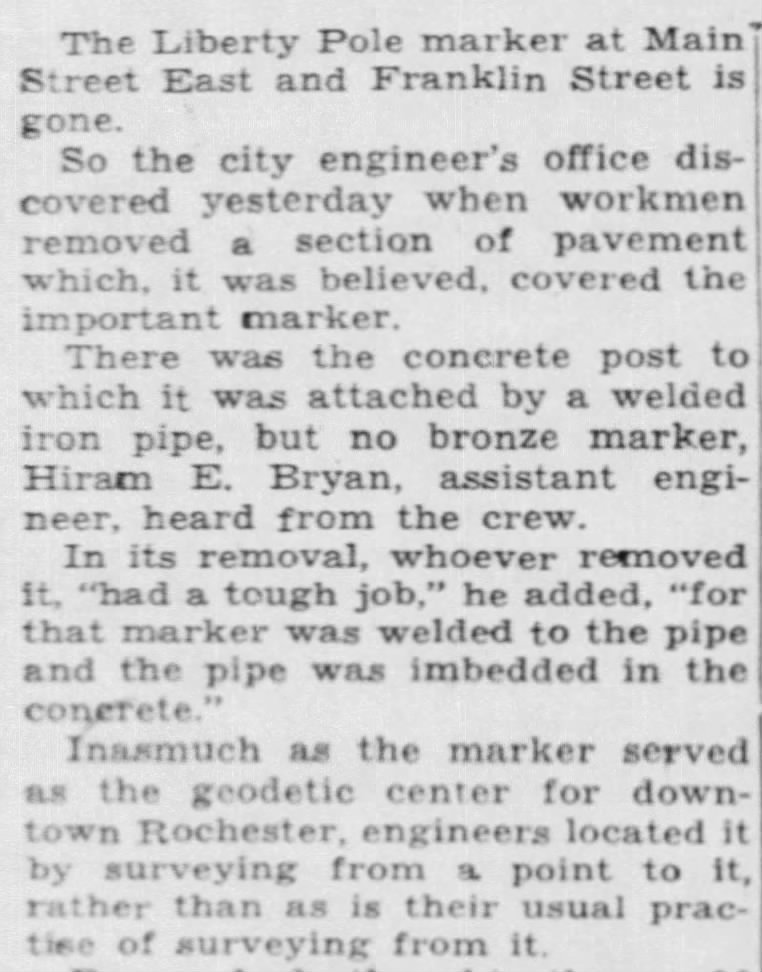
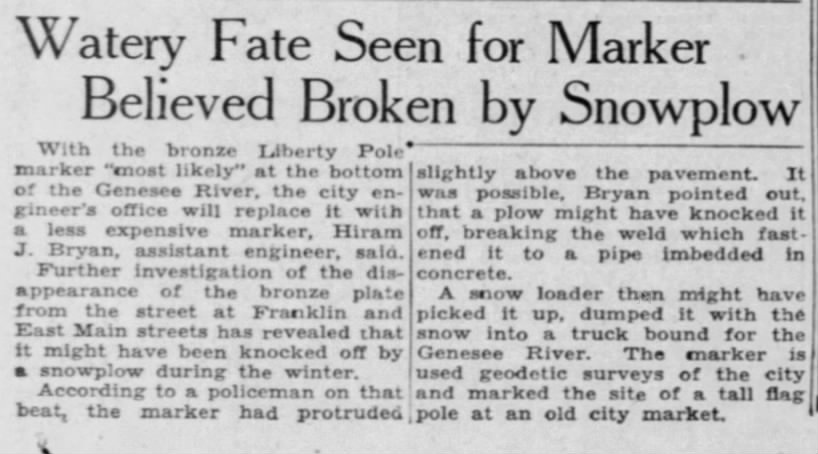
Eventually widening of East Main Street would leave the Liberty Pole marker out in the street, flush with the roadway. It would be paved over once in 1926 and uncovered shortly after, only to vanish permanently in 1940.
05 Jun 1940, Wed
[https://www.newspapers.com/clip/116729697/pole-marker-gone/]
07 Jun 1940, Fri
[https://www.newspapers.com/clip/116729931/watery-fate-for-marker/]
The leading theory is that one of those damned snowplows broke the marker off its foundation post and carried it away to be dumped into the Genesee with the rest of the snow. Regardless of how it happened, the story of the Geodetic Survey Marker for the Old Liberty Pole seems to have ended in 1940, a mere fifteen years after its initial installation.
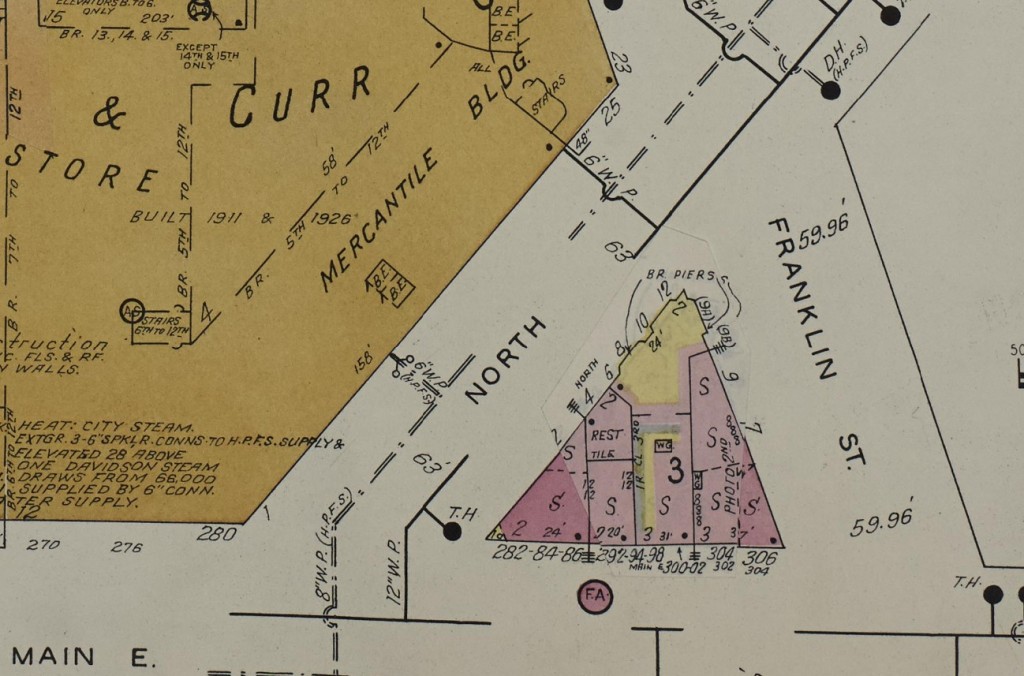
1950 Sanborn Map
[https://www.loc.gov/resource/g3804rm.g3804rm_g06217195002/?sp=2&r=0.472,0.891,0.385,0.236,0]
Kennedy Square?
Wed, Jun 24, 1964
[https://www.newspapers.com/article/democrat-and-chronicle-jfk-square/128435885/]
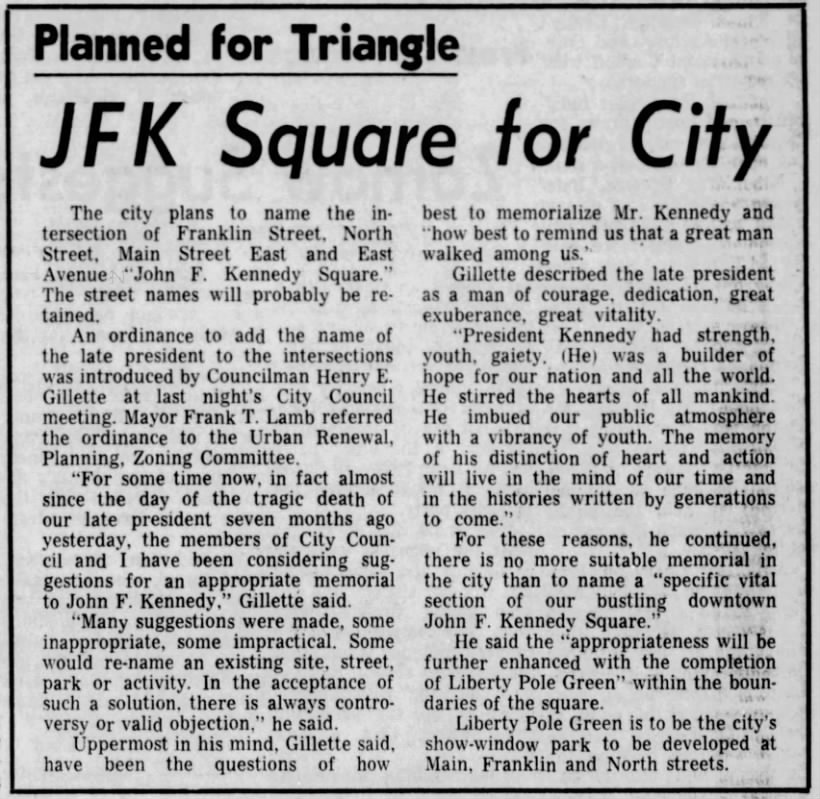
The paper clarified that Liberty Pole Green would not change its name, instead it would be Liberty Pole Green in John F. Kennedy Square. Not confusing.
Left: Rochester proposed renaming the intersection of the four major streets Franklin Street, North Street, East Main Street, and East Avenue as “John F. Kennedy Square” in memorial of the late president, assassinated the previous November.
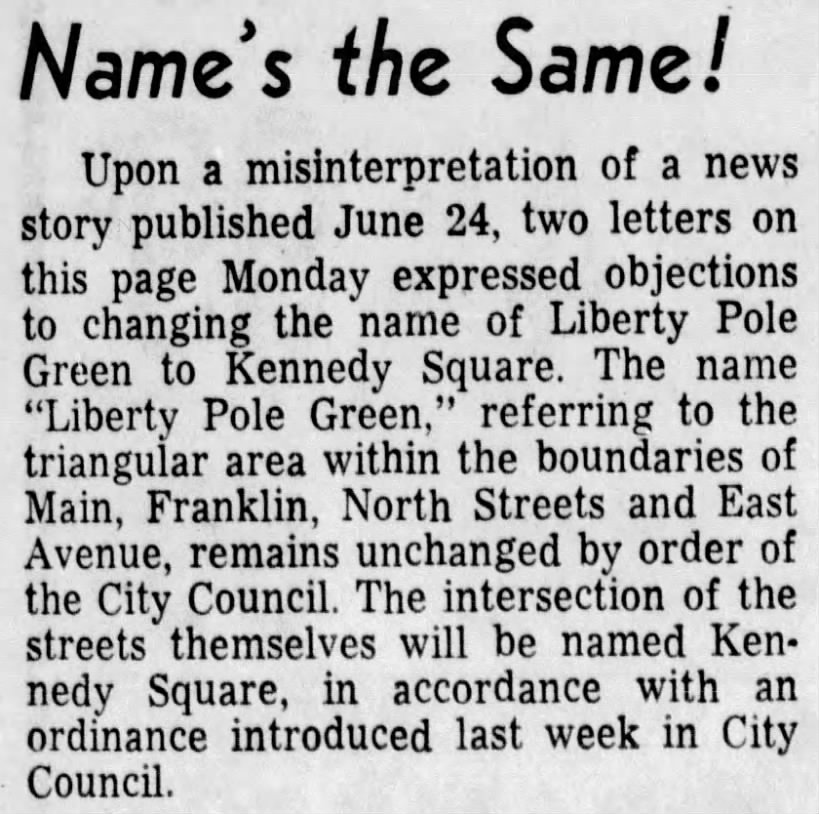
Wed, Jul 1, 1964
[https://www.newspapers.com/article/democrat-and-chronicle-names-the-same/128436087/]
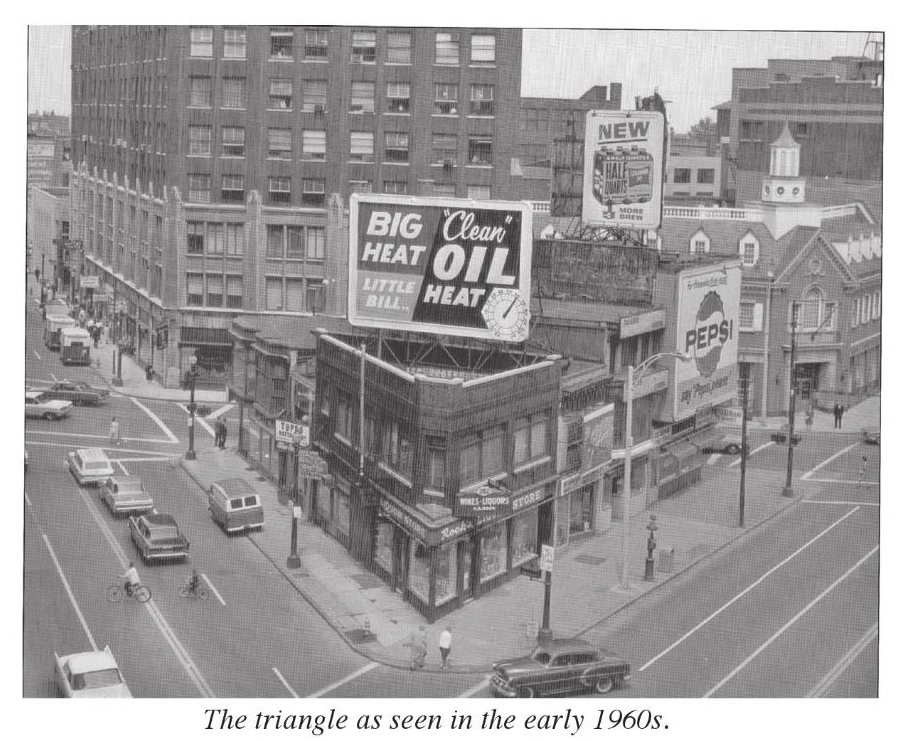
[https://www.google.com/books/edition/A_Rochester_Ramble/z8sfRFPeeyUC?hl=en&gbpv=0] (p.90)
The New Liberty Pole
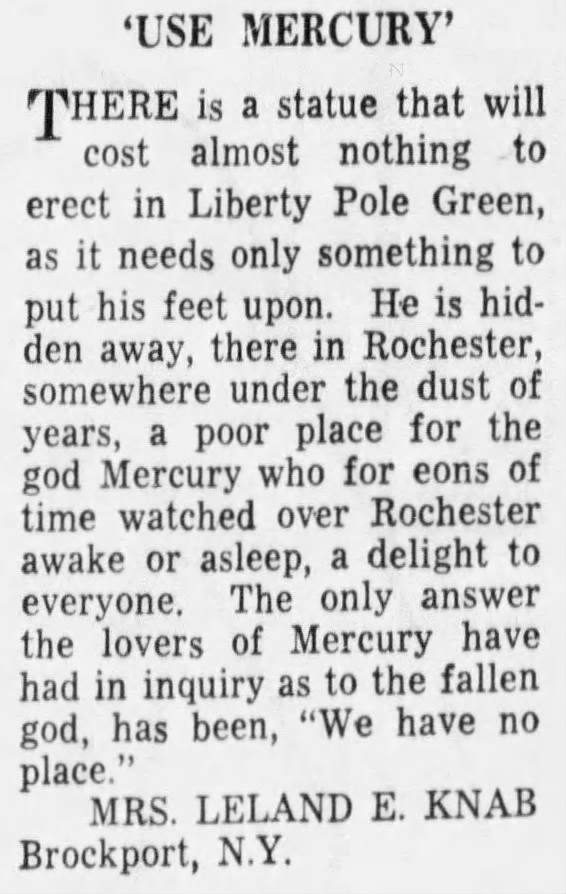
Wed, Jan 6, 1965
[https://www.newspapers.com/article/democrat-and-chronicle-use-mercury/128430471/]
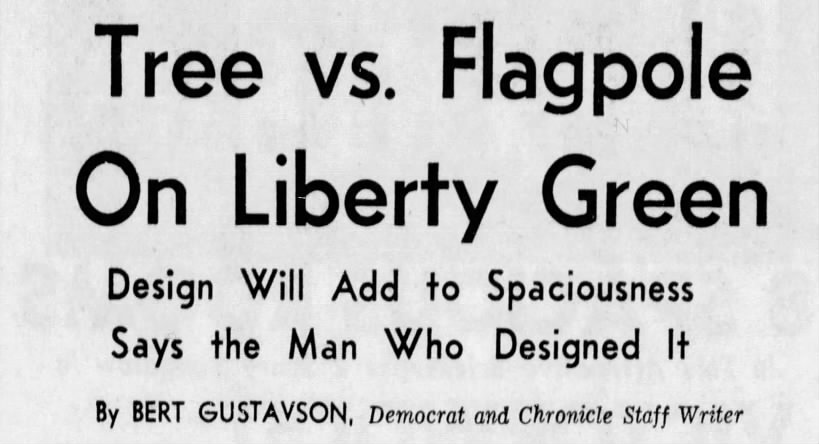
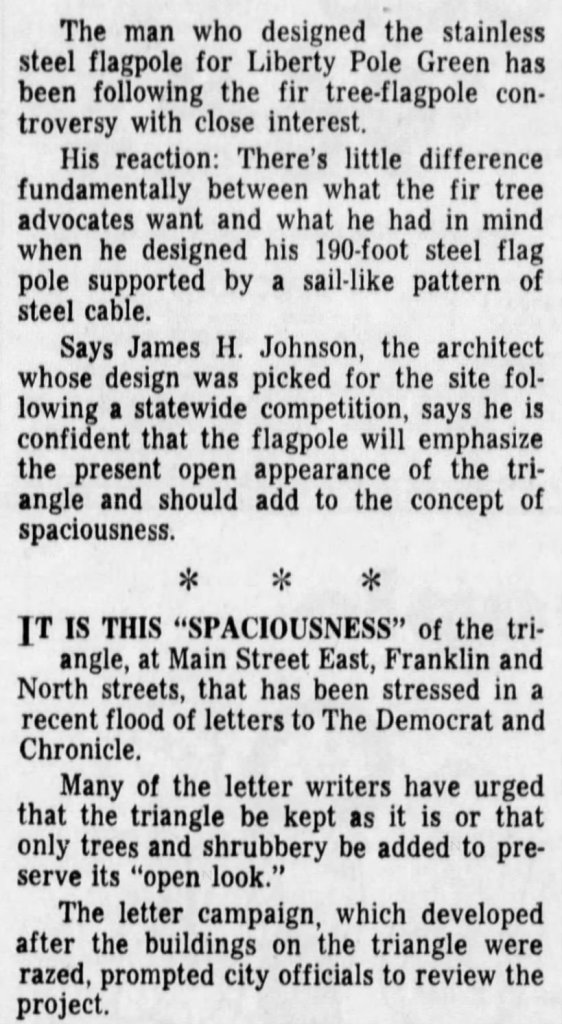
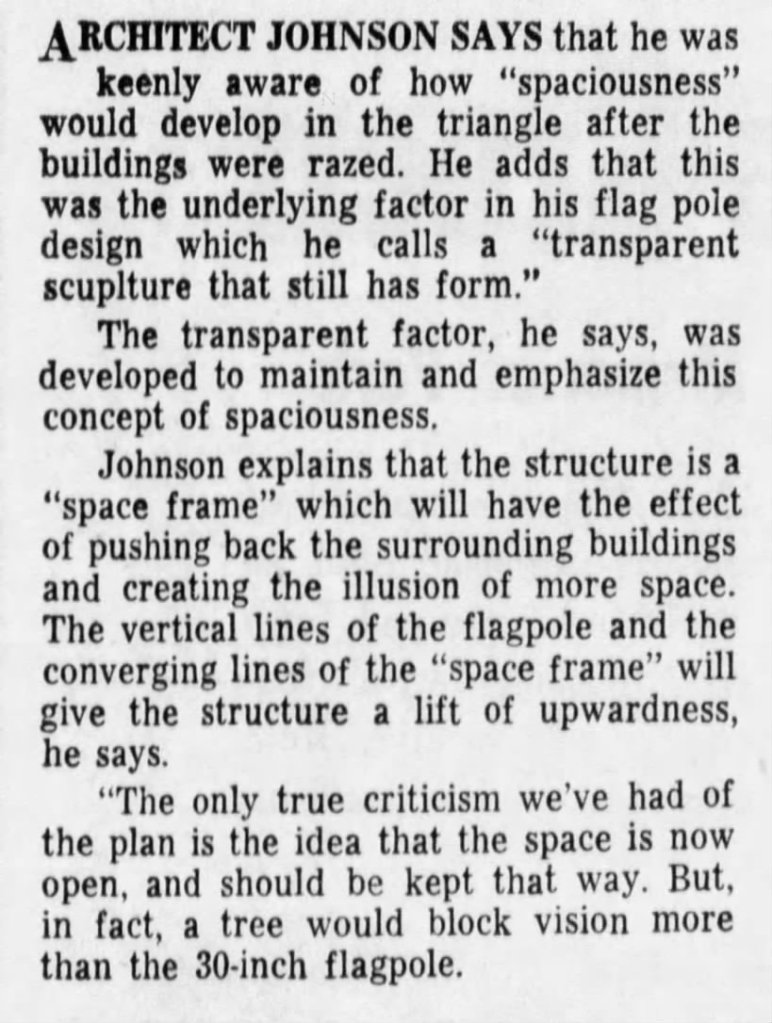
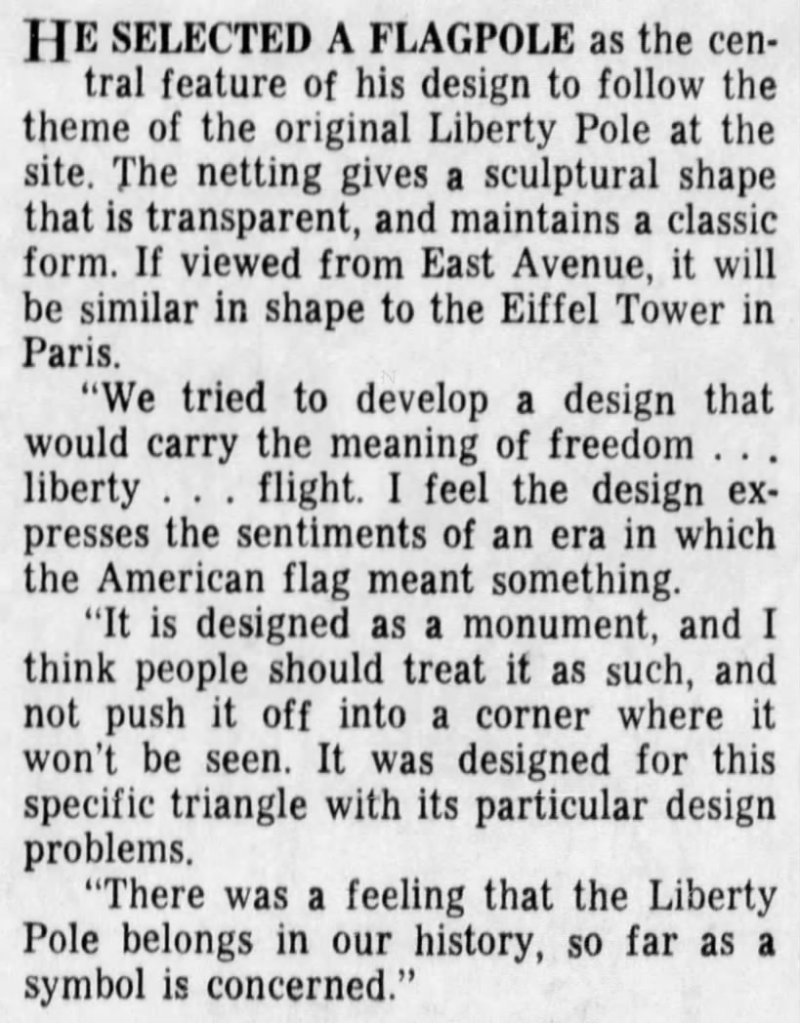
James H. Johnson, architect, won a contest to design a new monumental feature for the cleared Liberty Pole Green. His design was a sail-like construct around a central, 190-foot stainless steel pole with steel cables stretched between the ground and the pole.
Debates erupted in the editorial section over what should go in the green; the shiny stainless steel sliver had its proponents, while others favored a more traditional “big tree and some grass” arrangement in the triangular lot. Other options bubbled to the surface as Rochester’s homespun creative geniuses posited erecting the warehoused Mercury Statue in the green, or a monument honoring George Eastman.
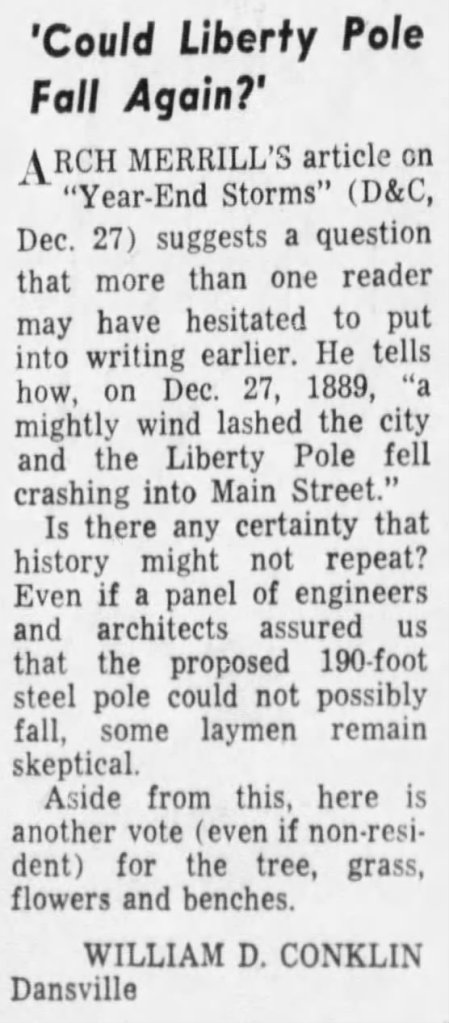
Wed, Jan 6, 1965
[https://www.newspapers.com/article/democrat-and-chronicle-fall-again/128430338/]
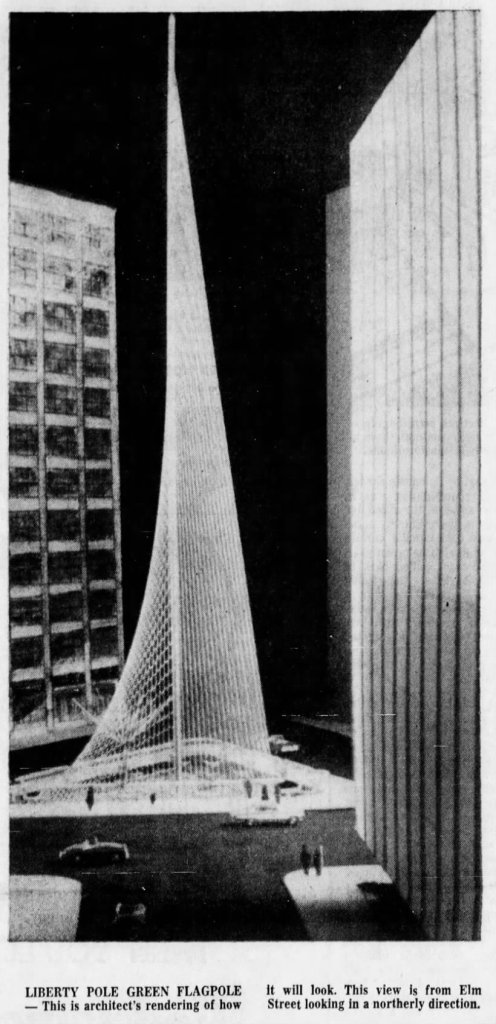
10 Jan 1965, Sun
[https://www.newspapers.com/clip/116734060/architect-james-h-johnson/]
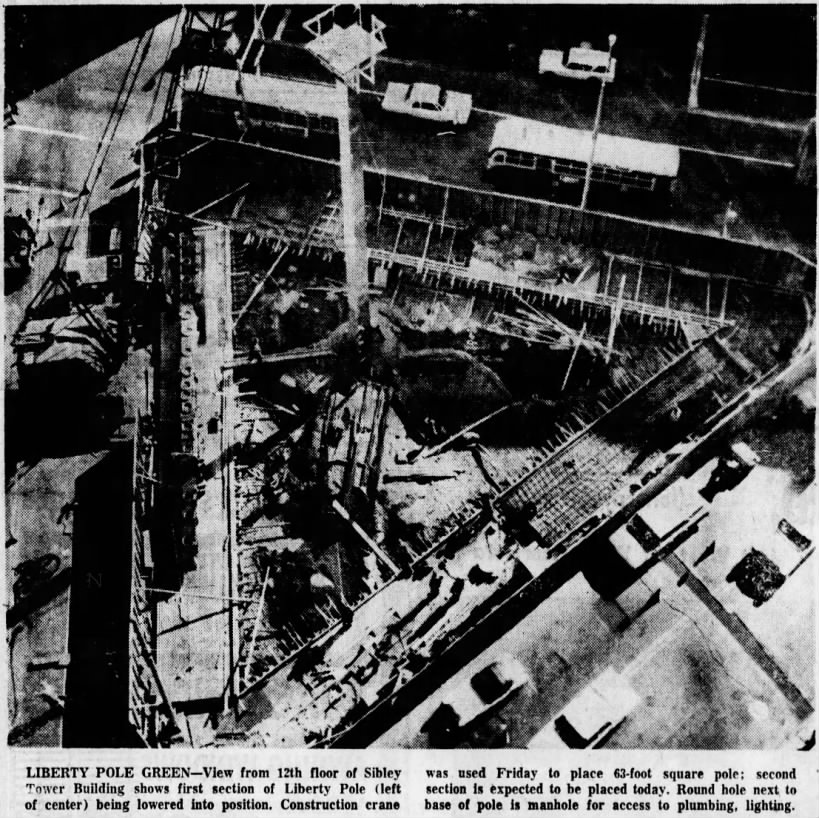
31 Oct 1965, Sun
[https://www.newspapers.com/clip/116805184/liberty-pole-construction/]
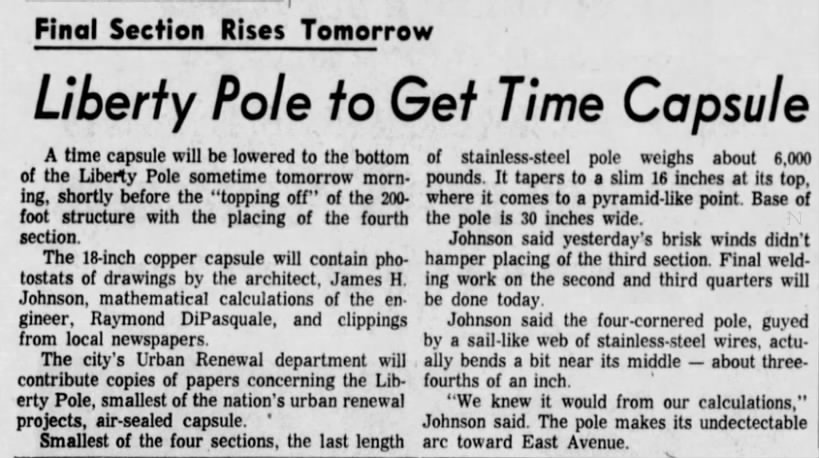
05 Nov 1965, Fri
[https://www.newspapers.com/clip/116804931/liberty-pole-time-capsule/]
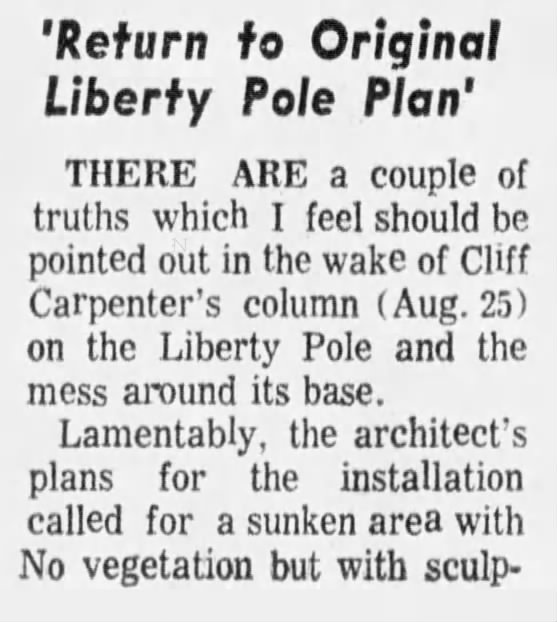
As familiar as the Liberty Pole is to Rochesterians, seeing the grounds littered with detritus is probably even moreso. According to this letter to the editor from Bert Gustavson, this problem had been considered ahead of time, with designs including blasts of cleansing water to sweep litter into catchments. This innovation was curtailed in the final iteration, as the concrete and jets gave way to poorly-maintained landscaping.
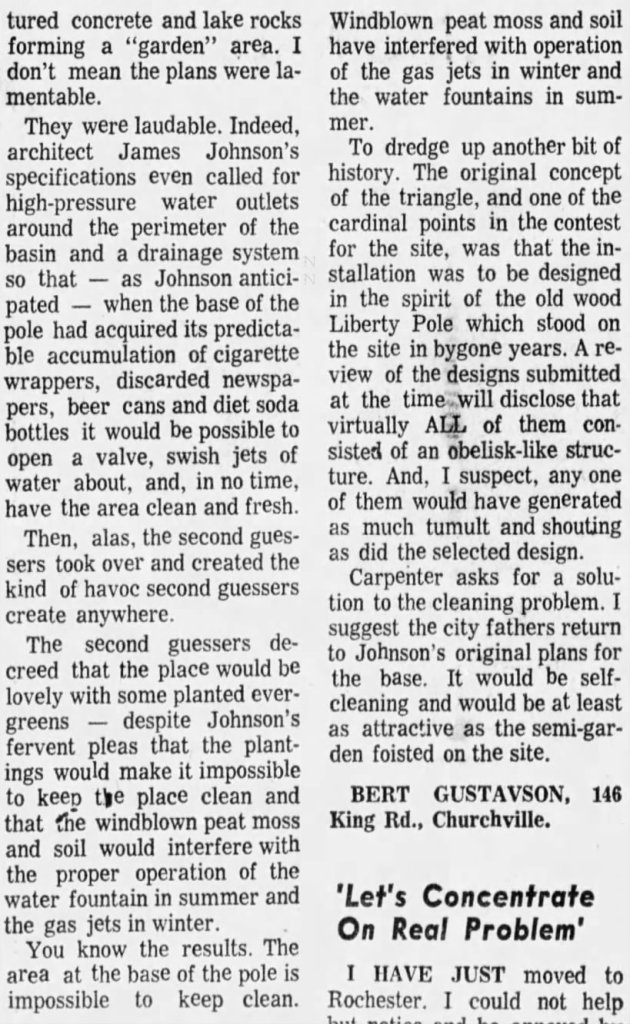
Sun, Jul 16, 1967
[https://www.newspapers.com/article/democrat-and-chronicle-2/128429762/]
Sun, Jul 16, 1967
[https://www.newspapers.com/article/democrat-and-chronicle-island-in-the-riv/128429727/]
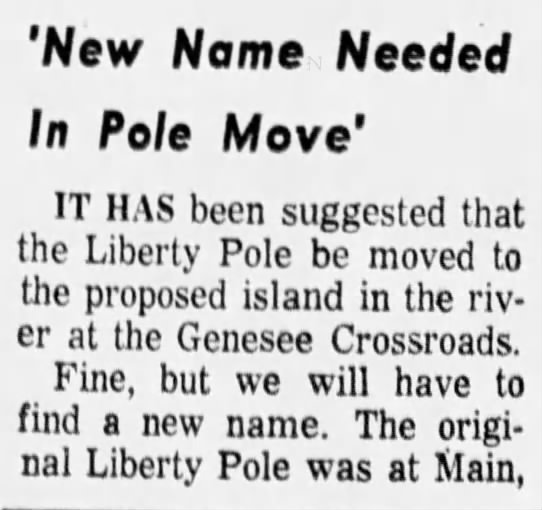
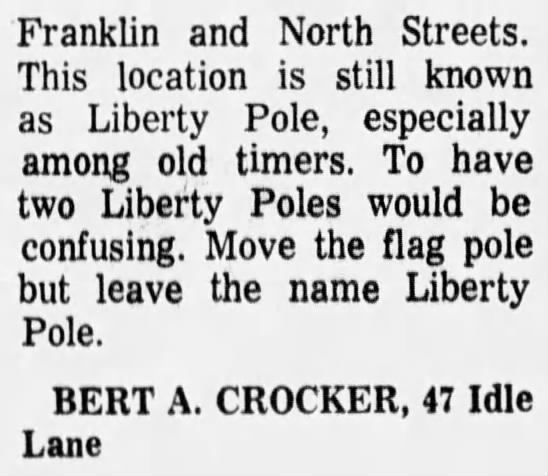
Old timers, indeed. Apparently, according to the above letter to the editor, a suggestion was floated that the Liberty Pole be moved. That sounds like quite an undertaking, so I’m somewhat suprised it was an option on the table. Moreover, it was to be moved to an island in the Genesee River–possibly an artificially-created one.
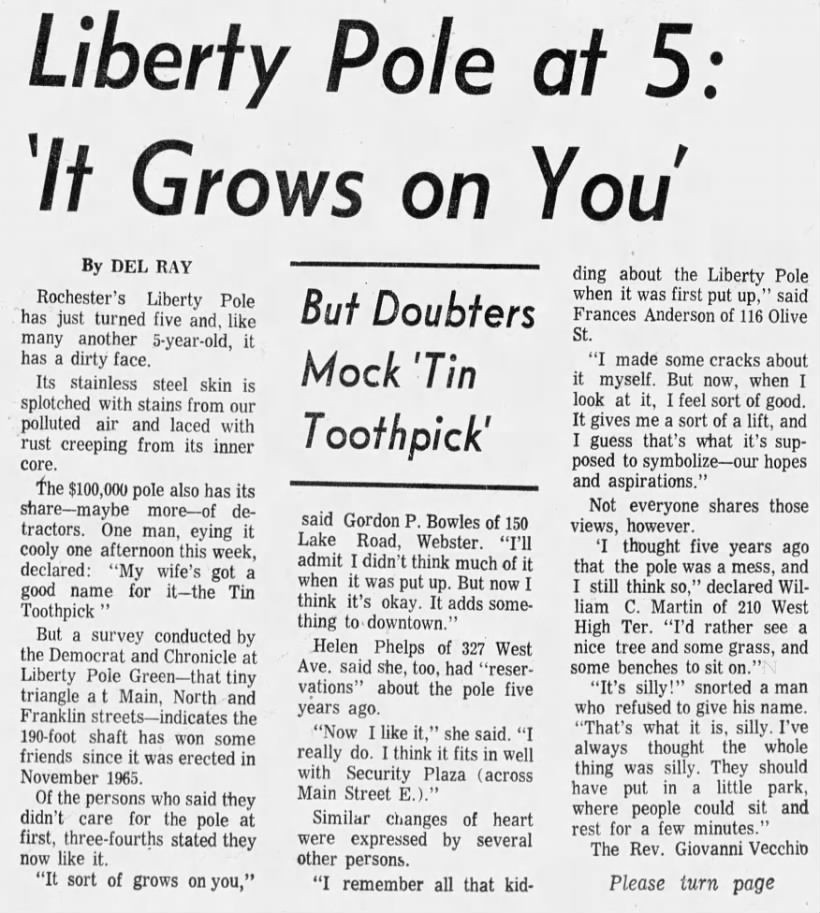
26 Nov 1970, Thu
[https://www.newspapers.com/clip/116712727/liberty-pole-at-5/]
In the image at right, covered in ice, we see the fountain-slash-flames which worked for two years, before Rochester winters broke them. Fountains do very poorly in Rochester.
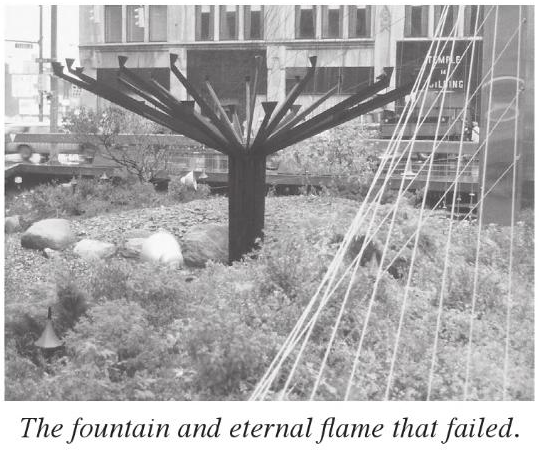
[https://www.google.com/books/edition/A_Rochester_Ramble/z8sfRFPeeyUC?hl=en&gbpv=0] (p.90)
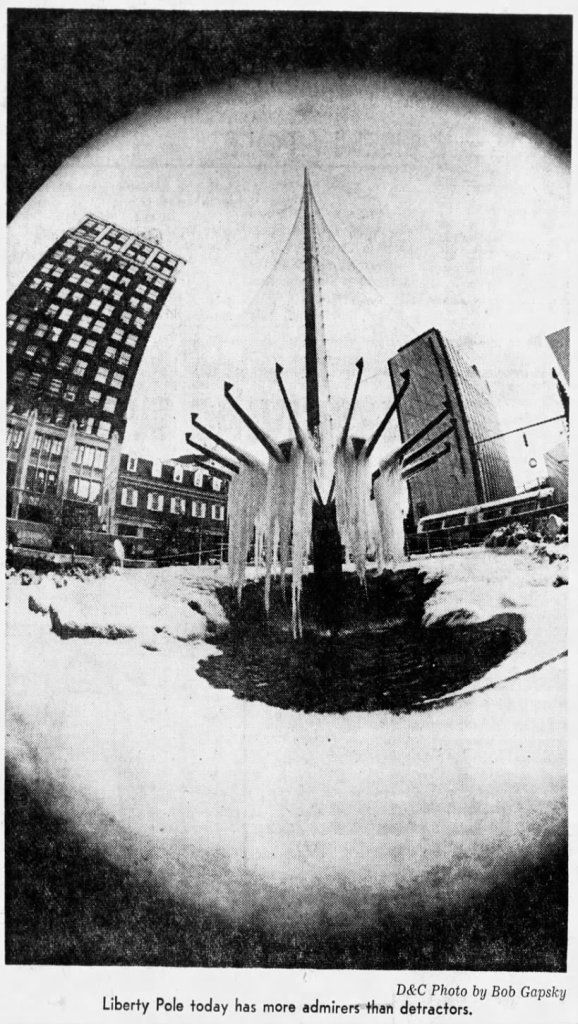
Left: as the caption says, another photo of the fountain that failed, during greener months. It’s actually a bit garish, but probably would have looked nice all lit up with flames.
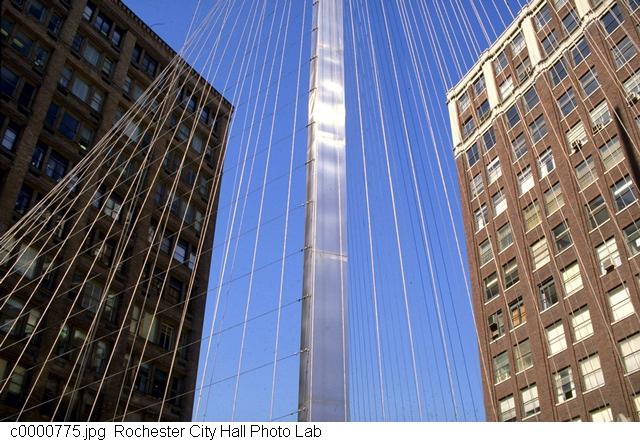
1980
[https://catalogplus.libraryweb.org/?section=resource&resourceid=1115992443]
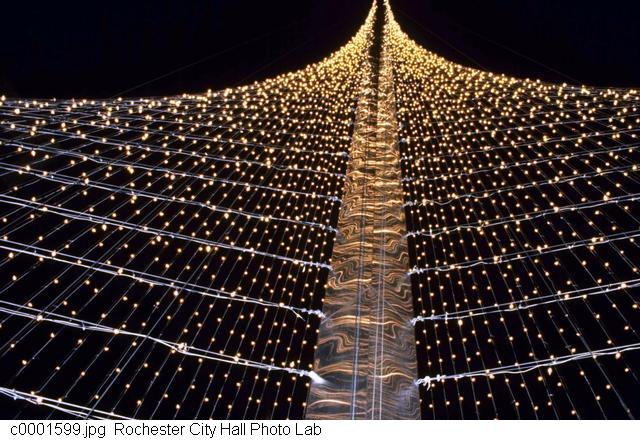
1989
[https://catalogplus.libraryweb.org/?section=resource&resourceid=1116743153]
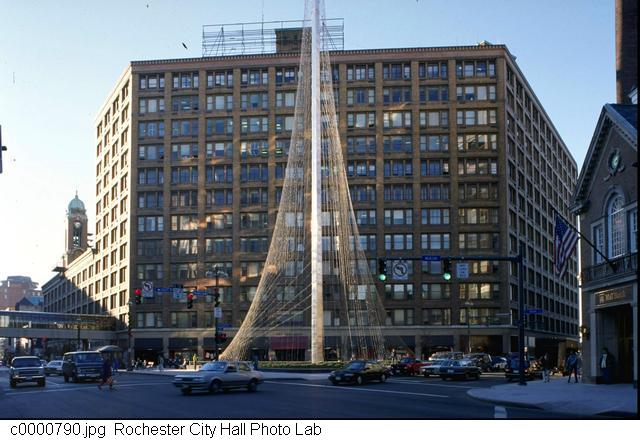
1990
[https://catalogplus.libraryweb.org/?section=resource&resourceid=1115966400]
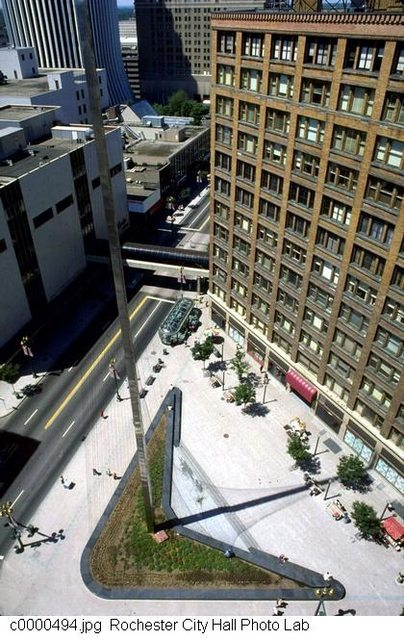
1990
[https://catalogplus.libraryweb.org/?section=resource&resourceid=1115942652]
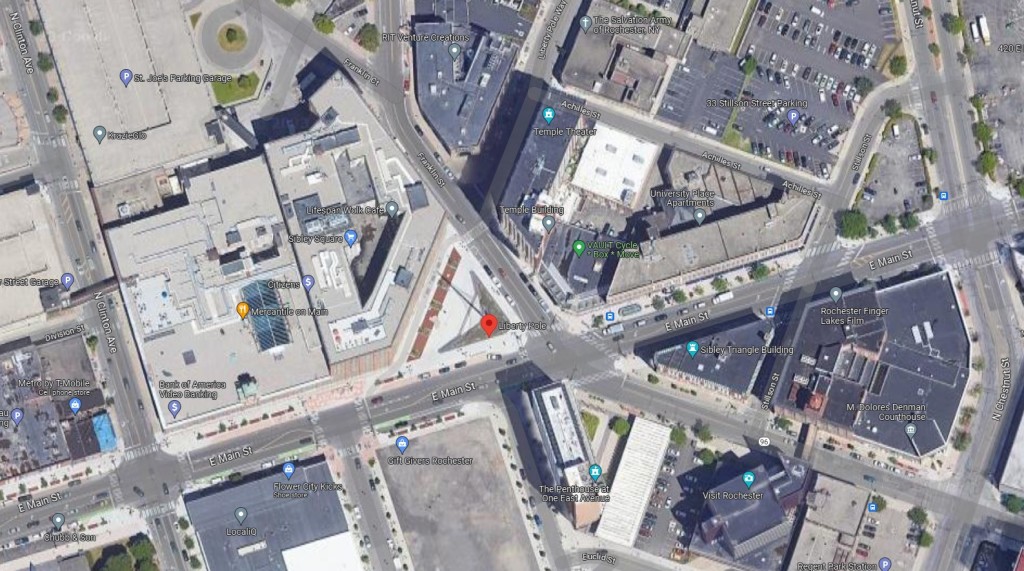
The present-day location of the current Liberty Pole
[43.1577° N, 77.6047° W]
I find myself having a greater appreciation for the Liberty Pole seeing it as an echo of earlier, historical poles. Despite gaps in the timeline, ultimately this triangle has to have a pole; that is a needle drawing a thread through time, and must be respected.
Want to publish a guest post?
Subscribe to Our Monthly Update
Enjoy our once-monthly newsletter highlighting our efforts to beautify downtown Rochester
Want to be a ROCstar?
Please consider supporting the work of Downtown ROCs with a tax-deductible gift. Every dollar directly funds awesome projects that beautify & energize our city.
Thank you for your support! 🙏🏼